September 9, 2026 | Jinan, China
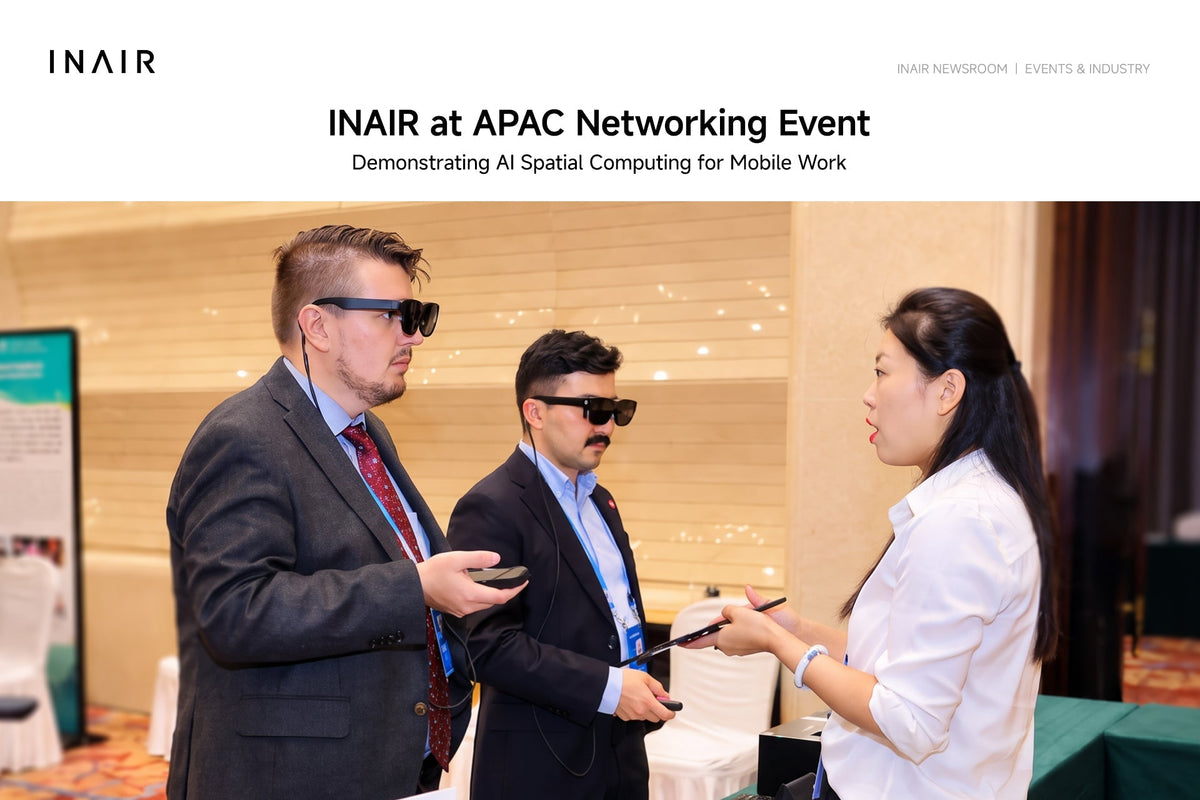
On September 2, INAIR showcased its AI Spatial Computer at the Asia-Pacific Networking Event in Jinan. International guests attending the broader Asia-Pacific Civil Society Conference experienced firsthand how INAIR seamlessly integrates AR glasses, portable computing, spatial software, and physical input into a single, cohesive system.
A Platform for Asia-Pacific Cooperation
The Asia-Pacific Civil Society Conference (Sept. 1–3), co-hosted by the China NGO Network for International Exchanges and the Shandong Provincial Government, served as a major lead-up event to APEC 2026 in China.
The event gathered over 300 international delegates from 36 countries, including policymakers, NGO leaders, business executives, and academics. Held alongside the main conference, the Networking Event featured more than 70 organizations presenting advanced products across sectors like smart energy, healthcare, and IT.
Within the high-tech exhibition sector, INAIR was featured alongside smart-grid technologies and humanoid robots. The event also underscored Shandong’s massive commercial ties with the Asia-Pacific region—with trade to APEC economies exceeding US$179 billion in early 2026 alone—providing a strong economic backdrop for discussions on tech adoption and cross-border investment.
Presenting a Portable Spatial Workspace
The glasses provide the visual interface, while the INAIR Pod serves as the portable computing and control unit. The Touchboard Fold adds familiar navigation and typing, and
INAIR OS brings applications and windows together in a unified spatial workspace.
Rather than just viewing concepts, guests went hands-on with the system. Our demonstrations focused on solving a highly practical question for the delegates: How can professionals carry a fully functional, multi-monitor workspace with them without relying on a fixed desk?
What International Guests Noticed
Electrochromic dimming drew the most attention during the demonstrations. Guests from countries with strong sunlight repeatedly switched the glasses between clearer and darker settings. They saw practical uses for the feature while traveling, working away from an office, or moving between indoor and outdoor environments.
Portability was the second most frequent topic. Several visitors praised the dedicated INAIR Pod and the system’s compact travel footprint, noting its relevance for executives and diplomats who constantly work on the move.
These interactions reinforced our core design philosophy: lighting flexibility and true portability matter deeply to users because they connect directly to real-world travel and work routines.
From On-Site Feedback to Product Priorities
Thank you to everyone who visited the INAIR display, tried the system, and shared feedback with our team.
We are actively feeding these observations from Jinan back into our product development roadmap. Moving forward, our team will pay particular attention to optimizing electrochromic performance across diverse lighting conditions and refining the out-of-the-box experience for frequent travelers.
We also plan to advance discussions with business associations and enterprise representatives regarding mobile productivity solutions across the Asia-Pacific region
About INAIR
INAIR is a spatial computing company headquartered in Hong Kong, with research, development, and manufacturing operations across mainland China.
Through INAIR OS, AR glasses, portable computing devices, and interaction accessories, INAIR develops integrated spatial computing experiences for productivity and entertainment. Its mission is to provide people with a more flexible, efficient, and private way to work with and experience digital content.