Nur noch $100.00 fehlen, um kostenlosen Versand zu erhalten!
Recently viewed
Suche
von INAIR Official
Building Beyond the Display: INAIR at DIC EXPO 2026
von INAIR Official
August 28, 2026 | Shanghai, China
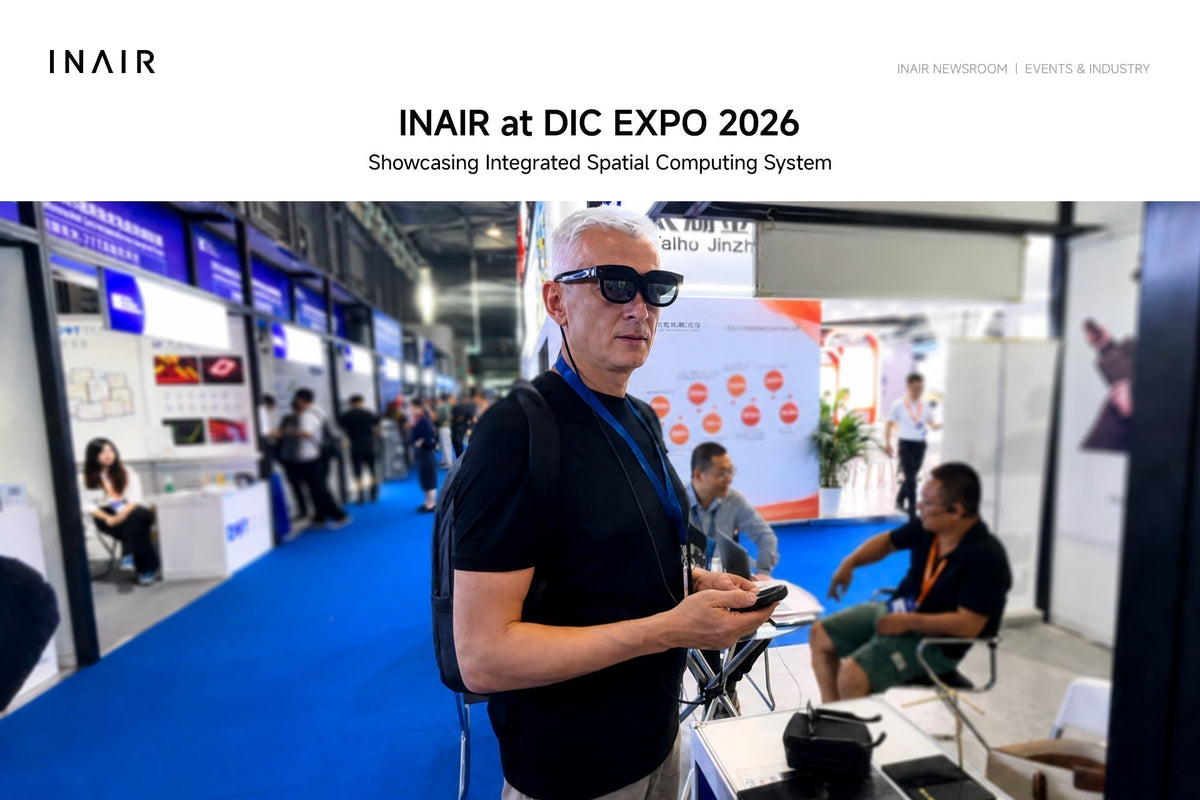
INAIR showcased its integrated spatial computing system at DIC EXPO 2026, held from August 26 to 28 at the Shanghai New International Expo Centre.
At Booth N5-A21-2, we presented our self-developed spatial computing system — a comprehensive ecosystem that brings together AR glasses, dedicated computing, spatial software, and intuitive input. Through hands-on demonstrations, visitors experienced how these components operate as a cohesive unit, translating advanced display technology into a truly practical spatial workspace.
DIC EXPO: Connecting the Global Display Ecosystem
Over the past 15 years, Display Innovation Collaboration (DIC) has evolved into a vital hub for the global display industry. By pairing the hands-on showcases of the DIC EXPO with the expert insights of the DIC FORUM, it provides a dedicated space for industry dialogue and business networking.
The 2026 exhibition hosted over 300 companies across 323,000 square feet (30,000 square meters), spanning the entire display value chain—from materials to smart AR/VR terminals. The floor featured industry giants like BOE, TCL CSOT, and Corning, alongside professional forums diving into emerging technologies such as microdisplays and AI glasses.
The scale of the event reflects a massive global market. According to the China Optics and Optoelectronics Manufacturers Association Liquid Crystal Branch (CODA), the global new display industry reached an estimated US$222.6 billion in 2025, with China generating RMB 838.6 billion — accounting for roughly 53% of the global share. For INAIR, this provided the perfect backdrop to demonstrate why the future of this massive industry relies on integrating next-generation screens with powerful computing and software.
One Integrated System, Built for Real Use
At INAIR, we see AR glasses not simply as an external display, but as the visual entry point to a complete computing environment.
The INAIR 2 Pro AR glasses provide the visual interface, while the INAIR Pod serves as the computing and control hub. For tactile control, the INAIR Touchboard Fold supports fluid navigation and typing. Tying it all together is INAIR OS, which brings applications, windows, and connected devices into a unified spatial interface.
At the EXPO, visitors explored multi-window workspaces and seamless cross-device workflows, experiencing firsthand how AI can convert conventional 2D content into immersive 3D. By presenting these features together, we proved that reducing complexity across the entire tech stack is the key to making spatial computing mainstream.
The hands-on sessions also offered direct insight into what drives user adoption. Visitors consistently highlighted the importance of effortless multitasking, out-of-the-box compatibility with existing devices, and the ability to transition smoothly between work and entertainment.
From Feedback to Next Steps
We appreciate everyone who visited our booth to try the system and share their perspectives. These conversations gave us a much clearer picture of what the market actually expects from spatial computing.
Following the event, we are channeling these insights directly into the development of INAIR OS. Our immediate focus is on refining multi-window interactions and ensuring flawless cross-platform compatibility.
At the same time, we are advancing talks with technology and distribution partners to build tailored solutions for mobile productivity and private, multi-screen workspaces.
For INAIR, the true value of DIC EXPO extends far beyond the exhibition floor. It lies in turning real-world feedback into better product decisions, focused partnerships, and spatial computing experiences that people are actually ready to use.
INAIR is a spatial computing company headquartered in Hong Kong, with research, development, and manufacturing operations across mainland China.
Through INAIR OS, AR glasses, portable computing devices, and interaction accessories, INAIR develops integrated spatial computing experiences for productivity and entertainment. Its mission is to provide people with a more flexible, efficient, and private way to work with and experience digital content.