


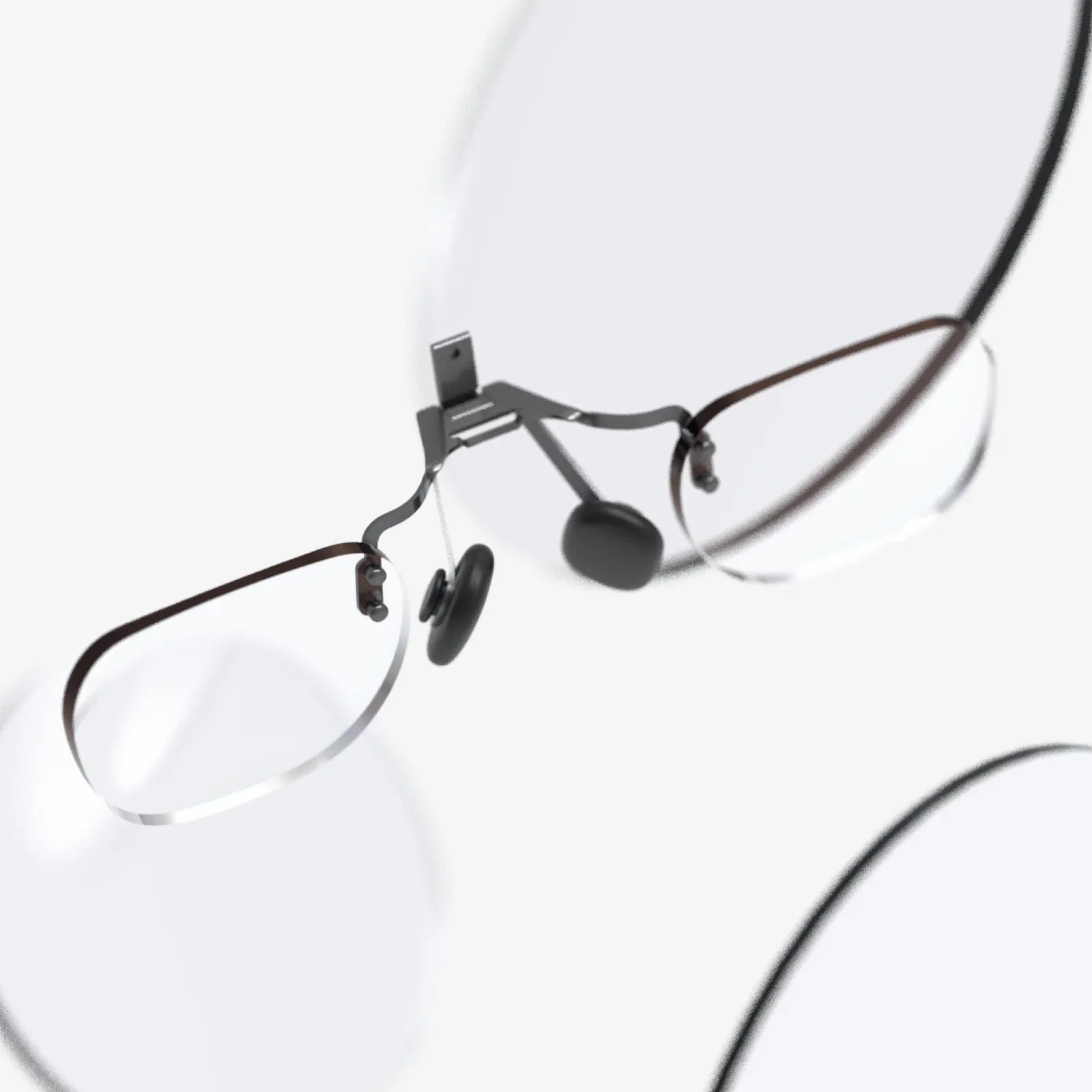
Imagine a world where your digital life doesn't require you to choose between seeing the screen and seeing the world around you—a world where the information you need is seamlessly integrated into your field of view, perfectly sharp and clear, without the awkwardness of devices perched on the end of your nose. This is the revolutionary promise of augmented reality, but for the billions of people worldwide who rely on corrective lenses, this future has long been clouded by a critical question: how will these advanced devices accommodate my individual vision needs? The answer, which is rapidly evolving from a niche afterthought to a central design pillar, lies in the sophisticated realm of AR glasses prescription support. This isn't just a minor feature; it's the key that unlocks true immersion and accessibility, transforming a novel gadget into an indispensable tool for everyday life.
The Fundamental Challenge: Blending Two Worlds Perfectly
At its core, augmented reality is about superimposing computer-generated imagery (CGI) onto the user's perception of the real world. For a user with 20/20 vision, the optical systems within AR glasses are engineered to project a crisp image onto their retina. However, for an individual with myopia (nearsightedness), hyperopia (farsightedness), astigmatism, or presbyopia (age-related farsightedness), their eye cannot correctly focus the light coming from either the real world or the digital projection. A standard pair of AR glasses, without any correction, would project a clear image, but the user's uncorrected eye would render it blurry. This creates a jarring and unusable experience where either the digital content is fuzzy or the real world is indistinct, defeating the entire purpose of augmented reality.
Beyond the Nuisance: Why Universal Adoption Depends on Inclusivity
The need for robust prescription support is not merely a convenience; it is a fundamental requirement for mass adoption. Excluding a significant portion of the global population from comfortably using a technology based on a biological characteristic is not a viable business or ethical strategy. Comprehensive prescription support is, therefore, a critical step towards making AR a truly universal platform for work, education, social connection, and entertainment. It ensures that the benefits of this transformative technology are accessible to everyone, regardless of their visual acuity.
The Technical Arsenal: How Prescription is Integrated into AR Glasses
Manufacturers and optical innovators have developed several compelling approaches to solve the prescription puzzle, each with its own advantages and considerations.
1. Custom Optical Inserts (The Modular Approach)
This is currently the most prevalent and precise method for high-quality AR devices. The core headset is designed with a dedicated bay or mounting system in front of the display projectors. Users then obtain custom-made optical inserts—essentially high-precision lenses ground exactly to their prescription—that snap magnetically or clip physically into this bay.
The Process:
- User Provides Prescription: After an eye exam with an optometrist or ophthalmologist, the user receives a standard ophthalmic prescription specifying sphere (SPH), cylinder (CYL), axis, and add power if needed.
- Ordering Inserts: This prescription is submitted to the device manufacturer or an authorized third-party optical lab.
- Precision Manufacturing: Using advanced freeform surfacing technology, the lab grinds the lenses to the exact specifications. These lenses are often made from high-index, lightweight materials and include premium coatings like anti-reflective and blue-light filtering.
- Secure Mounting: The finished inserts are mounted into a custom frame that interfaces perfectly with the AR headset, ensuring optimal alignment and a clear field of view.
Advantages:
- Optical Fidelity: Provides the highest possible visual acuity, as the correction is tailored perfectly to the user.
- Works with Complex Corrections: Easily handles high prescriptions and astigmatism.
- No Compromise on Display: The core display technology remains uncompromised, ensuring a bright, vibrant image.
Considerations:
- Additional Cost: Custom inserts represent an extra, sometimes significant, cost on top of the device itself.
- Waiting Period: There is a lead time between ordering and receiving the inserts.
- Potential for Obsolescence: If a user's prescription changes, new inserts must be purchased.
2. Integrated Prescription Lenses (The All-in-One Approach)
In this model, the prescription is directly ground into the primary lenses of the AR glasses themselves. The device is not a one-size-fits-all unit but is instead built to order, much like a traditional pair of prescription eyeglasses. The waveguides or other optical combiners that project the image are built into the prescription lenses.
Advantages:
- Seamless Experience: Offers a sleek, unified design without additional layers or attachments.
- Optimal Alignment: The digital image path is perfectly aligned with the corrective optics from the start.
Considerations:
- Cost and Replacement: The entire device becomes a custom unit, making it expensive to replace if the prescription changes or the device is upgraded.
- Manufacturing Complexity: This approach is more complex logistically for manufacturers.
3. Software-Based Digital Correction (The Adaptive Approach)
This is a more experimental and futuristic approach that seeks to eliminate physical lenses altogether. Using varifocal or light field technology, the display system itself can dynamically adjust the focal plane of the projected image. By understanding the user's prescription, the software can pre-distort the digital imagery in such a way that, when projected by the adaptive optics, it appears in perfect focus to the user's uncorrected eye.
Advantages:
- Ultimate Flexibility: A single device could adapt to any user instantly, or even adjust for different tasks (e.g., reading a document vs. looking into the distance).
- No Physical Add-ons: Leads to a lighter, simpler form factor.
Considerations:
- Technological Immaturity: This technology is still in active development and can struggle with high levels of correction or astigmatism.
- Potential for Eye Strain: Incorrect calibration or limitations in the technology could lead to visual fatigue.
- Computational Load: Requires significant processing power, which can impact battery life.
4. Diopter Adjustment Dials (The Universal Reader Approach)
Familiar from budget binoculars or some virtual reality headsets, this method incorporates a mechanical dial on the device that allows users to physically adjust the focus of the lenses across a limited range (e.g., +2 to -4 diopters). This is a form of mechanical analog correction.
Advantages:
- Immediate and Low-Cost: Provides a quick, inexpensive way to accommodate a range of common prescriptions without custom parts.
Considerations:
- Limited Range and Precision: Cannot correct for astigmatism and is ineffective for prescriptions outside its limited range.
- Bulk and Mechanics: Adds moving parts to the device, increasing potential points of failure and design complexity.
- Separate Real-World Blur: Corrects only the digital image, leaving the real world blurry for users who need correction, which is disorienting in an AR context.
Navigating the User Journey: From Eye Doctor to Digital World
For the average consumer, integrating their prescription into an AR device should be a simple and guided process. The ideal workflow mirrors getting glasses today but with a digital twist. It starts with a recent, valid prescription from a qualified eye care professional. Reputable AR platforms will then offer a seamless portal, either through a partnered optical provider or a verified network of labs, to submit this information. The key for users is to ensure they are providing accurate data and ordering from trusted sources to guarantee the optical inserts are made to the highest standards of safety and accuracy. A poorly made lens can cause headaches, eye strain, and even worsen vision over time.
The Future of Vision: Beyond Static Correction
Prescription support is not the endgame; it's the foundation for a new era of personalized vision enhancement. The next evolutionary step involves dynamic, intelligent vision systems that go beyond correcting static refractive errors.
- Autofocus Systems: Imagine AR glasses that use eye-tracking and depth-sensing cameras to understand what you are trying to look at—whether it's a text message hovering in the air or a mountain on the horizon—and automatically adjust the focus of the digital elements in real time to match the focal distance of the real world, eliminating any vergence-accommodation conflict that causes eye strain.
- Context-Aware Vision Augmentation: For users with specific visual impairments like age-related macular degeneration, AR systems could actively process the visual field and enhance contrast, highlight edges, or even zoom in on areas of interest, effectively acting as a smart visual aid that surpasses the capabilities of traditional glasses.
- Biometric Monitoring: The same sensors that enable eye-tracking could potentially be used to monitor pupil response, track signs of fatigue, or even screen for certain health conditions, turning the glasses into a powerful health and wellness device.
A Clearer, More Inclusive Digital Horizon
The seamless integration of individual prescription needs is what will transform AR glasses from a compelling prototype into an indispensable personal technology. It’s the bridge between a niche gadget for the tech-savvy and a universal tool that enhances how we all work, learn, and connect. The ongoing innovation in optical inserts, adaptive software, and dynamic focusing promises a future where visual correction is not just accommodated but is a deeply integrated, intelligent feature that opens up new possibilities for human vision itself. The path forward is clear: for augmented reality to truly see its potential, it must first learn to see through the eyes of every single user.
The blur between our physical reality and our digital one is finally coming into focus, and it’s a sight that everyone will be able to see perfectly. The race to perfect AR glasses prescription support isn't just about making a sharper display; it's about building the foundational layer for the next great computing platform, one that must be accessible to all. This relentless drive for optical inclusivity ensures that when the next chapter of digital interaction is written, no one will be left squinting at the page.
Share:
Digital Product Design Definition: The Complete Guide to Crafting Digital Experiences
VR Goggles for TV: The Ultimate Guide to Your Personal Cinema Revolution