


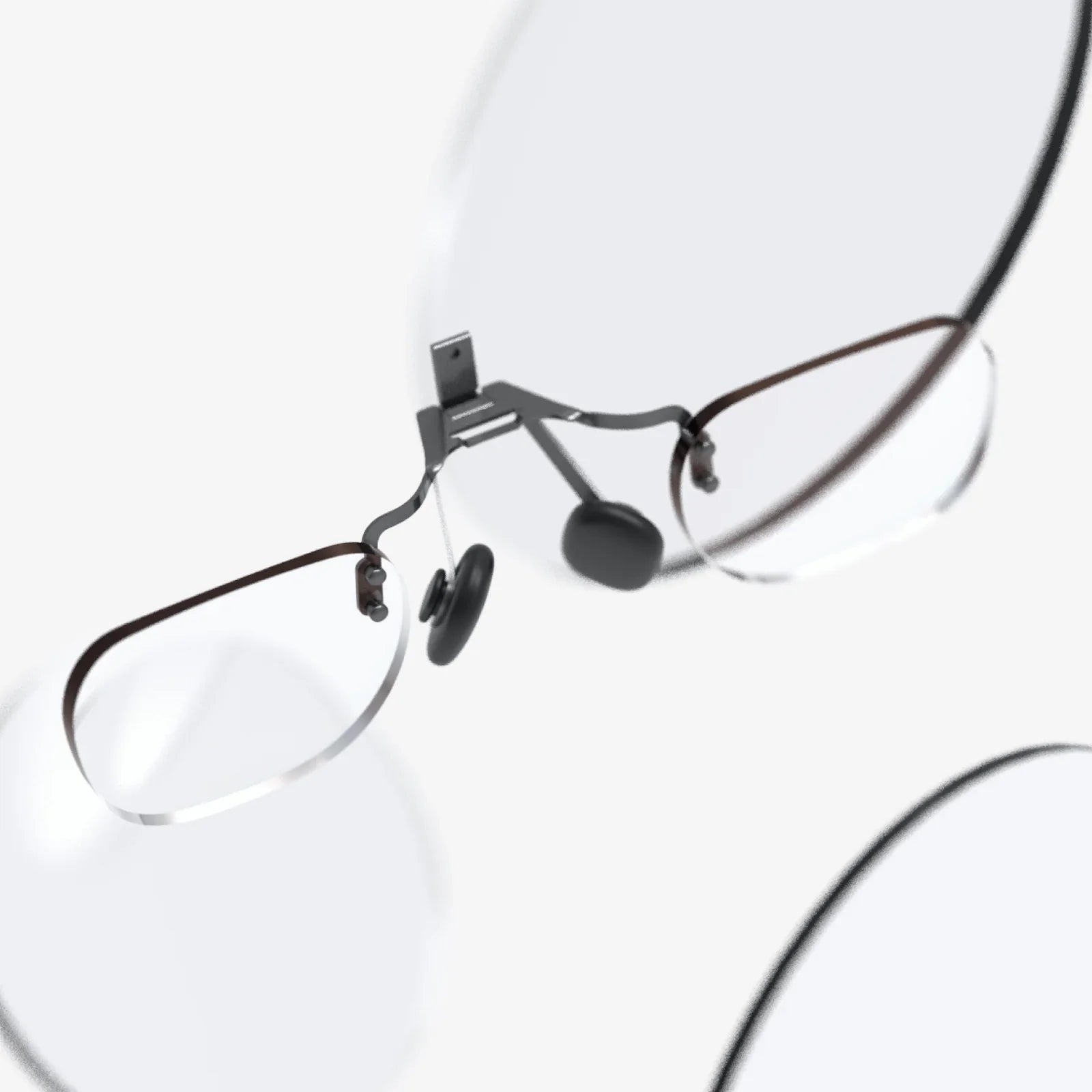
Imagine a world where information doesn’t live on a screen in your hand, but is seamlessly painted onto the canvas of your reality. Where directions materialize as a glowing path on the sidewalk, a complex engine part reveals its inner workings with a glance, and a historical figure stands before you, recounting tales on the very ground where history was made. This is not a distant science fiction fantasy; it is the imminent future being built today, and its primary vehicle is a pair of augmented reality glasses. This technology, often seen as the next great leap in personal computing, promises to fundamentally redefine our relationship with information, with each other, and with the very fabric of the world around us. We are standing on the precipice of a sensory revolution, and it’s about to change everything.
Beyond the Hype: Defining the Augmented World
At its core, augmented reality (AR) is the integration of digital information with the user's environment in real time. Unlike virtual reality (VR), which creates a completely artificial environment, AR overlays computer-generated perceptual information onto the physical world, allowing both to coexist and interact. Augmented reality glasses are the dedicated hardware designed to deliver this experience hands-free and immersively.
The magic of these devices hinges on a sophisticated symphony of components. They typically include:
- Advanced Displays: Using technologies like waveguides, micro-LEDs, or holographic optical elements, these project images directly into the user's eyes, making them appear as part of the real world.
- Spatial Mapping Sensors: An array of cameras, LiDAR scanners, and depth sensors constantly scan the environment to understand the geometry, surfaces, and objects within it. This creates a live 3D map, allowing digital content to be placed accurately on a table, attached to a wall, or occluded by a real object.
- Precise Tracking Systems: Inertial Measurement Units (IMUs), including gyroscopes and accelerometers, track the precise movement and rotation of the user's head to keep digital elements locked in place.
- Powerful Onboard Compute: A miniaturized computer, often with specialized processors for AI and machine learning, handles the immense task of processing sensor data, running applications, and rendering graphics in real-time.
- Natural Input Methods: Instead of a mouse and keyboard, interaction is achieved through voice commands, hand-tracking gestures, eye-tracking, and even subtle neural interfaces, making the technology feel more intuitive and human.
The Professional Paradigm Shift: Redefining the Workspace
While consumer applications often grab headlines, the most immediate and transformative impact of augmented reality glasses is occurring in industrial and professional settings. Here, they are not merely gadgets; they are powerful tools solving real-world problems and unlocking unprecedented levels of efficiency and expertise.
In fields like manufacturing and complex machinery repair, technicians can wear glasses that overlay step-by-step instructions, animated diagrams, and safety warnings directly onto the equipment they are servicing. A novice engineer could be guided through a intricate procedure by a remote expert who sees their view and can draw annotations directly into their field of vision, effectively teleporting knowledge and experience. This "see-what-I-see" remote assistance slashes downtime, reduces errors, and democratizes expertise.
For architects, engineers, and construction professionals, these devices are revolutionizing design and planning. Instead of examining a 3D model on a flat screen, they can don a pair of glasses and walk through a full-scale, holographic rendering of a building before a single foundation is poured. They can visualize HVAC systems within walls, check for structural clashes, and make real-time adjustments, saving millions in costly post-construction modifications.
In healthcare, the potential is staggering. Surgeons can have vital signs, 3D scans of anatomy, and procedural checklists displayed in their periphery without ever looking away from the patient. Medical students can practice complex procedures on hyper-realistic holographic patients. The technology can even assist in precise needle placements or guide incisions with sub-millimeter accuracy, improving patient outcomes and safety.
The Social Fabric Rewoven: Connection and Shared Experience
Perhaps the most profound long-term shift will be in how we connect with one another. The current model of digital social interaction—texting, video calls, social media feeds—is a poor facsimile of physical presence. Augmented reality glasses promise to bridge that gap, creating a future of embodied telepresence.
Imagine a video call where, instead of seeing your conversation partner in a small rectangle, their photorealistic avatar appears sitting on your couch, making eye contact and using natural gestures. You could watch a sporting event with a friend who lives across the country, both seeing the same virtual big screen floating on your wall and reacting together in real time. Families separated by geography could share meals, read stories to children, and feel a tangible sense of togetherness that a smartphone screen cannot provide.
This evolution will give rise to new forms of art, entertainment, and shared memory. Artists will create interactive sculptures that can only be viewed in specific locations through AR glasses. Musicians will perform holographic concerts in your living room. Tourists will walk through ancient ruins that are digitally reconstructed to their former glory, populated by the ghosts of the past. Our shared reality will become a dynamic, customizable, and deeply personal experience.
Navigating the Uncharted: Ethical and Societal Challenges
This powerful technology does not arrive without significant challenges and risks. The path to widespread adoption is littered with hurdles that are as much ethical and social as they are technical.
The Privacy Paradox
Devices that see everything you see and hear everything you hear represent the ultimate surveillance tool. The constant capture of first-person video and audio data raises monumental privacy concerns. Who owns this data? How is it stored, processed, and used? Could it be accessed by governments, advertisers, or malicious actors? The potential for pervasive advertising, where every physical object becomes a trigger for a targeted ad, could create a dystopian consumerist nightmare. Without robust, transparent regulations and privacy-by-design principles, the always-on nature of AR glasses could erode personal privacy to an unprecedented degree.
The Digital Divide 2.0
If AR glasses become the primary portal to information, services, and social connection, a new and deeper digital divide could emerge. Those who cannot afford the hardware or access the high-bandwidth connectivity it requires risk being left behind, unable to participate fully in an increasingly augmented society. This could exacerbate existing social and economic inequalities, creating a class of information-haves and information-have-nots.
Reality Bending and Psychological Impact
When everyone can curate their own reality with digital filters, how do we establish a shared, objective truth? The technology could be used to manipulate perception on a grand scale, from subtle political messaging to overwhelming misinformation. Furthermore, the long-term psychological effects of blending digital and physical realities are unknown. Will we become desensitized to our actual surroundings? Could it lead to new forms of addiction or social anxiety? Ensuring these technologies enhance rather than diminish our humanity will be a critical challenge.
The Road Ahead: From Prototype to Paradigm
For all this potential to be realized, several key technological and design hurdles must be cleared. Current prototypes often struggle with limited field of view, bulky and socially awkward designs, and battery life that is measured in hours, not days. The dream device is one that is as lightweight, comfortable, and socially acceptable as a standard pair of eyeglasses, with all-day battery life and a visual fidelity that is indistinguishable from reality.
Breakthroughs in battery technology, chip design, and display miniaturization are happening at a rapid pace. Furthermore, the development of a intuitive and universal spatial operating system—a true successor to today’s mobile OS—will be essential for developers to create cohesive and powerful experiences. The companies and ecosystems that solve these problems will not only win the market; they will shape the next era of human-computer interaction.
The journey of augmented reality glasses is just beginning. We are in the equivalent era of the clunky, brick-sized mobile phones of the 1980s. But just as those devices evolved into the sleek, indispensable smartphones of today, so too will AR glasses mature, shrink, and fade into the background of our lives. They will cease to be something we look at and become something we look through—a silent, intelligent partner enhancing our perception and empowering our capabilities. The goal is not to escape reality, but to enrich it; not to replace human connection, but to deepen it across any distance. The future is not on its way; it’s already being built, layer by digital layer, right before our eyes.
Share:
Virtual Reality Glasses: A Portal to New Worlds and a Revolution in Human Experience
Mobile Home Office The Ultimate Guide to Productivity Anywhere