


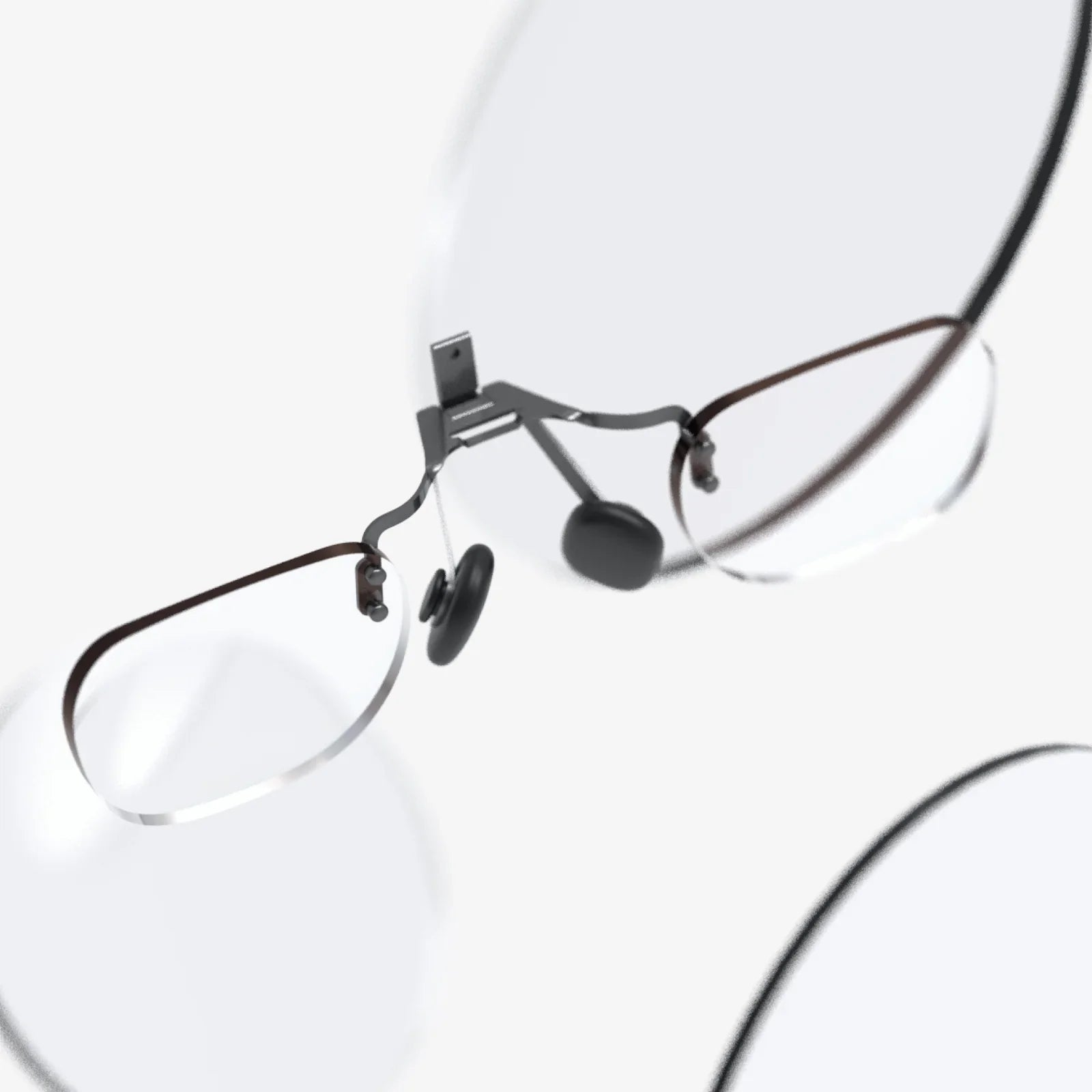
Imagine a world where the digital and the physical are no longer separate realms, but a single, seamless experience. Where crucial information, from navigation prompts to a friend’s name, floats effortlessly in your field of vision, accessible without ever glancing down at a screen. This is not a distant science fiction fantasy; it is the imminent future being built today, and it’s being delivered through a revolutionary piece of wearable technology: smart glasses with overlay.
The Evolution of Seeing More
The journey to modern smart glasses is a story of miniaturization and ambition. The concept of augmenting human vision is centuries old, but the technological path began in earnest with the head-up displays (HUDs) developed for fighter pilots in the mid-20th century. These complex optical systems projected critical flight data onto the cockpit canopy, allowing pilots to keep their "heads up" and focused on the dogfight, not on their instruments. This was the foundational proof-of-concept—information overlaid on reality to enhance performance in a high-stakes environment.
The next major leap came with the birth of augmented reality (AR) as an academic field in the 1990s. Early systems were monstrously bulky, often requiring users to carry backpack-mounted computers connected to headgear that was more scaffold than spectacles. They were confined to research labs and niche industrial applications. The true catalyst for change was the smartphone revolution. The mass production of components like micro-displays, miniature cameras, motion sensors (IMUs), and powerful, efficient processors—all driven by mobile phone demand—provided the essential building blocks. Suddenly, the processing power that once required a backpack could be housed in the temples of a pair of glasses. This convergence of technologies has finally made it possible to create devices that are socially acceptable, lightweight, and powerful enough to deliver a compelling overlay experience to the masses.
Deconstructing the Magic: Core Technologies
At its heart, a pair of smart glasses with overlay is a sophisticated sensor and display system designed to understand the world and present information within it. This magic is powered by several key technologies working in concert.
The Display Systems: Painting Light onto the World
How digital images are projected into the user’s eye is the single most defining characteristic of these devices. There are two primary methods, each with its own advantages.
Waveguide Technology: This is the most prevalent method in modern, sleek designs. It involves projecting light from a micro-display located in the temple of the glasses into a thin, transparent piece of glass or plastic (the waveguide) in the lens. This plate contains nanostructures or holographic optical elements that "bounce" the light down the waveguide through a process called total internal reflection before finally directing it into the user’s eye. The result is a bright, sharp image that appears to float in space several feet away, seamlessly overlaying the real world. The major benefit is that it allows for a normal eyeglass form factor.
Curved Mirror Combiners: An older but still effective method uses a small, semi-transparent curved mirror positioned in the upper part of the user’s field of view. The micro-display projects an image onto this combiner, which reflects it into the eye while allowing the user to see through it. While this can often create a smaller "window" for the digital content and can be slightly more obtrusive in the frame design, it is a proven and effective technology for many applications.
Sensing the World: The Device's Eyes and Ears
For the overlay to be contextually relevant and stable, the glasses must perceive the environment as you do. This is achieved through a suite of sensors.
- Cameras: One or more high-resolution cameras continuously capture the user’s field of view. This visual data is the primary input for computer vision algorithms.
- Inertial Measurement Unit (IMU): This cluster of sensors—including accelerometers, gyroscopes, and magnetometers—tracks the precise movement, orientation, and rotation of the user’s head in real-time. This is crucial for anchoring digital objects in space so they don’t jitter or float away as you move.
- Depth Sensors: Some advanced systems incorporate time-of-flight sensors or structured light projectors to create a detailed 3D map of the surroundings. This allows the glasses to understand the geometry of a room, the distance to objects, and precisely place digital content on physical surfaces.
- Microphones and Speakers: Audio input and output are essential for voice control and private audio feedback, making the interaction hands-free and immersive.
The Brain: Processing and Machine Intelligence
The raw sensor data is meaningless without interpretation. This is where the onboard processor and sophisticated software come into play. Powerful algorithms perform simultaneous localization and mapping (SLAM), constructing a live 3D map of the unknown environment while tracking the device's position within it. Computer vision models analyze the camera feed to identify objects, read text, recognize faces, and understand scenes. This entire pipeline—sensing, processing, and displaying—must happen with incredibly low latency to avoid a noticeable lag between your head movement and the overlay’s response, which is critical for both immersion and user comfort.
A Day in the Life: Transformative Applications
The true power of this technology is revealed not in tech demos, but in its practical, everyday applications that are already beginning to unfold.
Revolutionizing the Professional Workspace
The enterprise and industrial sectors are leading the adoption of smart glasses with overlay, as they solve clear, costly problems.
In manufacturing and field service, technicians can receive schematic diagrams, animated assembly instructions, or video calls from remote experts overlaid directly onto the machinery they are repairing. This provides hands-free, contextual guidance, drastically reducing errors, training time, and downtime. A complex wiring harness is no longer a puzzle when color-coded instructions are projected onto the exact wires that need connecting.
In logistics and warehousing, workers equipped with smart glasses can see navigation arrows on the floor guiding them to the next item to pick, along with real-time inventory data and quantity checks, supercharging efficiency and accuracy in massive fulfillment centers.
In healthcare, surgeons could potentially see vital signs, ultrasound data, or pre-operative plans overlaid on their patient during a procedure. Medical students could practice complex procedures on interactive, anatomical holograms. The potential to enhance precision and improve outcomes is enormous.
Redefining Social and Personal Interaction
Beyond the workplace, this technology promises to change how we interact with the world and each other.
Imagine walking through a foreign city where translation overlays appear instantly on street signs and menus. Or attending a conference where the name and professional background of everyone you meet is subtly displayed next to their face (with appropriate privacy controls, of course). Navigation becomes intuitive, with giant virtual arrows painted onto the street, eliminating the need to constantly consult a phone.
For the creatively minded, these glasses could become the ultimate canvas. Digital artists could sculpt virtual statues in a public park, architects could walk clients through the full-scale hologram of a building before the foundation is even poured, and gamers could turn their entire neighborhood into an immersive playground for adventures.
The Double-Edged Sword: Challenges and Considerations
Despite the exciting potential, the path to widespread adoption is fraught with significant technical, social, and ethical hurdles.
The Battleground of Form Factor and Battery Life
The ultimate goal is a device that is indistinguishable from regular eyewear—lightweight, stylish, and with all-day battery life. We are not there yet. Balancing processing power with energy consumption is a constant engineering challenge. Large batteries add weight, and cutting-edge waveguide displays can be expensive to manufacture. Achieving a socially acceptable design that people will actually want to wear all day remains the holy grail for manufacturers.
The Privacy Paradox
This is arguably the most significant barrier. Devices with always-on cameras and microphones worn on one’s face represent a profound shift in surveillance capability. The potential for misuse is staggering, raising critical questions: Who has access to the video feed? Is it being recorded? How is facial recognition data handled? Without clear, transparent, and robust privacy frameworks—both in company policies and in law—public trust will be impossible to earn. The concept of informed consent in public spaces, where your image might be captured by dozens of passive devices, needs to be completely rethought.
The Attention and Safety Dilemma
Overlaying digital information onto the real world creates a constant competition for the user’s attention. Will we become more distracted, lost in a flood of notifications and virtual objects, rather than more connected to our surroundings? The safety implications are immediate, particularly for tasks like driving or operating machinery. Designing user interfaces that are context-aware and prioritize critical information without causing dangerous cognitive overload is a immense design challenge.
The Invisible Revolution
The development of smart glasses with overlay is not merely about creating a new gadget; it is about forging a new human-computer interface. It’s a shift away from pulling a rectangle out of our pockets and towards a future where computing is ambient, contextual, and integrated into our natural perception. It promises to augment our abilities, break down language barriers, revolutionize entire industries, and unlock new forms of creativity and connection. Yet, it simultaneously demands that we confront profound questions about privacy, attention, and the very nature of our shared reality. The technology itself is racing forward, but its successful integration into society will depend entirely on our ability to guide its development with careful thought, strong ethical principles, and a clear vision for the human experience we want to enhance, not replace. The overlay is coming; it is now up to us to decide what we write upon it.
We stand at the precipice of a fundamental shift in how we perceive and interact with our world, a moment where the line between helper and hindrance, between enhancement and intrusion, has never been thinner—or more critical to define. The promise of instant knowledge and seamless connection is tantalizing, but the true test of this technology won't be its processing power or display clarity; it will be its ability to earn a place on our faces and in our lives without compromising the very humanity it seeks to augment.
Share:
AR Explanation: Unlocking the Digital Layer of Reality
AR Explanation: Unlocking the Digital Layer of Reality