


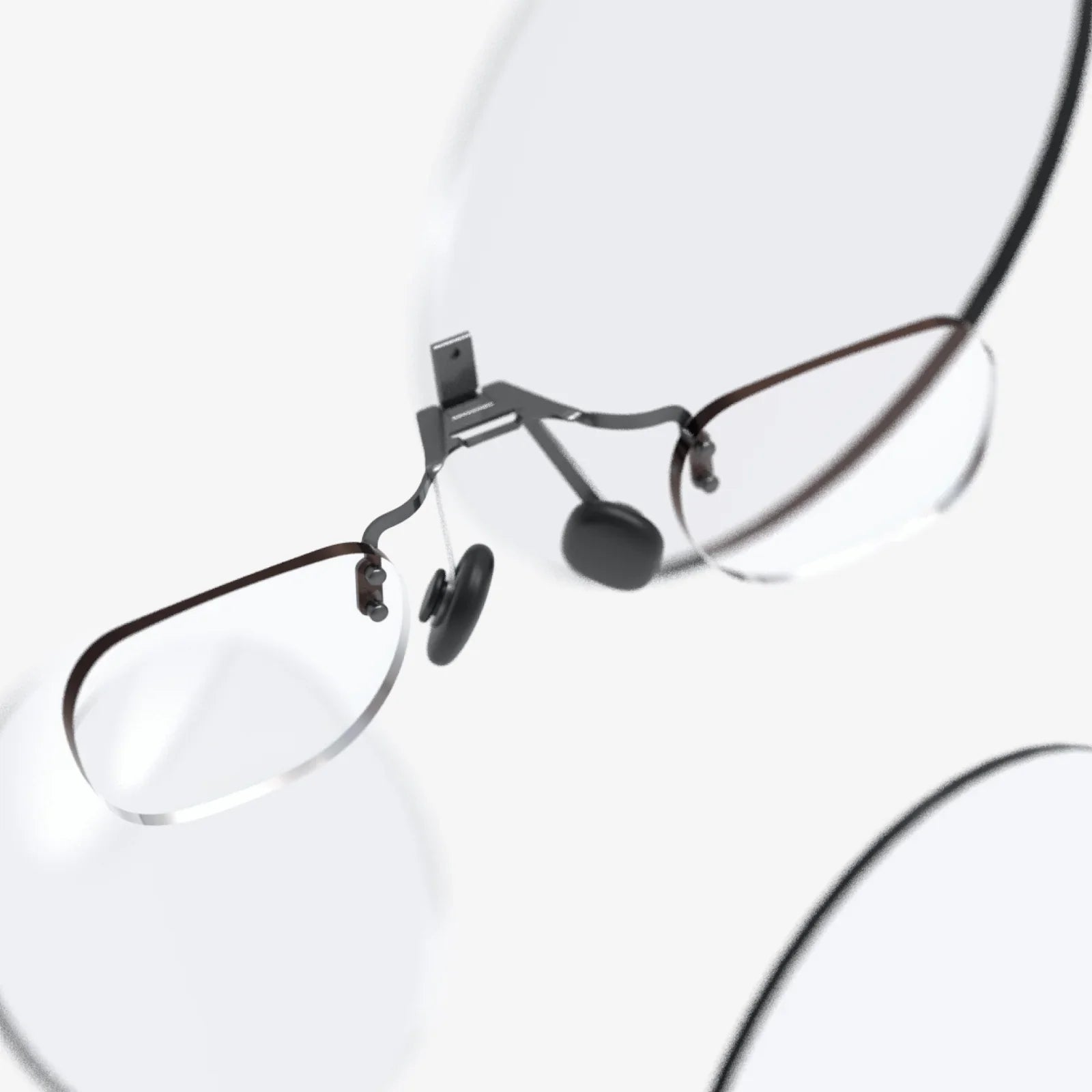
Imagine a world where your digital life seamlessly blends with your physical reality, where holographic assistants help you cook and virtual monsters hide behind your sofa. This isn't distant science fiction; it's the promise of today's wearable technology, a battlefield where two titans clash: the sleek, futuristic XR glasses and the powerful, all-encompassing VR headset. Your choice will define how you play, work, and connect for years to come. But which one is right for you? The answer is more complex and exciting than you might think.
Demystifying the Jargon: More Than Just Acronyms
Before we dive into the clash of the titans, it's crucial to understand the spectrum they occupy. The term "XR," or Extended Reality, is the umbrella that encompasses all immersive technologies.
- Virtual Reality (VR): This is a fully digital, immersive experience. A VR headset blocks out the physical world entirely and replaces it with a computer-generated environment. When you put one on, you are transported somewhere else entirely—a space station, a racetrack, or a fantasy realm.
- Augmented Reality (AR): This technology overlays digital information onto the real world. Using cameras and sensors, AR projects images, text, and 3D models into your field of view, allowing you to interact with them as if they were part of your environment. Think of digital navigation arrows painted onto the street in front of you.
- Mixed Reality (MR): A more advanced subset of AR, MR not only overlays digital content but also allows it to interact intelligently with the real world. A virtual character could jump onto your real-world coffee table and hide behind your lamp, understanding the geometry and physics of your room.
So, where do our two competitors fit in? XR Glasses are typically sleek, eyeglass-style wearables designed for AR and MR experiences. They are meant to be worn for extended periods, augmenting your daily life. A VR Headset is a more substantial device focused on creating a completely virtual, immersive experience, disconnecting you from your surroundings. The line is blurring, but this core distinction in purpose is the heart of the debate.
The Form Factor Face-Off: Design and Comfort
The most immediate difference between the two is how they look and feel. This isn't just about aesthetics; it dictates how and where you can use them.
XR Glasses: The Discreet Companion
Modeled after traditional eyeglasses or slightly larger sunglasses, XR glasses prioritize social acceptability and all-day comfort. They are lightweight, often weighing a fraction of a VR headset. The goal is to be something you can wear on your morning commute, at the office, or in a café without drawing excessive attention. Their open or semi-transparent design allows you to remain fully aware of your surroundings, making them ideal for multitasking between the digital and physical realms. However, this sleekness often comes at a cost. Battery life can be limited due to size constraints, and the field of view for the digital projections is often narrower than the immersive canvas of a VR headset.
VR Headsets: The Immersive Powerhouse
VR headsets are unapologetically bulky. They feature a fully enclosed design that blocks out all ambient light and sound, with a high-resolution display mere inches from your eyes. This design is intentional—it's built for maximum immersion. They typically feature robust head straps and counterweights for stability during active experiences. The trade-offs are significant: they are heavier, isolate you completely from your environment, and are generally impractical for mobile use beyond a dedicated play space. Using one in public is not just awkward; it's dangerous, as you are effectively blind to the world around you.
Under the Hood: A Tale of Two Technologies
The differing goals of these devices demand radically different technological approaches.
VR Headset Tech: Raw Processing Power
VR headsets are computational beasts. Their primary job is to render two high-resolution, high-refresh-rate displays (one for each eye) to create a convincing, lag-free world. This requires immense graphical processing power. Many high-end headsets are tethered to even more powerful external computers, unlocking photorealistic graphics and incredibly complex virtual environments. They rely on inside-out or outside-in tracking systems, using multiple cameras and sensors to precisely map your movement in space, down to the millimeter, to prevent the nausea-inducing disconnect between your physical movement and virtual view.
XR Glasses Tech: The Sensor Symphony
While XR glasses also require processing power, their genius lies in their sophisticated sensor arrays. They are packed with high-resolution cameras, depth sensors, LiDAR scanners, and microphones. Their primary task is not to render a new world, but to understand the existing one in real-time. They must map the room, identify surfaces, track objects, and understand spatial audio to convincingly anchor digital content to your reality. This happens continuously and instantaneously. The processing is often a combination of onboard chips and offloading to a connected companion device, like a smartphone or a small wearable computer, to maintain the sleek form factor.
The Application Arena: Work, Play, and Everything In Between
This is where the philosophical differences become practical. Each device excels in fundamentally different areas.
The VR Headset: King of Immersion
- Gaming: This is VR's undisputed kingdom. From heart-pounding horror titles and intricate simulations to social platforms where you embody an avatar, VR offers an unmatched level of presence and engagement.
- Training and Simulation: Pilots, surgeons, and soldiers use VR to practice complex, expensive, or dangerous procedures in a completely safe, controlled virtual environment.
- Virtual Tourism and Storytelling: Explore the pyramids of Giza, walk the surface of Mars, or step inside a documentary. VR's ability to evoke empathy and transport users is its superpower.
The XR Glasses: The Ultimate Utility Tool
- Remote Assistance and Collaboration: A expert can see what a field technician sees and annotate the real world with arrows and instructions, as if they were standing right there.
- Navigation and Contextual Information: Walking through a foreign city, directions can be overlaid onto the streets, and historical information can pop up as you look at a monument.
- Screen Proliferation and Productivity: Imagine replacing your physical monitors with vast, floating, virtual screens that you can arrange anywhere, turning any café or airport into a productive workspace.
- Subtle HUDs for Daily Life: Your messages, notifications, and health metrics could appear subtly in your periphery, eliminating the need to constantly look down at your phone.
The Social Conundrum: Isolation vs. Integration
Perhaps the most profound difference is how these devices affect human interaction. A VR headset is inherently isolating. When you are in a virtual world, you are absent from the physical one. This makes social use in a shared space difficult; you are a person in the room with a black box on their face.Conversely, XR glasses are designed for social integration. Because your face is visible and you maintain eye contact with your surroundings, they have the potential to enhance interaction rather than replace it. You could be looking at the same real-world object with a friend while seeing complementary digital information, creating a shared augmented experience. The path to social acceptance for XR glasses is far clearer than for VR headsets.
Gazing into the Crystal Ball: The Future is Convergent
The current "vs." narrative will likely become obsolete. The future lies in a hybrid device—a single pair of glasses that can seamlessly switch between VR and AR modes. Imagine transparent lenses that can become digitally opaque at a moment's notice, allowing you to toggle between being present in your room and being fully immersed in a virtual game. The technological hurdles for this are immense, requiring breakthroughs in display technology, battery life, and processing power all in a glasses-like form factor. But the race to create this ultimate all-in-one device is already underway. We are moving towards a paradigm where the device adapts to the experience, rather than the user needing to choose a device for a specific task.
The question is no longer which technology will win, but when they will merge to redefine our reality entirely. The ultimate winner of the XR glasses vs. VR headset battle won't be one or the other; it will be you, equipped with a device that erases the line between the digital and the physical, unlocking human potential in ways we are only beginning to imagine. The next evolution of computing isn't on your desk or in your pocket; it's on your face, waiting to change everything.
Share:
What Are AI Glasses and What Do They Do - A Guide to Wearable Intelligence
Looking at AR & VR: The Digital Revolution Reshaping Our Reality