


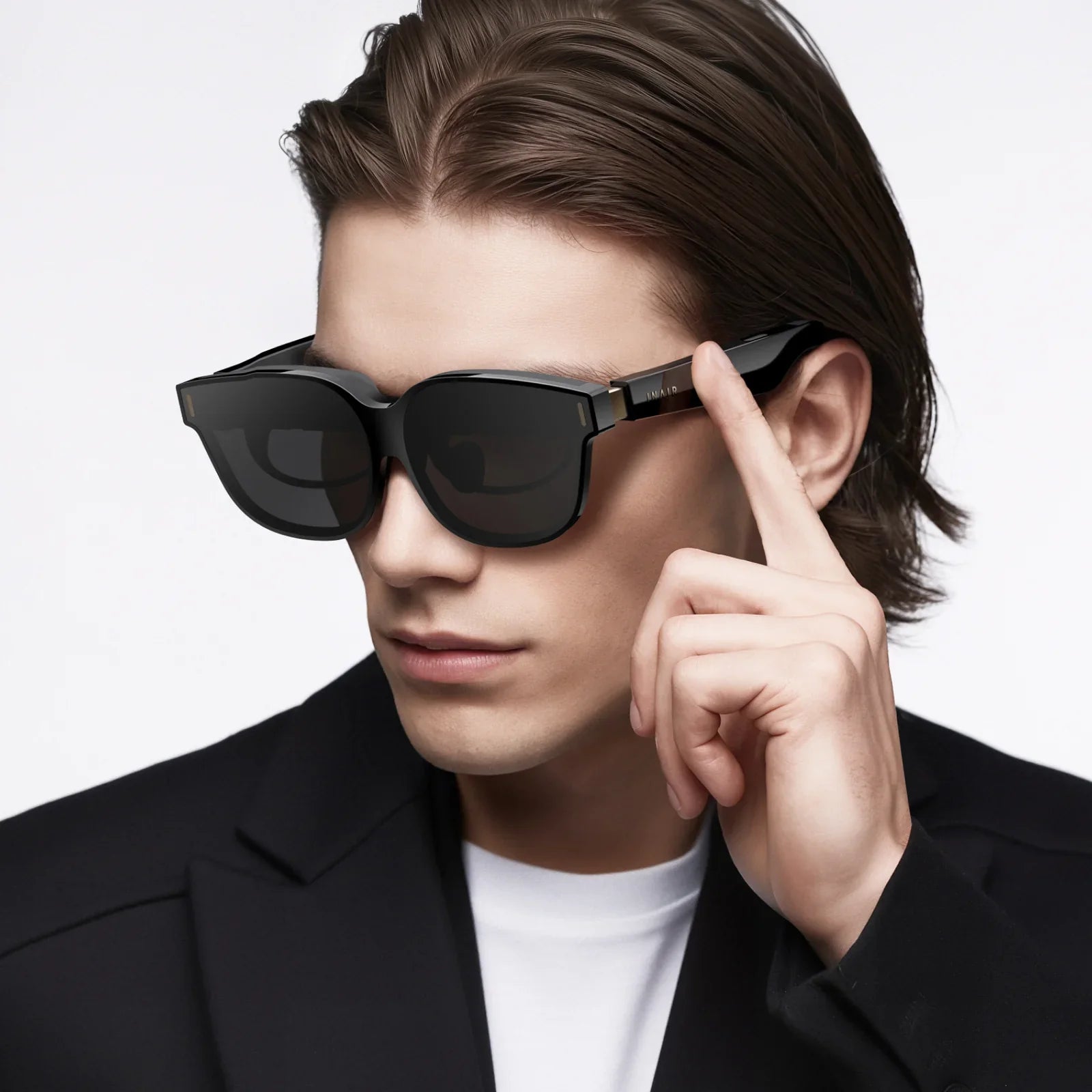
Imagine reaching out and feeling the digital world. Not through a screen or a joystick, but with your own two hands, manipulating holograms and virtual interfaces as if they were physical objects right before your eyes. This is no longer the stuff of science fiction; it is the promise held by the next generation of 3D VR controllers for smart glasses, a technological leap that is set to dissolve the final barriers between ourselves and the digital dimensions we seek to explore. The journey from abstract command to intuitive interaction is here, and it begins not with a click, but with a gesture.
Beyond the Screen: The Evolution of Human-Computer Interaction
The history of computing is, in many ways, a history of interfaces. We have progressed from punch cards and command-line interfaces to the graphical user interface (GUI), which gave us the mouse and the metaphor of the desktop. The touchscreen revolution then put a direct, tactile connection to digital information in billions of pockets. Each step brought us closer to a more natural, intuitive way of commanding machines. Virtual and augmented reality represent the next, and perhaps most profound, step in this evolution: the spatial interface. Instead of looking at a representation of a world, we are placed within it. But for years, a disconnect remained. We were inside these worlds, but our primary tools for interaction—gamepads, wands, and even basic motion controllers—were often clumsy translations of 2D input devices into a 3D space. They required learning new button combinations and abstract mappings. The true potential of spatial computing could only be unlocked with an input device that was as spatially aware and nuanced as the output device—the headset or pair of smart glasses. This is the critical role the advanced 3D controller is designed to fill.
Decoding the Technology: How a 3D Controller for Glass Works
At its core, a sophisticated 3D controller for smart glasses is a marvel of miniaturized engineering, combining several technologies to achieve precise, low-latency tracking. Unlike controllers that rely solely on external sensors or base stations, those designed for the mobile, untethered nature of smart glasses often use inside-out tracking. This means the glasses themselves, equipped with cameras and sensors, understand the controller's position and orientation in real-time.
Inside-Out Tracking and Computer Vision
The glasses' cameras continuously scan the environment, identifying unique features and patterns. The controller, often adorned with infrared LEDs or specific visual markers invisible to the human eye, acts as a highly visible reference point. By analyzing the controller's position from multiple camera viewpoints, the system can triangulate its exact location in 3D space with astonishing accuracy, down to the millimeter.
Inertial Measurement Units (IMUs)
Complementing the optical tracking is an IMU inside the controller itself. This package of sensors—including accelerometers, gyroscopes, and magnetometers—measures acceleration, rotation, and orientation. The IMU data is incredibly responsive and is used to fill in the gaps between camera frames, predicting movement and ensuring there is no perceptible lag, which is crucial for maintaining immersion and preventing motion sickness.
Haptic Feedback and Expressive Input
True immersion is not just about seeing your hand in the right place; it's about feeling a response. Advanced linear resonant actuators (LRAs) provide precise and varied haptic feedback. This isn't just a simple rumble; it can simulate the subtle texture of a virtual slider, the snap of a toggle, or the resistance of squeezing a virtual object. Furthermore, these controllers go beyond simple triggers. They incorporate capacitive touch sensors on grips and surfaces, detecting not just a button press but the presence of a finger, enabling gestures like a thumbs-up or a pinching motion. This allows for a rich vocabulary of input, from gross motor movements for large-scale manipulation to fine motor control for delicate tasks.
The Symbiotic Relationship: Controller and Glass
The true magic happens in the seamless integration between the controller and the smart glasses. This is not a generic peripheral; it is a co-dependent component of a unified system. The glasses provide the persistent understanding of the environment. They map the room, identifying surfaces, objects, and boundaries. This environmental awareness is shared with the controller. The result is context-aware interaction. You can reach out and rest your virtual hand on a real physical table, with the controller providing a subtle haptic bump as it aligns with the surface in the digital overlay. You can point the controller at a real-world smart lamp and, through the glasses' UI, turn it on. The controller becomes a magic wand, a paintbrush, a surgical tool, or a remote control for your physical environment, all defined by the context provided by the glasses.
Unlocking New Realms: Applications Across Industries
The implications of this technology extend far beyond immersive gaming. It is a foundational tool for the future of work, education, and creativity.
Professional Design and Architecture
Architects and industrial designers can step inside their 3D models, holding a controller to sculpt, stretch, and rearrange elements with natural hand movements. Instead of using a mouse to manipulate a camera view, they can walk around a full-scale holographic model of a building, using the controller to adjust the curvature of a roof or the placement of a support beam intuitively. This tactile connection to digital clay dramatically accelerates the iterative design process.
Medicine and Training
Medical students can practice complex surgical procedures on hyper-realistic virtual patients. A 3D controller can emulate a scalpel, forceps, or other instruments, providing haptic feedback that mimics the resistance of tissue or the click of a joint. This allows for risk-free repetition and mastery of motor skills. Furthermore, remote specialists could guide a procedure by overlaying instructions and diagrams directly into a surgeon's field of view, with the controller used to annotate and highlight specific areas.
Remote Collaboration and Telepresence
Imagine a team of engineers from across the globe meeting in a shared virtual space around a 3D model of a new engine. Each engineer, wearing their glasses and using their controller, can point to components, make adjustments, and manipulate the model simultaneously. The controller becomes an extension of their pointer finger, allowing for natural and expressive communication that flat video calls can never replicate. This creates a powerful sense of shared presence and collaborative potential.
Everyday Computing and Productivity
The ultimate promise of AR glasses is to replace the myriad of screens in our lives. With a precise 3D controller, your entire computing environment becomes spatial. You can pin browser windows, virtual monitors, and media players to your physical walls. The controller allows you to resize them, drag them around, and interact with them as if they were tangible objects. Scrolling through a document could be a flick of the wrist, and selecting an icon a simple point-and-press gesture, creating a computing experience that is both limitless and intuitively grounded in the real world.
Challenges on the Horizon: Latency, Precision, and Form Factor
For all its promise, perfecting this technology presents significant hurdles. The single greatest enemy of immersion is latency—the delay between a user's movement and the corresponding action reflected in the display. Even a delay of a few milliseconds can break the illusion and cause discomfort. Achieving the sub-20-millisecond latency required for true realism demands incredibly powerful processing and optimized algorithms. Furthermore, precision remains a challenge. While current technology is excellent for gross movements, replicating the fine motor skills required for writing or detailed artistic work with absolute fidelity is an ongoing pursuit. Finally, the form factor of the controller itself is a balance between capability and comfort. It must be lightweight enough to use for extended periods, ergonomically designed to avoid fatigue, and yet packed with enough sensors and batteries to function effectively.
The Future is in Your Hand: The Path Forward
The evolution of the 3D controller for glass is moving towards even greater invisibility. The logical endpoint is moving past held controllers altogether, towards advanced hand-tracking that allows us to use our bare hands. However, held controllers will likely remain essential for years to come for applications requiring haptic feedback, precise input, or simulating specific tools. The future may see a hybrid approach, where we seamlessly switch between using our hands and picking up a specialized tool for a specific task, much like we do in the real world. Ultimately, the goal is to make the technology so seamless, so intuitive, that it fades into the background, leaving only the pure experience of creation, exploration, and connection.
The gap between the digital and the physical is closing, not with a loud bang, but with the quiet hum of haptic motors and the precise tracking of infrared light. This new era of interaction, powered by the synergy of intelligent glasses and responsive 3D controllers, invites us not just to observe digital worlds, but to truly touch them, shape them, and bring them into our own. The tool that will let you grasp the future is already taking shape in the palm of your hand.
Share:
VR Headset Dimensions: The Ultimate Guide to Size, Weight, and Fit
VR Headset How Does It Work: A Deep Dive Into Virtual Reality Technology