


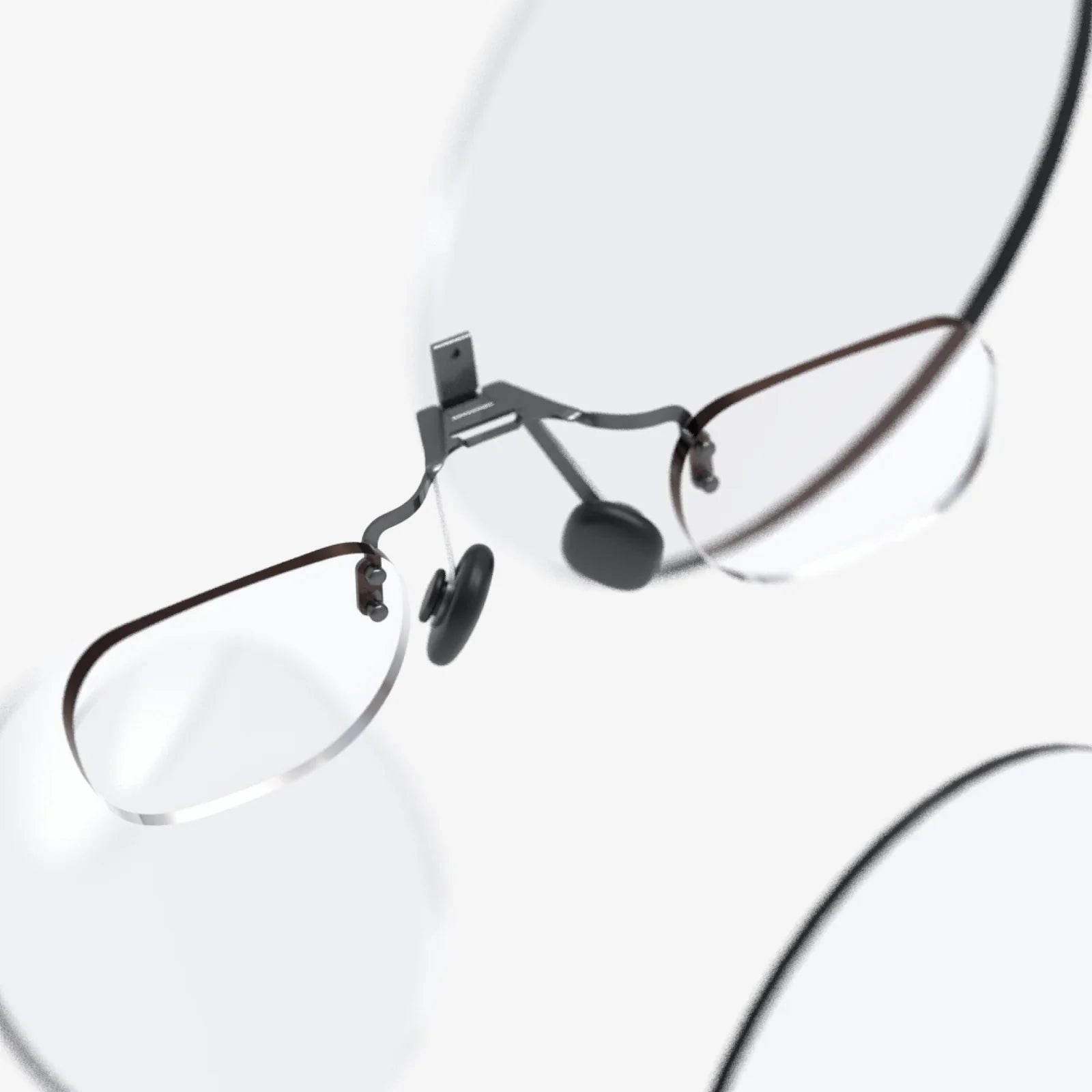
Imagine walking through a foreign city and seeing translations seamlessly overlaid onto street signs, historical facts popping up beside ancient buildings, and directions painted as a glowing line on the pavement right before your eyes. Or envision a mechanic seeing a schematic diagram hover over a complex engine, a surgeon visualizing a patient’s vital signs and 3D scans without looking away from the operating table, or a family gathering where a digital board game materializes on the living room floor for everyone to play. This isn't a distant dream from a cyberpunk novel; this is the imminent future being unlocked by actual augmented reality glasses. For decades, AR has been a promise perpetually on the horizon, but a confluence of technological breakthroughs is finally bringing functional, wearable, and truly useful AR glasses into the light, poised to redefine our relationship with information and with each other.
The Technological Leap: From Bulky Prototypes to Wearable Wonders
The journey to creating actual augmented reality glasses has been a monumental engineering challenge, requiring the miniaturization of incredibly powerful components into a form factor light enough to wear all day. The core of any AR glasses is its display system, and the solutions being developed are nothing short of magical.
Waveguide Optics: The Magic of Overlaying Light
Early AR devices often used bulky combiner mirrors or required projecting images onto semi-transparent surfaces. The modern standard, however, is moving towards waveguide technology. Think of a waveguide as an incredibly thin piece of glass or plastic that acts as a conduit for light. Tiny holographic gratings or other optical elements etched into the waveguide “paint” the digital image directly onto your retina, perfectly aligned with the real world. This allows for a large, immersive digital canvas while maintaining a sleek, eyeglasses-like profile. It’s the key to making the digital elements appear bright, crisp, and anchored in your physical space.
Spatial Computing and World-Locking
For digital objects to feel real, they can’t drift or jitter. They must stay locked in place, whether on a table or next to a building. This requires a sophisticated suite of sensors working in perfect harmony. Cameras, LiDAR scanners, and depth sensors continuously map the environment, creating a real-time 3D mesh of the space around you. Simultaneously, an Inertial Measurement Unit (IMU) tracks the precise movement and orientation of your head. Powerful onboard processors then fuse this data instantaneously, a process known as simultaneous localization and mapping (SLAM). This complex dance of hardware and software is what allows a virtual pet to convincingly hide behind your real-world couch or for a navigation arrow to stick to a street corner as you walk.
The Invisible Engine: Processing Power and Connectivity
Driving these experiences demands serious computational power. While some early devices offloaded processing to a companion phone or a dedicated compute puck, the goal is full untethered independence. This is being achieved through custom-built silicon—system-on-chips (SoCs) designed specifically for the immense demands of AR. They handle complex computer vision algorithms, render high-fidelity graphics, and manage power consumption efficiently, all from a chip small enough to fit in the arm of the glasses. Coupled with high-speed, low-latency wireless connections like 5G, these glasses can also tap into cloud computing for even more intensive tasks, creating a seamless blend of local and distributed processing.
Beyond Novelty: The Transformative Applications
The true measure of any technology is its utility. Actual augmented reality glasses are not merely a new screen; they are a new interface between humans and data. Their potential applications span nearly every facet of professional and personal life.
Revolutionizing the Workplace
The enterprise and industrial sectors are poised to be the earliest and most profound beneficiaries. The concept of remote expert assistance is revolutionized. A senior engineer located thousands of miles away can see what a field technician sees, and with simple hand gestures or voice commands, can annotate the technician’s real-world view with arrows, diagrams, or instructions, effectively guiding their hands. This drastically reduces downtime, errors, and the need for travel.
In design and manufacturing, 3D prototypes can be reviewed at full scale, walked around, and interacted with before a single physical part is made. Complex assembly and maintenance instructions can be superimposed directly onto machinery, eliminating the need to consult thick paper manuals or look away at a tablet. For logistics, warehouse workers can have picking paths and inventory information visually overlaid onto shelves, dramatically increasing speed and accuracy.
Redefining Social Connection and Entertainment
On a personal level, AR glasses promise to make our digital interactions more human, not less. Instead of staring down at a small screen for a video call, your caller could appear as a life-like hologram sitting across from you on your sofa, making eye contact and sharing gestures naturally. This is a step beyond flat video conferencing; it’s a step towards telepresence.
Entertainment will cease to be confined to rectangles. Movies could play on a virtual big screen on your wall. Sports games could have live stats and replays floating around your living room. Gaming will become a truly physical and social activity, transforming your entire environment into a playground for digital characters and objects that everyone wearing glasses can see and interact with together.
Enhancing Daily Life and Accessibility
The mundane can become magical. Navigation will be intuitive, with a path glowing on the street. Shopping could involve seeing how a new piece of furniture would look in your home at true scale or getting real-time nutritional and sourcing information by simply looking at products in a grocery store.
Perhaps most importantly, AR glasses hold immense promise for accessibility. For those with visual impairments, the glasses could highlight obstacles, enhance contrast, or read text aloud from the environment. For those who are hard of hearing, real-time subtitles could be generated for conversations. This technology has the potential to create a more equitable and navigable world for millions.
The Hurdles on the Road to Ubiquity
Despite the breathtaking progress, the path to making actual augmented reality glasses a mainstream consumer product is fraught with significant challenges that engineers and society must overcome.
The Form Factor and Battery Life Conundrum
The ultimate goal is a device that looks, feels, and weighs as much as a standard pair of eyeglasses, yet contains the power of a supercomputer. We are not there yet. Current devices, while vastly improved, often represent a trade-off between capability and wearability. Battery life remains a critical bottleneck. Powering bright displays, multiple sensors, and powerful processors drains energy quickly. Innovations in low-power displays, more efficient processors, and potentially new battery chemistries are essential to achieving all-day use.
The Privacy Paradox
This is perhaps the most significant societal challenge. AR glasses, by their very nature, are equipped with always-on cameras and microphones that perceive the world. This raises profound questions about consent, surveillance, and data ownership. How do we prevent a world where everyone is unknowingly recorded? What safeguards are needed to prevent facial recognition from being used maliciously? Establishing clear ethical guidelines, robust privacy-by-design frameworks, and perhaps even physical signaling (like a visible light) to indicate recording will be non-negotiable prerequisites for public acceptance.
The Digital Divide and Social Etiquette
As with any transformative technology, there is a risk of a new digital divide emerging between those who can afford these advanced tools and those who cannot. Furthermore, new social norms will need to be established. Is it rude to wear AR glasses during a conversation? How do we ensure we remain present in our real lives and not lost in digital overlays? These are not engineering problems but human ones that we will collectively have to solve through experience and dialogue.
A New Layer of Reality
The development of actual augmented reality glasses represents a fundamental shift in computing. We are moving from a era of personal computing (desktops, laptops) to mobile computing (phones) and now to spatial computing. This new paradigm doesn't ask us to look down at a device; it brings information and experience into our world, contextually and immediately.
The potential for enhancing human capability, boosting productivity, fostering connection, and assisting those with disabilities is staggering. It’s a platform that will spawn entirely new industries and ways of interacting that we haven't even conceived of yet. The glasses themselves will evolve, becoming lighter, more powerful, and eventually, perhaps even indistinguishable from regular eyewear.
The age of peering into a handheld screen is slowly drawing to a close. The next technological revolution won't be in your pocket; it will be directly in your field of vision, seamlessly blending the atoms of our world with the bits of the digital universe. The future is not something we will watch on a display; it is something we will see through our actual augmented reality glasses, and it’s a future that is arriving faster than anyone anticipated.
Share:
Superdisplay Virtual Monitor: The Future of Workspace Expansion is Here
Virtual Reality PC Monitor: The Ultimate Immersive Desktop Experience Unveiled