


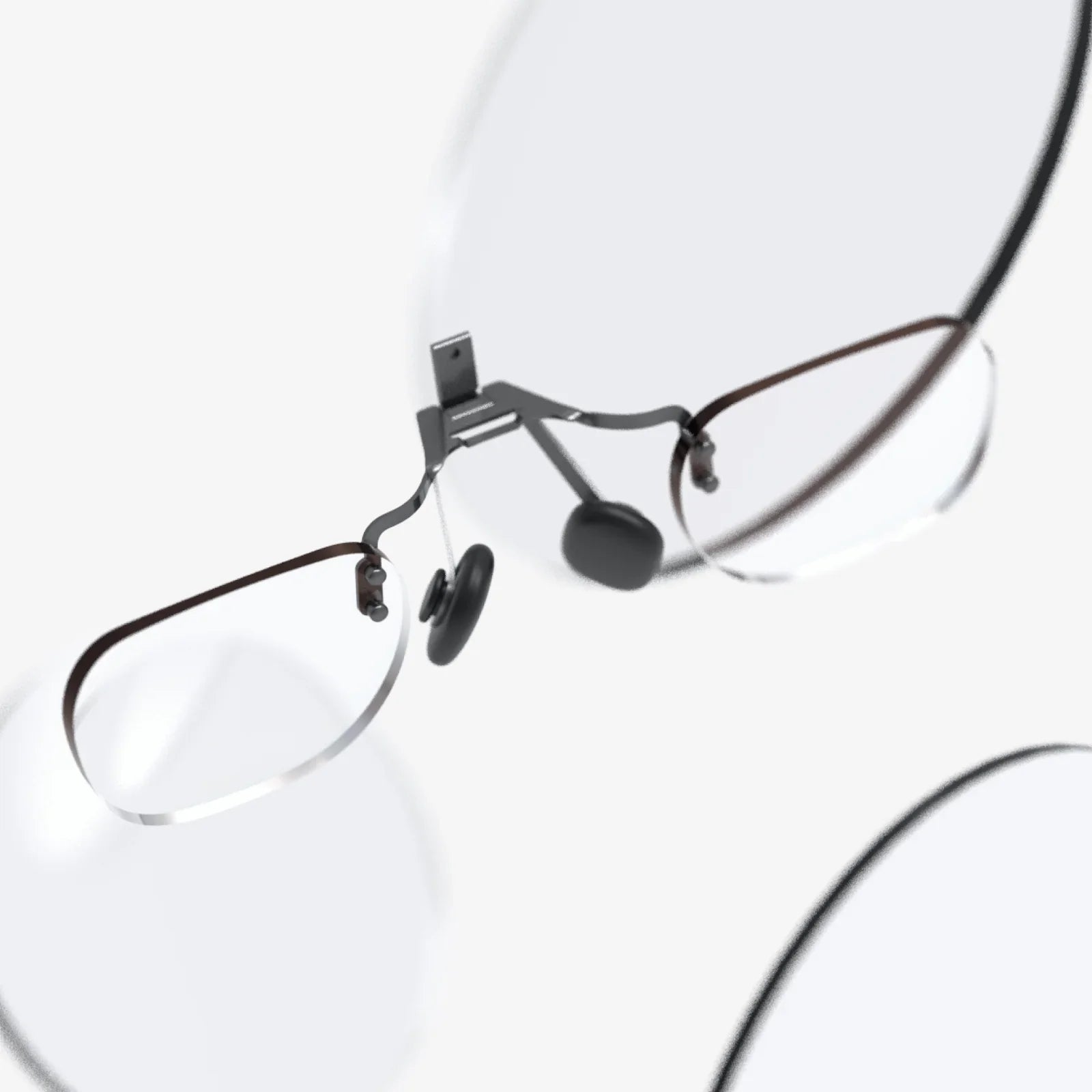
Imagine a world where information doesn’t live on a screen in your hand, but is seamlessly painted onto the canvas of your reality. Where the digital and the physical cease to be separate realms, merging into a single, enhanced experience. This is not a distant science fiction fantasy; it is the imminent future being built today, and it’s being worn on our faces. The convergence of artificial intelligence, advanced optics, and wearable computing is birthing a new class of device poised to revolutionize everything from how we work and learn to how we connect and perceive the world around us. The era of passive observation is ending; the age of augmented interaction is dawning.
The Architectural Symphony: How AI and AR Converge in a Single Frame
At their core, AI glasses augmented reality smart glasses are a feat of miniaturization and computational harmony. They are not merely cameras and displays strapped to your head; they are sophisticated systems comprising several critical components working in concert.
The visual processing unit acts as the eyes, utilizing one or more high-resolution cameras to continuously capture the user’s field of view. This raw visual data is the foundational layer upon which everything else is built.
The inertial measurement unit (IMU), a cluster of sensors including accelerometers and gyroscopes, tracks the precise movement, orientation, and rotation of the user’s head. This allows the system to understand not just what it is looking at, but from what angle and in what context, ensuring digital overlays remain locked in place in the real world.
The onboard AI processing chip is the brain. This is where the magic happens. Using sophisticated machine learning models and neural processing units (NPUs), this chip performs real-time object recognition, spatial mapping, and scene understanding. It can identify a person’s face, read text, recognize a product on a shelf, map the dimensions of a room, and understand depth and surfaces. This local processing is crucial for low-latency interactions, where a delay of even milliseconds can break the illusion of immersion and cause user discomfort.
The optical display system is the brush that paints the digital onto the physical. Unlike virtual reality, which blocks out the real world, AR smart glasses use waveguides, holographic mirrors, or micro-LED projectors to beam light directly onto the retina or through a transparent lens. This creates the perception that high-resolution text, images, and 3D models are existing within the user’s environment.
Finally, a suite of audio technology provides spatial sound, allowing digital audio cues to feel as if they are emanating from a specific point in the room, further deepening the sense of immersion. This entire symphony is conducted by a powerful, efficient operating system designed for perpetual awareness and context-shifting.
Beyond Novelty: The Enterprise Metamorphosis
While consumer applications capture the imagination, the most profound and immediate impact of AI-powered smart glasses is occurring in the enterprise and industrial sectors. Here, the value proposition is clear: augmenting human capability to drive efficiency, accuracy, and safety.
In manufacturing and field service, a technician repairing a complex machine can see animated, step-by-step instructions overlaid directly onto the equipment. They can have a remote expert see their view and draw digital arrows or circles onto their reality to guide them, eliminating miscommunication and reducing travel costs. AI can proactively highlight potential issues, like a worn-out component, by comparing the live view to a digital twin.
In logistics and warehousing, workers equipped with smart glasses can have the most efficient picking route displayed in their vision, with digital markers pinpointing exact shelf locations. Item verification, quantity checks, and inventory management can be handled through a glance, freeing hands for lifting and moving, dramatically speeding up fulfillment processes.
In healthcare, the potential is staggering. A surgeon could have vital signs, ultrasound data, or 3D anatomical models projected directly over the patient during a procedure. Medical students could practice complex surgeries on holographic patients. A nurse making rounds could instantly see a patient’s history, allergy alerts, and current medication schedule without ever looking away from them, fostering a more human connection.
In design and architecture, professionals can walk through a full-scale, holographic model of a building before a single brick is laid. They can change materials, move walls, and test lighting conditions in real-time, collaborating with colleagues who appear as photorealistic avatars within the shared virtual space.
The Consumer Horizon: Redefining Daily Life
As the technology matures, becomes more socially acceptable, and drops in price, the consumer applications will explode, fundamentally altering the fabric of daily life.
Contextualized Navigation will evolve from blue dots on a map to giant, floating arrows superimposed onto streets, with the name of your destination visually tagged onto the building itself as you approach. You’ll never miss a turn or struggle to find a specific shop again.
Hyper-Personalized Information will become the norm. Look at a restaurant, and see its menu, health inspection rating, and tonight’s specials floating beside it. Look at a landmark, and receive a digest of its historical significance. Attend a conference, and have the name and professional background of everyone you meet subtly displayed, making networking seamless and informed.
Real-Time Language Translation will break down barriers like never before. Look at a street sign in a foreign language, and see it instantly rewritten in your own. Have a conversation with someone speaking a different language, and see their translated subtitles in real-time, or hear their words seamlessly converted into your language through advanced audio processing.
Immersive Learning and Creativity will be transformed. A mechanic-in-training could practice on a holographic engine. A chemistry student could conduct dangerous experiments with virtual chemicals. An artist could sculpt in 3D space using nothing but their hands and imagination, with their creation existing in the room with them.
The Invisible Elephant in the Room: Privacy, Security, and the Social Contract
The power of a device that sees what you see and hears what you hear is immense, and so are the ethical implications. The advent of always-on, always-sensing AI glasses forces a critical re-evaluation of privacy and the social contract.
The most visceral concern is the pervasive camera. The potential for covert recording in changing rooms, private meetings, and public spaces is a legitimate fear. Society will need to develop new norms and potentially new laws. Will there be a universal visual or audio cue to indicate when recording is happening? How will consent be managed in public spaces?
The amount of data collected is unprecedented. These devices will know everything about your daily patterns: what you look at, for how long, who you talk to, what you buy, and where you go. This dataset is a goldmine for advertisers, corporations, and, worryingly, malicious actors and authoritarian governments. Robust, transparent data governance, end-to-end encryption, and giving users true ownership over their data are not features; they are absolute necessities.
There is a risk of a new digital divide. Will access to this layer of augmented information become a prerequisite for success in certain jobs or social circles, creating a class of "augmented" and "unaugmented" citizens?
Finally, there is the psychological impact. Will constant augmentation lead to information overload and cognitive fatigue? Could we become so reliant on digital annotations that we lose our innate ability to navigate, remember, and observe? The goal must be augmentation, not replacement, of human capability.
The Road Ahead: From Clunky to Invisible
The current generation of devices, while impressive, is still in its relative infancy. The path to mass adoption is paved with technological hurdles that must be overcome.
Form Factor is paramount. For people to wear them all day, every day, they must be indistinguishable from regular eyewear—lightweight, stylish, and offering prescription options. The goal is not a headset, but a pair of glasses that just happen to be incredibly powerful computers.
Battery Life remains a colossal challenge. Processing high-fidelity AR and running powerful AI models are energy-intensive tasks. Breakthroughs in battery technology, ultra-low-power chips, and perhaps even alternative charging methods like solar or kinetic energy will be required to achieve all-day, always-on performance.
The need for seamless connectivity is critical. To access the full power of the cloud and stream rich data, these devices will rely on high-bandwidth, low-latency networks like 5G and eventually 6G. The augmented world will stutter and fail without a robust and ubiquitous connective tissue.
Finally, we need a new user interface paradigm. Touchscreens and voice assistants have their limitations. The next step is subtle gesture control (a pinch of the fingers, a glance), and ultimately, brain-computer interfaces (BCI) that can interpret intention directly from neural signals. The interface must become invisible, letting the technology fade into the background of our experience.
The true potential of AI glasses augmented reality smart glasses lies not in the technology itself, but in its ability to fade away. The ultimate success of this revolution will be measured by its invisibility—not of the information it provides, but of the device delivering it. We are marching towards a future where the boundary between our minds and the digital universe will dissolve, granting us capabilities that today seem like superpowers. The question is no longer if this future will arrive, but how quickly we can build it responsibly, and how wisely we will choose to use it.
Share:
How Eyewear Industry Uses Technology: A Visionary Revolution
What Is Augmented Reality Meaning: Bridging Our Digital and Physical Worlds