


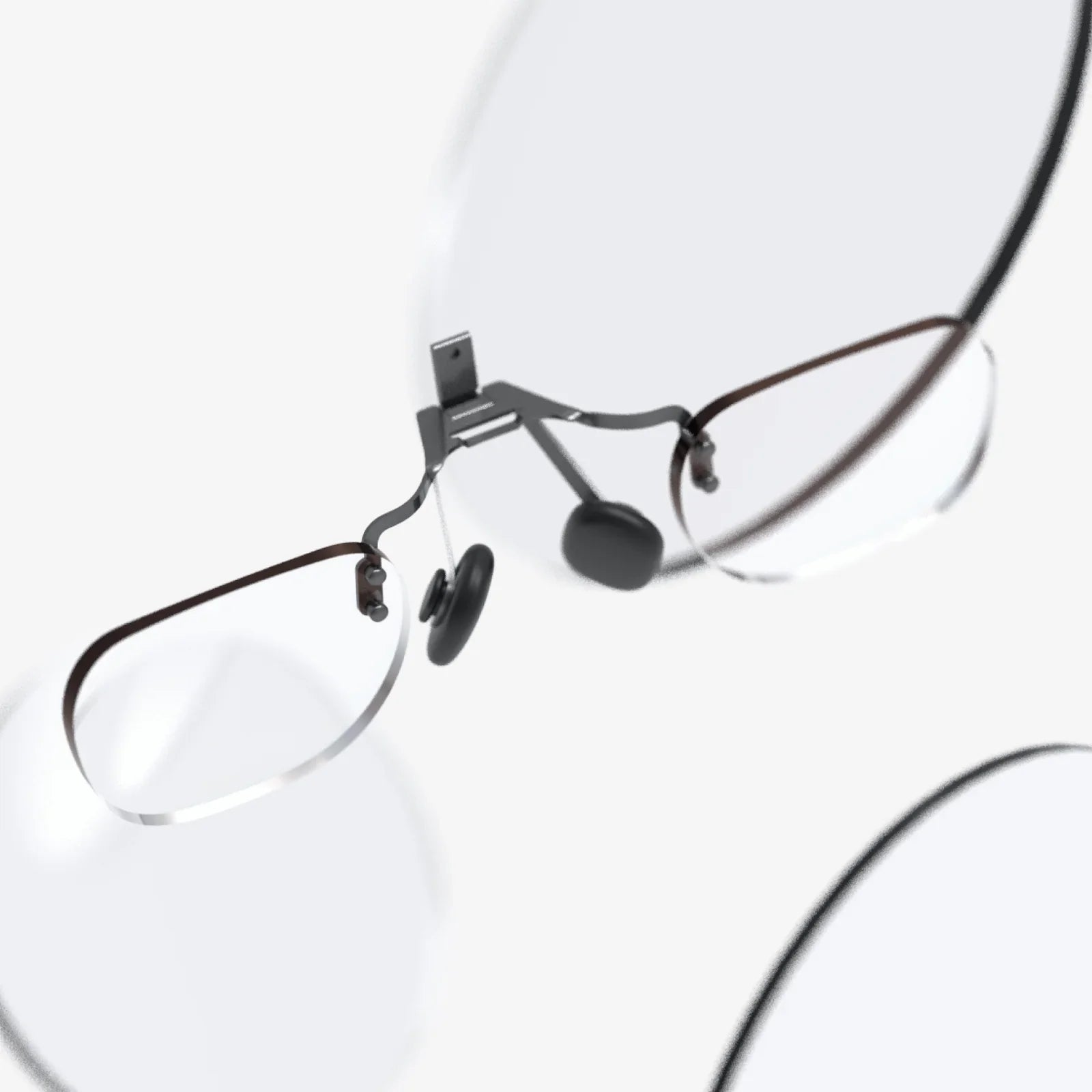
Imagine a world where your entire digital life—your messages, your memories, your work, your entertainment—is no longer confined to a small, glowing rectangle in your hand, but is instead seamlessly woven into the fabric of your reality. This is not a distant science fiction fantasy; it is the imminent future being forged in the labs of one of the world's most influential tech giants. The era of staring down at a screen is rapidly approaching its twilight, ready to be usurped by looking out at a world infinitely enhanced. The question is no longer if, but when and how, a new wearable paradigm will completely redefine our relationship with technology, moving us beyond the touchscreen and into a spatial age where information, connection, and possibility live all around us.
The Inevitable Evolution: From Pocket to Eyeline
The history of personal computing is a story of increasing immersion and intimacy. We moved from shared terminals in locked rooms to personal computers on desks, then to laptops on our laps, and finally to smartphones in our pockets. Each transition brought the digital world closer, making it more personal, accessible, and immediate. The smartphone, epitomized by the iPhone, was the apex of this trend for over a decade. It consolidated countless devices—a phone, a camera, a map, a music player, a gaming console—into a single, sleek slab of glass and metal. It was a revolutionary leap.
However, this consolidation came with a inherent limitation: it created a chasm between the user and their environment. To interact with the digital world, one must disengage from the physical one. We walk down the street with our heads bowed, we sit at dinners with companions while focusing on a screen, and we experience moments through the lens of a camera rather than through our own eyes. This is the fundamental paradox the smartphone can never solve. It is a portal to another world, but one that requires us to turn away from our own.
Augmented Reality (AR) glasses represent the next logical, and perhaps final, step in this evolutionary chain. The goal is not to create a new device to carry, but to eliminate the concept of a 'device' altogether. The technology itself should fade into the background, becoming an invisible layer of enhancement atop our natural perception. Instead of pulling a phone from your pocket, you simply glance at a restaurant to see its reviews, or look at a friend to see their recent social post. The interface moves from your hand to your eyeline, from a destination to a dimension. This shift from a portable computing device to a perceptual computing platform is what will ultimately allow AR glasses to replace the iPhone.
Deconstructing the iPhone: How AR Glasses Will Assume Its Roles
To understand the replacement thesis, we must break down the core functionalities of the modern smartphone and see how a capable AR headset would not just replicate, but profoundly enhance each one.
Communication: From Text and Video to Presence and Holograms
The iPhone transformed communication, but it remains a fundamentally flat experience. A video call is a window into another room, but you are always acutely aware of the screen's borders. AR glasses will shatter this frame. Imagine a communication protocol where the caller appears as a life-sized, photorealistic hologram sitting across from you at your kitchen table, able to gesture, share 3D models, and interact with your environment as if they were physically present. This sense of telepresence is impossible on a phone screen. Text messages could float in your periphery, easily dismissed or addressed with a glance. Notifications would no longer be intrusive alerts demanding your attention; they would be subtle, contextual cues integrated into your world.
Photography and Videography: From Capturing to Remembering
The iPhone is the world's most popular camera because it's always there. But AR glasses will be there even more seamlessly. Always-on, first-person perspective cameras will allow for the capture of life's moments without the artificial act of raising a device. You'll be able to record your child's first steps from your own point of view, not from a shaky hand held above the action. More importantly, the concept of a 'photo' or 'video' could evolve into a 'spatial memory'—a 3D, volumetric recording of a moment that you can literally walk back into and experience from any angle, hearing the sounds and seeing the events exactly as they unfolded. Your entire life could become a searchable, immersive archive of experiences.
Navigation: From Turn-by-Turn to Pathfinding
Navigation on a phone requires constant checking and reorientation. You follow a blue dot on a map. With AR glasses, the path is painted onto the world itself. Giant arrows materialize on the road ahead, guiding your driving. In a complex airport, a glowing line on the floor leads you directly to your gate. As you walk down a city street, the names of businesses and historical facts about buildings hover above them. The transition is from abstract map interpretation to intuitive, in-context wayfinding. The world itself becomes labeled and interactive.
Entertainment and Gaming: From Content Consumption to World Augmentation
Watching a movie on an iPhone is a solitary, small-scale experience. With AR glasses, any blank wall can become a 100-inch high-definition screen. A board game can spring to life on your coffee table, with animated characters battling it out over the physical game board. Gaming will be transformed entirely, blending the physical and digital into a cohesive playground. You could defend your living room from an alien invasion or solve spatial puzzles that unfold across your entire home. The passive consumption of content becomes an active augmentation of your space.
Productivity: From Desktop in Your Pocket to Workspace in the Air
The iPhone allows for light productivity, but it's a compromised experience. AR glasses will enable a true spatial workspace. Instead of a single small screen, you can have multiple virtual monitors arrayed around you, as large as you desire. You can manipulate 3D models with your hands, collaborate with colleagues who appear as avatars around a virtual conference table, and access data simply by looking at a physical object. Your entire field of view becomes a multitasking canvas, limited only by your physical space, not by screen size.
The Technological Hurdles: The Canyon Between Concept and Consumer Product
For all this potential, the path to a device that can truly replace the iPhone is fraught with monumental engineering challenges. These are not mere incremental improvements; they require breakthroughs across multiple domains.
The Form Factor: The Quest for Social Acceptability
This is arguably the biggest hurdle. Current AR prototypes are often bulky, heavy, and geeky. For mass adoption, the glasses must be indistinguishable from, or at least as desirable as, fashionable eyewear. They must be lightweight, comfortable enough to wear all day, and powered by a battery solution that doesn't require a bulky pack or constant charging. The goal is a product people want to wear, not just use. Achieving this requires miniaturization of components on an unprecedented scale, likely leveraging custom silicon and novel materials science.
Display Technology: The Magic of Blending Light
The core magic of AR is overlaying digital information onto the real world. This requires displays that are bright enough to be seen in daylight, high-resolution enough to be indistinguishable from reality, and capable of blending digital light with natural light perfectly. They must also solve the vergence-accommodation conflict—the physiological issue where your eyes struggle to focus on a virtual object placed at a different depth than the physical world behind it, often causing eye strain or nausea. Solutions like pancake lenses, micro-OLED displays, and eventually retinal projection are all being explored to create a comfortable, convincing, and magical visual experience.
Power and Thermal Management: The Invisible Engine
Processing the real world through high-fidelity cameras, understanding it through complex computer vision and machine learning algorithms, and rendering photorealistic graphics in real-time is an astronomically computationally intensive task. Doing this in a device on your face, with severe size, weight, and thermal constraints, is the ultimate challenge. It will require a system-on-a-chip (SoC) more powerful than those in current smartphones, but designed for extreme power efficiency to avoid overheating the user's face. This likely points to a hybrid architecture where the glasses handle sensor data and basic overlays, while a companion device (perhaps a smartphone initially, evolving into a more specialized compute module) handles the heavy number crunching.
The Interface Paradigm: Beyond Touch
The iPhone's success was built on the intuitive simplicity of the multi-touch interface. AR requires a new, even more intuitive language of interaction. This will be a multimodal blend of:
- Voice: A powerful, always-listening intelligent assistant for complex commands.
- Gesture: Subtle hand and finger movements to select, drag, and manipulate virtual objects.
- Eye-Tracking: Using gaze as a pointer, knowing exactly where you are looking to enable 'look to select' interactions.
- Neural Input: Eventually, more direct interfaces reading neural signals for intended actions could make interaction effortless.
Designing this interface to feel natural, magical, and not socially awkward is a immense software and hardware challenge.
The Ecosystem: The Invisible Wall Garden
A device is nothing without its ecosystem. The iPhone's dominance is secured by iOS and the App Store—a tightly integrated, curated platform that provides a seamless user experience and a lucrative marketplace for developers. For AR glasses to succeed, they cannot exist in a vacuum.
A new operating system, likely dubbed something like 'xrOS' or 'realityOS,' will need to be built from the ground up for spatial computing. It will need to provide developers with powerful tools (SDKs and APIs) to create these immersive experiences easily. Most critically, it will need to leverage the existing iOS ecosystem, allowing for a graceful transition. Early versions of the glasses will almost certainly function as an accessory to the iPhone, relying on it for processing, connectivity, and its established app library, which can be 'projected' into AR. Over time, as the glasses gain independence, a new native ecosystem of spatial apps will emerge, creating a virtuous cycle that eventually makes the iPhone redundant.
The Societal Impact: A New Reality Brings New Questions
The replacement of the iPhone by always-on, always-seeing AR glasses will trigger profound societal shifts and ethical dilemmas that we are only beginning to grapple with.
- Privacy: A device with always-on cameras and microphones on your face is a privacy advocate's nightmare. How is recorded data stored, processed, and protected? How do we prevent continuous surveillance? Robust, transparent privacy controls and on-device processing will be non-negotiable features.
- Digital Divide: Will this new technology create an even greater chasm between those who can afford it and those who cannot? Will we see a world of 'augmented' and 'unaugmented' citizens?
- Social Interaction: If everyone is wearing glasses and interacting with digital overlays, does our shared reality fragment? Will we be more present with each other, or more distracted? Establishing new social etiquette for such devices will be crucial.
- Safety and Security: How do we prevent AR-driven distractions from causing physical accidents? How do we secure these devices from malicious attacks that could overlay dangerous or misleading information onto the real world?
The journey from the iPhone to mainstream AR glasses will not be a single event, but a gradual transition. It will start with prosumer and enterprise applications, slowly refining the technology and use cases, before culminating in a consumer product that is truly ready for everyone. It will be the most significant computing launch since the iPhone itself, marking the end of one era and the thrilling, uncertain, and transformative beginning of the next. We are on the cusp of leaving the world of apps behind and stepping into a world of infinite, dynamic, and personalized realities, forever changing how we work, play, connect, and perceive the universe around us.
The glowing rectangle that defined a generation is living on borrowed time. Its successor is being designed not for your pocket, but for your face, promising to not just show you a world of information, but to make your world itself the information. The next revolution won't be held in your hand; it will be seen through your eyes, blending the lines between the digital and the physical so completely that the very idea of 'logging on' will become a quaint relic of the past. Get ready to see your reality, remixed.
Share:
AR Headset Companies Are Shaping a New Reality
VR Headset Wearing: The Ultimate Guide to Comfort, Hygiene, and Immersion