


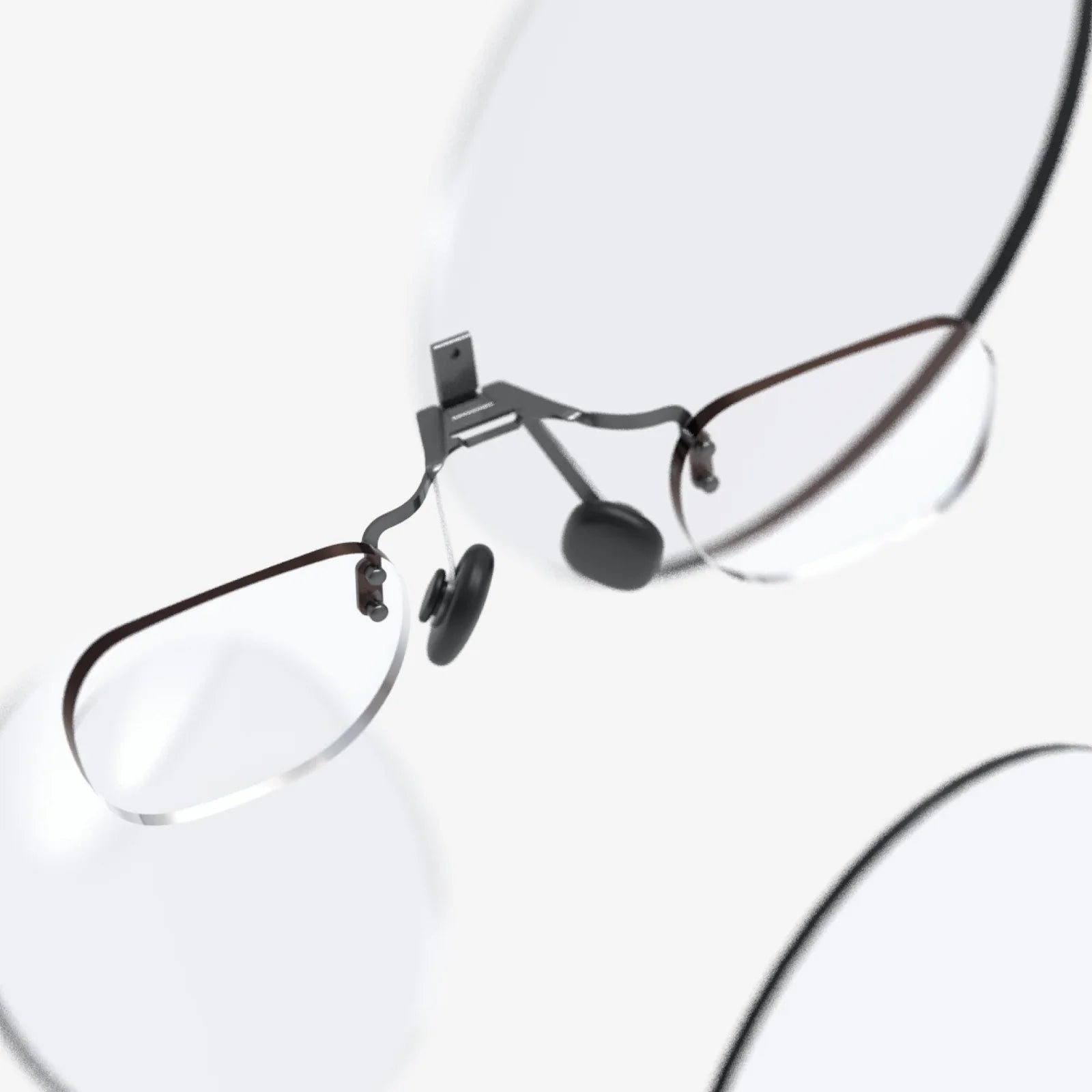
Imagine glancing at a street sign and instantly seeing translated text, looking at a complex engine and having a schematic diagram appear over it, or watching a recipe materialize right on your countertop as you cook. This is no longer the stuff of science fiction; it’s the burgeoning reality made possible by a remarkable piece of technology: the AR attachment for eyeglasses. This unassuming innovation is poised to become the most personal and integrated computing device we’ve ever known, transforming the familiar frames on your face into a powerful portal to an augmented world.
Beyond the Headset: A Discreet Computing Revolution
For years, the promise of augmented reality has been tethered to the concept of cumbersome headsets, virtual reality helmets, or unwieldy goggles that isolate the user from their environment. While powerful, these devices often create a barrier to social interaction and everyday use. The AR attachment for standard eyeglasses shatters this paradigm. Instead of replacing your vision, it enhances it. Instead of being a separate device you wear for specific tasks, it becomes a seamless part of your daily attire, as natural and forgettable as your prescription lenses.
This shift from a dedicated head-mounted display to an attachment is profound. It represents a move towards ambient computing, where technology fades into the background of our lives, providing information and functionality only when we need it, without demanding our full attention. The goal is not to immerse us in a digital world but to enrich our existing physical one with a delicate layer of useful data.
Deconstructing the Magic: How These Attachments Work
The engineering behind these tiny projectors is a marvel of miniaturization. While designs vary, most systems rely on a core set of components working in concert.
- The Micro-Projector: This is the heart of the device. Using technologies like LCoS (Liquid Crystal on Silicon) or MicroLED, these tiny, energy-efficient projectors generate the digital images that will be superimposed onto your field of view.
- The Waveguide or Combiner: This is the true magic trick. This optical element, often a thin, transparent piece of glass or plastic with microscopic structures etched into it, is responsible for directing the light from the projector into your eye. It acts like a clever mirror, bouncing the image off its internal surfaces until it is aligned with your natural vision, all while allowing ambient light to pass through so you can see the real world clearly.
- The Processing Unit: The computational brain of the operation is typically housed in a small, separate module that can clip onto an eyeglass arm or be carried in a pocket. This unit contains the processor, battery, wireless connectivity chips (like Bluetooth and Wi-Fi), and sensors. These sensors are critical—including accelerometers, gyroscopes, and sometimes cameras—to understand the world in front of you and anchor digital content precisely within it.
- Control Interface: Interacting with a screen floating in front of your eye requires novel input methods. Many systems use a simple touchpad on the arm of the glasses for swiping and tapping. Others employ voice commands for a hands-free experience, and the most advanced are developing gesture recognition, allowing you to manipulate virtual objects with subtle finger movements.
A World of Applications: More Than Just Novelty
The potential uses for this technology extend far beyond flashy demos and gaming. They promise to revolutionize numerous professional fields and enhance daily life.
Professional and Industrial Empowerment
In hands-on professions, the ability to access information without looking down at a manual or screen is a game-changer.
- Field Technicians & Engineers: A technician repairing a complex piece of machinery can see a exploded-view diagram overlaid on the actual equipment, highlighting the specific part and providing torque specifications. An engineer on a construction site can view architectural plans and BIM data superimposed onto the unfinished structure.
- Healthcare & Medicine: Surgeons could have vital signs, ultrasound images, or pre-op scans displayed in their periphery during a procedure. Medical students could practice procedures on augmented reality cadavers. Nurses could have patient information and medication dosages instantly available during rounds.
- Logistics and Warehousing: Warehouse pickers could see the most efficient route through the aisles with digital arrows on the floor and have item locations and quantities highlighted on the shelves, dramatically speeding up fulfillment and reducing errors.
Everyday Life Enhancement
The benefits aren't confined to the workplace. This technology can seamlessly integrate into our personal routines.
- Navigation: Turn-by-turn directions can be painted onto the road in front of you, allowing you to navigate a new city without constantly staring at your phone.
- Language Translation: Look at a restaurant menu in a foreign language, and the translated text appears right next to the original, in real-time. This could demolish language barriers for travelers and immigrants alike.
- Accessibility: For individuals with low vision, the system could highlight curb edges, amplify text on signs, or identify and label objects in their path. For those who are hard of hearing, real-time speech-to-text transcription could be displayed, captioning conversations as they happen.
- Interactive Learning: A student learning astronomy could point their gaze at the night sky and see constellations labeled. A cooking enthusiast could follow a recipe with each step visually annotated on their ingredients and utensils.
Navigating the Challenges: The Road to Ubiquity
Despite the exciting potential, several significant hurdles must be overcome before these devices become as common as smartphones.
- Battery Life and Form Factor: The eternal struggle of mobile tech. Projecting images is power-intensive, and the processing unit needs to be both small and powerful with enough battery to last a full day. Advances in chip efficiency and battery technology are crucial.
- Display Clarity and Field of View (FOV): Early systems often suffer from a limited field of view—like looking through a small window—and issues with brightness, contrast, and resolution. The digital image must be crisp, bright enough to see in daylight, and blend naturally with the real world without causing eye strain.
- The Social Hurdle: How will society adapt to people who appear to be staring into space while interacting with a digital interface? Social acceptance is key. The discreet nature of the attachment, which is far less obvious than a full headset, is a major step in the right direction.
- Privacy and Security: Devices with always-on cameras and sensors raise legitimate privacy concerns. Clear, transparent policies on data collection, storage, and usage, along with physical indicators like LED lights showing when the camera is active, will be non-negotiable for public trust.
The Future is Clear: What Lies Ahead for AR Attachments
The trajectory of this technology points toward even greater integration. We can anticipate a future where the processing module shrinks to the point of being embedded entirely within the eyeglass frame itself, powered by all-day batteries. Display technology will advance to offer a wider, more immersive field of view with photorealistic digital overlays. Most importantly, the killer application—the one thing everyone will want to use it for—has likely yet to be invented, and it will be the catalyst for mass adoption.
This evolution will move us from a world where we actively use computers to one where computing is an ambient utility, a layer of intelligence woven into the very fabric of our perception. It promises a future where our tools understand our context and intentions, providing information not on a screen we have to hold, but within the world we are already looking at.
We stand on the precipice of a fundamental shift in human-computer interaction. The humble eyeglass, a tool for clear sight for centuries, is being reimagined as the most intuitive display ever created. It’s a technology that doesn’t ask you to look down, but to look up and see your world, amplified. The next time you put on your glasses, consider that soon, they might not just help you see the world more clearly—they might help you understand it completely.
Share:
AI Virtualization: The Invisible Engine Reshaping Our Digital World
3D and 5D Reality: Navigating the Shift in Human Consciousness