


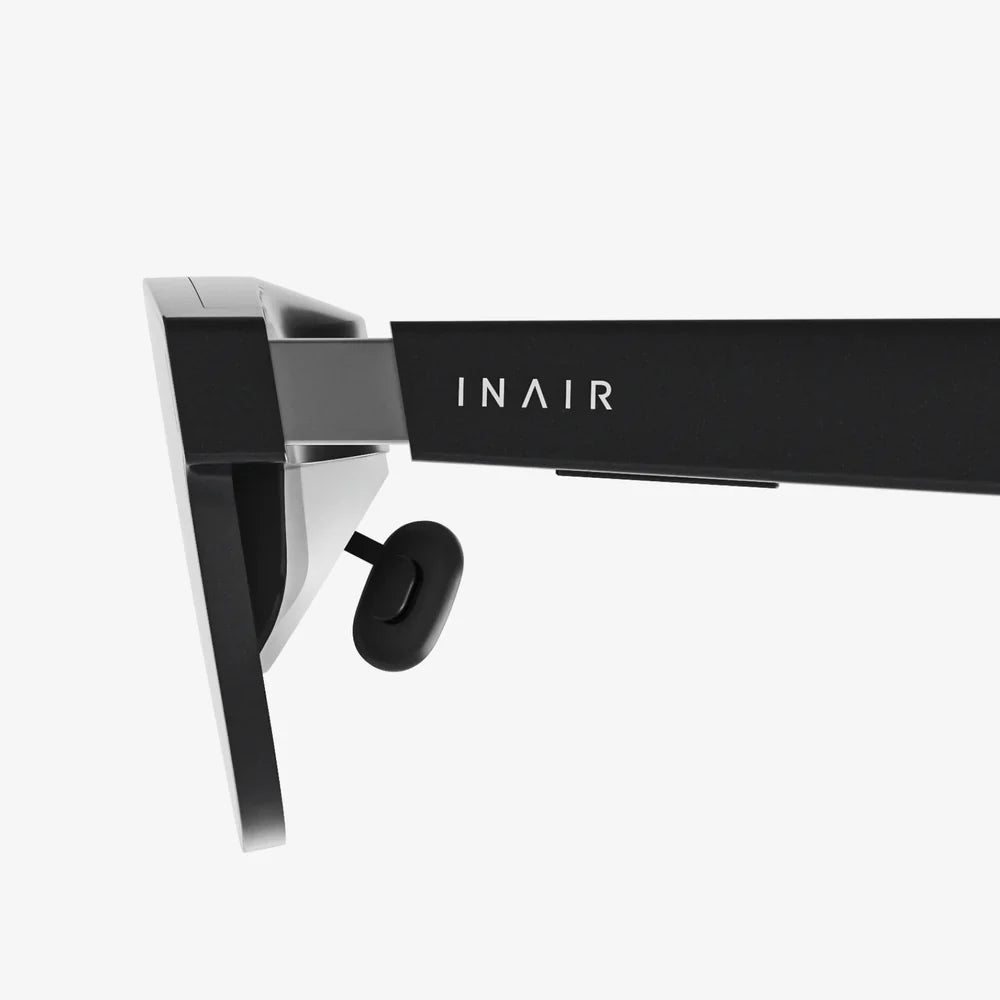
Imagine looking at a city street and seeing historical facts pop up next to ancient buildings, following a floating navigation arrow to your destination, or having a video call with a colleague who appears to be sitting across from you at the café table. This is no longer the stuff of science fiction. The seamless merger of the digital and physical worlds is arriving not through bulky, isolating headsets, but through a subtle, elegant, and profoundly accessible technology: the AR attachment for glasses. This revolutionary approach is poised to democratize augmented reality, transforming the familiar frames on your face into a gateway to an enriched reality.
Beyond the Hype: Defining the AR Attachment Ecosystem
At its core, an AR attachment for glasses is a self-contained hardware module that clips or magnetically attaches to a standard pair of prescription or non-prescription eyewear. Unlike dedicated AR glasses, which are a complete, all-in-one system, an attachment is a modular component that adds advanced computational and display capabilities to a simple pair of frames. This modularity is its greatest strength, offering a level of flexibility and user choice previously unavailable in the wearables market.
The typical attachment houses a miniature projector, a series of waveguides or combiners (essentially tiny, transparent screens that reflect images into your eye), a battery, a processor, sensors like accelerometers and gyroscopes for tracking head movement, and often outward-facing cameras for capturing the environment. When engaged, the projector beams information onto the combiners, which then superimpose that digital imagery onto your view of the real world. The result is a stable, interactive digital overlay that feels intrinsically part of your surroundings.
The Architectural Breakthrough: How These Attachments Work
The magic of these devices lies in their optical engineering. The primary challenge has always been how to place a bright, high-resolution digital image in front of the user's eye without obstructing their natural vision. Early head-mounted displays were often cumbersome and offered a limited field of view.
Modern AR attachments utilize several sophisticated techniques:
- Waveguide Technology: This is the most common method in high-end attachments. Light from the micro-projector is coupled into a thin, transparent glass or plastic substrate. It then travels along this substrate through a process called total internal reflection before being decoupled and directed toward the eye. This allows for a very thin and lightweight form factor.
- Birdbath Optics: This design uses a beamsplitter cube and a spherical mirror (the "birdbath") to fold the optical path. While potentially offering brighter images and a wider field of view, it can sometimes result in a slightly bulkier module compared to waveguides.
- Free-Form Combiners: These are complex, custom-shaped optical surfaces that precisely direct light from the projector into the eye. They allow designers more freedom to integrate the optics into stylish form factors.
This focus on miniaturization and optical efficiency is what differentiates the current generation of attachments from the prototypes of the past. They are designed to be worn all day, shifting augmented reality from a dedicated activity to a constant, ambient enhancement.
A World Enhanced: Transformative Use Cases and Applications
The potential applications for this technology span nearly every facet of professional and personal life. By adding a contextual information layer to our reality, these attachments promise to make us more efficient, knowledgeable, and connected.
Revolutionizing the Professional Workspace
In industrial and field service settings, the impact is immediate and profound. A technician repairing a complex piece of machinery can have schematics, torque specifications, and animated repair guides overlaid directly onto the equipment they are working on. Their hands remain free, and they no longer need to constantly look down at a tablet or manual. Similarly, architects and construction managers can walk through a building site and see the proposed digital blueprint superimposed onto the unfinished structure, identifying potential clashes or verifying measurements in real-time. For logistics and warehouse workers, order-picking becomes incredibly efficient as navigation arrows point the way and item information highlights the exact shelf and bin needed.
Redefining Social Connection and Communication
AR attachments have the potential to dissolve the barriers of physical distance. Video calls could transition from a flat screen on your phone to a life-sized, spatially aware hologram of the person in your room. You could share a 3D model with a remote colleague and both manipulate it together as if it were physically present. This creates a sense of co-presence and shared space that is impossible to achieve with current video conferencing tools. Social media and notifications could also become ambient, appearing contextually rather than demanding your full attention on a phone screen.
Unlocking New Dimensions of Learning and Exploration
For education and tourism, the technology is a game-changer. Imagine a student studying astronomy by having the solar system orbit around their classroom, or a medical student practicing anatomy on a detailed, interactive hologram of the human body. A tourist walking through Rome could see the Colosseum restored to its former glory, with virtual citizens in togas milling about. Museum exhibits could come alive, with artifacts explaining their own history. This contextual, immersive learning is far more engaging and memorable than reading a placard or watching a video.
Enhancing Daily Life and Accessibility
The benefits extend into everyday navigation, fitness, and accessibility. Turn-by-turn directions can be painted onto the street itself, eliminating the need to hold a phone while walking or cycling. Runners could see their pace and heart rate floating in their periphery. For individuals with visual impairments, attachments could highlight curbs, identify objects, and read text from signs aloud, providing a powerful new layer of environmental awareness and independence.
The Modular Advantage: Why Attachments Are Winning the Race
The choice between dedicated AR glasses and an AR attachment is fundamental. While all-in-one glasses offer integration, the attachment model presents several compelling advantages that address key barriers to mass adoption.
Prescription Freedom and Style: The greatest hurdle for dedicated smart glasses is the vast diversity of human vision and personal style. People are fiercely loyal to their eyewear, which is a deeply personal expression of identity. An attachment bypasses this entirely. Users can keep their favorite frames, their precise prescription lenses, and their photochromatic transitions. The AR module becomes an accessory they add when they want its functionality, not a compromise they have to make with their vision or appearance.
Rapid Technological Iteration: The technology inside these attachments—processors, displays, sensors—is evolving at a breakneck pace. If this tech is built into a $2,000 pair of glasses, the entire unit becomes obsolete in a few years. With an attachment model, users can upgrade the computational "brain" of their AR system without replacing their expensive prescription lenses and frames. This extends the product's lifespan and protects the consumer's investment.
Reduced Cost and Lower Risk: Developing a full pair of smart glasses is incredibly expensive, and those R&D costs are passed on to the consumer. An attachment focuses the cost on the technology itself, potentially making high-end AR more affordable. For the manufacturer, it also reduces risk by catering to a much larger market of existing glasses wearers without needing to solve the intractable problems of prescription and style.
Navigating the Hurdles: Challenges on the Path to Adoption
Despite the exciting potential, the path forward for AR attachments is not without its obstacles. Technical, social, and ethical challenges remain.
Technical Limitations: Battery life is a perennial challenge for any wearable. Balancing all-day usage with a form factor that is small and light enough to clip to glasses is difficult. Display brightness must be sufficient to be visible in bright sunlight without consuming too much power. The field of view—how much of your vision can be filled with digital content—is still limited in current models, creating a somewhat "letterbox" effect. Furthermore, achieving precise spatial mapping and persistent occlusion (where digital objects convincingly hide behind real-world ones) requires immense computational power and sophisticated algorithms.
The Social Acceptance Factor: Any new wearable technology faces a social hurdle. How will people react to someone wearing a device that may include a camera? Privacy concerns are paramount. Clear and intuitive indicators that the camera is active will be essential to build public trust. Furthermore, the design must avoid a overly technical or "cyborg" aesthetic to achieve widespread social acceptance. The goal is to be unnoticeable, not a conversation starter for the wrong reasons.
Software and Developer Ecosystem: The hardware is only as good as the software it runs. Building a robust ecosystem of apps and developers is critical. This requires powerful and easy-to-use software development kits (SDKs) that allow creators to build immersive AR experiences that feel native to the platform. The killer app—the one experience that makes the device a must-have—has yet to be universally identified.
Glimpsing the Horizon: The Future of Augmented Attachments
The evolution of this technology is pointing towards an even more integrated and seamless future. We can expect attachments to become lighter, thinner, and more powerful with each generation. Advances in battery technology, such as solid-state batteries, could finally deliver all-day battery life in a tiny package.
Perhaps the most exciting frontier is the move towards more contextual and intuitive interfaces. The future of interaction will likely move beyond simple hand gestures and voice commands. Emerging technologies like subvocal recognition (reading the nerve signals sent to your vocal cords when you talk to yourself) and advanced neural interfaces could allow for silent, private control of the device. The system will learn from your habits, preferences, and environment, proactively offering information and tools before you even know you need them.
Ultimately, the success of the AR attachment will be measured by its ability to fade into the background. The technology itself will become invisible, leaving only the magic of an enhanced reality. It won't be about the device on your glasses; it will be about the effortless way you can connect, create, and understand the world around you.
The frames on your face have always been a window to the world. Now, with a simple click, they are becoming a dynamic canvas, a personal assistant, and a portal to a universe of information and experience. This isn't just an upgrade to your glasses; it's the beginning of a fundamental shift in how we perceive and interact with reality itself, and it's an evolution you can literally see coming.
Share:
What is the Future of Wireless Technology: A World Beyond the Cable
AI Simple Definition: Unpacking the Hype to Understand How It Actually Works