


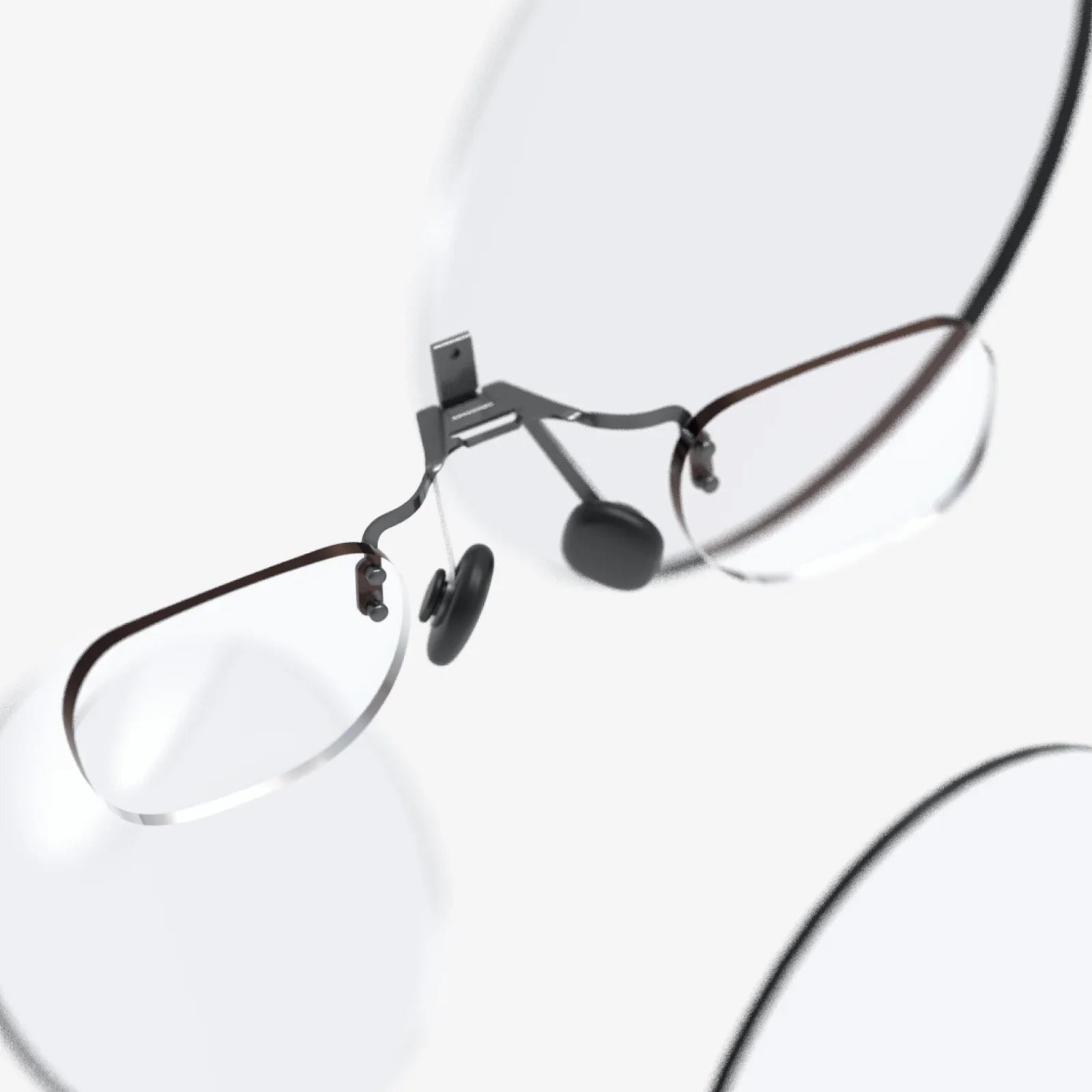
Imagine a world where information doesn’t live on a screen in your hand or on your desk, but floats seamlessly in the air around you, integrated into the very fabric of your environment. Your morning run stats hover in the corner of your vision, a recipe’s instructions are overlaid on the mixing bowl in your kitchen, and a navigational arrow is painted onto the sidewalk ahead of you. This is not a distant science fiction fantasy; it is the imminent future being unlocked by the rapid evolution of AR digital glasses. This technology represents a paradigm shift in human-computer interaction, promising to dissolve the barrier between the digital and the physical, fundamentally altering our daily lives in ways we are only beginning to comprehend.
Beyond the Hype: Defining the True Nature of AR Glasses
To understand the revolution, we must first move beyond the simplistic comparisons to smartphones or virtual reality headsets. Augmented Reality (AR) digital glasses are a distinct category of wearable computing. Their primary function is not to transport you to a fully digital world (Virtual Reality) or to simply display notifications like a smartwatch (a common feature of early smart glasses). Instead, their core purpose is to augment your perception of the real world by superimposing contextually relevant digital information, objects, and experiences onto your field of view.
The magic lies in a sophisticated combination of hardware and software. Advanced micro-displays, often using technologies like waveguides or micro-LEDs, project images directly onto the lenses. A suite of sensors, including high-resolution cameras, depth sensors, gyroscopes, and accelerometers, constantly scans the environment. This sensor data is processed by onboard chipsets in real-time to understand the geometry of the space, track the user’s precise head and eye movements, and anchor digital content persistently to physical locations. This creates the illusion that the digital and physical coexist, enabling interactions that feel intuitive and magical.
The Architectural Pillars of Augmented Vision
The functionality of AR glasses rests on several critical technological pillars, each advancing at a breakneck pace.
Visual Fidelity and Display Technology
The holy grail is achieving high visual fidelity in a small, lightweight, and power-efficient form factor. Early versions suffered from a narrow field of view, making digital objects feel small and confined, or were too bulky for all-day wear. Modern advancements in optical waveguides—thin, transparent lenses that bend light from a micro-display into the user’s eye—are creating slimmer designs. breakthroughs in resolution and brightness are ensuring digital content is crisp, vibrant, and visible even in bright sunlight, a significant hurdle for transparent displays.
Spatial Mapping and Understanding
For digital content to feel real, it must understand and respect the physical world. This is achieved through simultaneous localization and mapping (SLAM) algorithms. SLAM allows the glasses to construct a 3D map of the environment on the fly, identifying surfaces like floors, walls, and tables. This enables a virtual cat to jump on your actual sofa or a large data visualization to be pinned to your office wall, remaining locked in place as you move around. This spatial awareness is the foundation for persistent AR, where experiences remain in the location you left them, waiting for your return.
Intuitive Interaction Paradigms
How do you interact with a interface that has no mouse or touchscreen? AR glasses are pioneering new, more natural forms of interaction. Voice commands, powered by increasingly sophisticated AI assistants, are a primary method. Hand-tracking technology allows users to pinch, select, and manipulate virtual objects with fine-grained gestures as if they were physically there. Perhaps the most futuristic is gaze-tracking, where the system understands where you are looking, enabling selection through dwell time or subtle intent. These multimodal inputs combine to create a frictionless and intuitive user experience.
Transforming the Professional Landscape
While consumer applications capture the imagination, the most immediate and profound impact of AR glasses is occurring in enterprise and industrial settings, where they solve concrete problems and deliver a clear return on investment.
The Future of Field Service and Maintenance
Imagine a field technician arriving to repair a complex, unfamiliar piece of machinery. Instead of fumbling with a physical manual or a tablet, their AR glasses overlay animated, step-by-step repair instructions directly onto the equipment. They can see internal parts highlighted, receive real-time guidance from a remote expert who can draw annotations into their field of view, and access schematics hands-free. This reduces errors, slashes training time, and dramatically improves first-time fix rates, saving companies millions.
Revolutionizing Design and Manufacturing
In architecture and construction, teams can walk through a full-scale, holographic model of a building before a single brick is laid, identifying design flaws and spatial issues early. On the factory floor, assembly line workers can see exactly which part goes where, with quality control checks automated by AR systems that compare the assembled product to its digital twin. This digital thread, connecting the design to the physical outcome, enhances precision and efficiency.
Healthcare and Medical Visualization
For surgeons, AR glasses can project critical patient vitals, ultrasound data, or 3D anatomical models directly into their visual field during a procedure, eliminating the need to look away at monitors. This keeps their focus entirely on the patient. Medical students can practice complex procedures on detailed holograms, and nurses can use them to accurately locate veins for injections, improving patient care and safety.
Weaving AR into the Fabric of Daily Life
As the technology matures, becomes more affordable, and its form factor approaches that of regular eyewear, AR glasses will begin their migration into the consumer mainstream, redefining everyday activities.
Navigation and Contextual Awareness
Turn-by-turn navigation will evolve from a 2D map on a phone to giant, floating arrows and pathways painted onto the streets. Walking through a new city, you could glance at a restaurant and instantly see its reviews and menu highlights. Historical landmarks could come alive with recreations of past events, transforming tourism into an immersive, educational experience.
Redefining Social Connection and Communication
Remote communication will leap beyond flat video calls. With AR glasses, a friend or family member living across the globe could appear as a realistic hologram sitting on your couch, able to share and interact with virtual objects in your shared space. This creates a powerful sense of presence and co-presence, making distance feel less significant.
Personalized Entertainment and Gaming
The success of mobile AR games has given us a glimpse of the potential. AR glasses will take this to another level, enabling persistent game worlds that exist in your local park or allowing you to watch a sports game with live stats and replays hovering over your coffee table. Your entire environment becomes a playground for entertainment.
Navigating the Inevitable Challenges
This transformative future is not without its significant hurdles and societal questions that must be addressed thoughtfully.
The Privacy Conundrum
A device that is always on, always seeing, and always listening presents an unprecedented privacy challenge. The constant capture of first-person video and audio data raises profound questions about surveillance, data ownership, and consent. Clear, transparent, and robust ethical frameworks and regulations must be established to prevent misuse and protect individual privacy before these devices become ubiquitous.
The Social Acceptance Hurdle
Wearing technology on your face is a very personal and public act. Early adopters may face social stigma or be perceived as rude if they are interacting with a digital interface during a conversation. The design must evolve to include clear social signals—like a visible "activity light"—to indicate when recording or processing is happening, helping to navigate new social etiquette.
Battery Life and Connectivity
For all-day use, AR glasses will require immense computational power while remaining energy-efficient. Pushing complex rendering to the cloud requires ultra-low-latency, high-bandwidth connectivity like 5G and eventually 6G. Solving the power and connectivity equation is essential for a smooth, untethered experience.
The Road Ahead: From Tool to Extension of Self
The development of AR glasses is an iterative journey. The first generations will likely be companion devices, used for specific tasks rather than all-day wear. They will gradually become more powerful, more stylish, and more integrated with the AI ecosystems that power them. The ultimate goal is a device that feels less like a piece of technology and more like a seamless extension of our own cognition—a silent partner that enhances our abilities without demanding our attention.
We are standing at the precipice of the next major computing shift, one as significant as the transition from mainframes to personal computers, or from PCs to smartphones. AR digital glasses have the potential to democratize information, enhance human capability, and deepen our connection to the world around us. They challenge us to reimagine the very nature of reality, asking not what we can see on a screen, but what we can create when the screen itself disappears. The future is not something we will look at; it is something we will look through.
Share:
Developing Virtual Reality Applications Foundations of Effective Design for Immersive Success
AR Glasses for Reading Books: The Ultimate Guide to the Future of Literature