


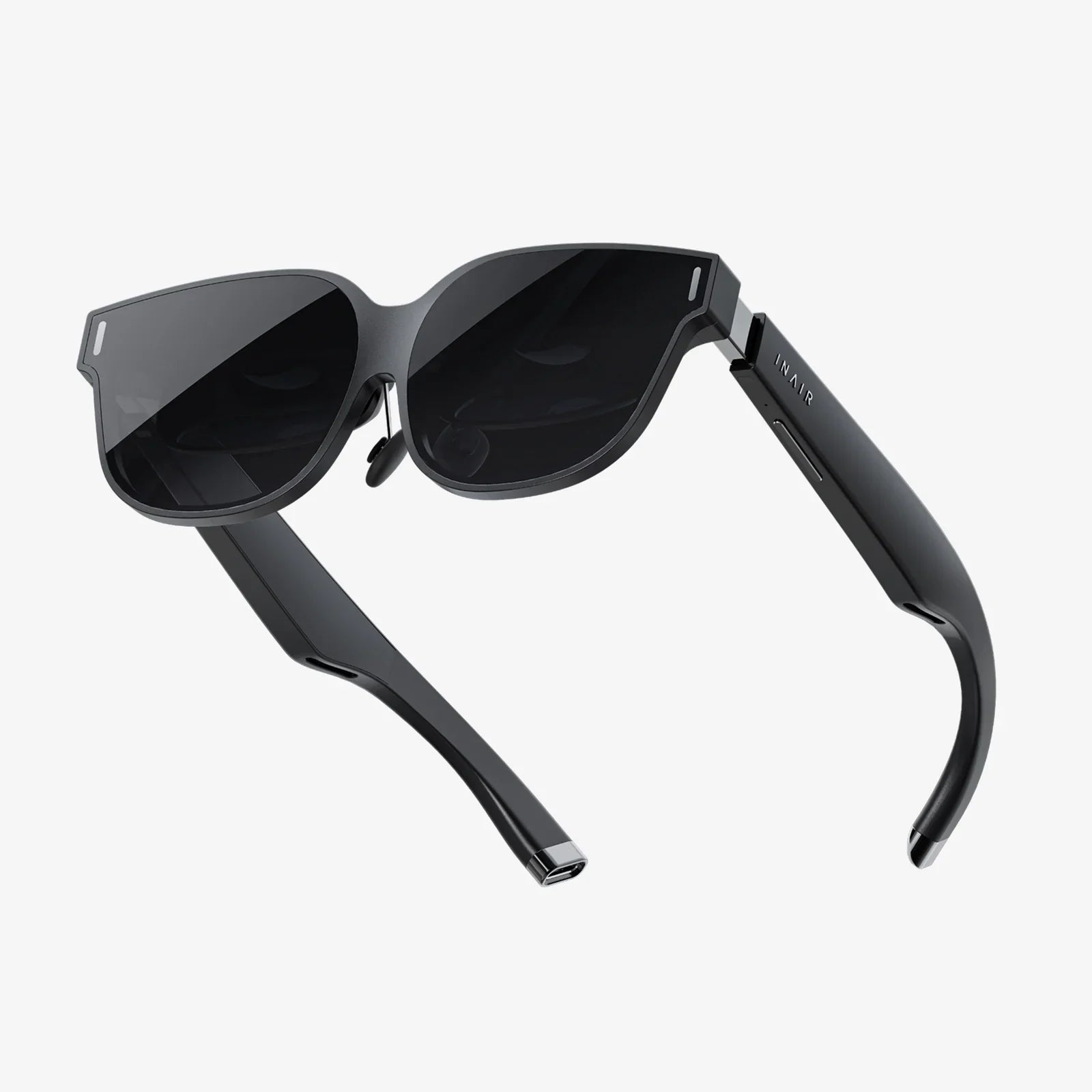
Imagine a world where information doesn't reside on a screen in your pocket but is elegantly woven into the very fabric of your perception. A world where directions appear as glowing arrows on the pavement, a foreign language is instantly translated onto a restaurant menu before your eyes, and a complex engine part you're repairing is overlaid with animated instructions. This is not a distant science fiction fantasy; it is the imminent future being unlocked by a revolutionary piece of technology. To understand this shift, we must first grapple with the core concept: the true AR glasses meaning. It’s a term that signifies far more than a wearable gadget; it represents a fundamental evolution in how we interact with both the digital universe and our physical environment, promising to redefine human-computer interaction and blur the lines between what is real and what is digitally enhanced.
Beyond the Hype: A Technical Deconstruction
At its most fundamental level, the meaning of AR glasses is rooted in a sophisticated symphony of hardware and software designed to augment—not replace—your reality. Unlike Virtual Reality (VR) headsets that transport you to a completely digital world, AR glasses keep you grounded in your surroundings while superimposing computer-generated information onto your field of view. This is achieved through a complex interplay of components.
The Core Technologies
Central to their function are micro-displays, tiny projectors that beam images directly towards the user's eyes. These images are then directed onto the lenses, which are not mere pieces of glass but advanced optical waveguides or combiners. These specialized lenses act as a magical canvas, merging the light from the real world with the digital light from the projectors, creating the final, composite image that the user perceives.
This process would be disorienting and useless without precise spatial awareness. This is where a suite of sensors comes into play. Cameras, accelerometers, gyroscopes, and often LiDAR scanners work in concert to perform simultaneous localization and mapping (SLAM). In essence, these glasses are constantly scanning the environment, building a 3D map of the space, and understanding their precise position and orientation within it. This allows digital objects to be "locked" in place in the real world—a virtual pet sitting convincingly on your real coffee table or a navigation pin steadfastly hovering over a building down the street.
Finally, all this data is processed by onboard chipsets, the brains of the operation, which handle the immense computational load of rendering graphics, running complex algorithms, and ensuring a seamless, low-latency experience. The ultimate goal of this entire technological orchestra is to achieve what pioneers call "pervasive computing" or "calm technology"—where the computer recedes into the background, providing information precisely when and where it's needed, without demanding our constant attention.
A Spectrum of Augmentation: From Assisted Reality to True AR
The term "AR glasses" often encompasses a spectrum of devices with varying capabilities. On one end, there are simpler devices often referred to as "Assisted Reality" or "monocular" glasses. These typically feature a small, transparent display in one eye, showing basic information like text messages, notifications, or simple diagrams. They are designed for hands-free task completion in fields like logistics and manufacturing, offering a constant heads-up display without full immersion.
On the other end of the spectrum lies the dream of full, immersive AR. These are binocular devices that offer a wide field of view, rich color, and deep integration with the environment, allowing for complex 3D models to be placed and interacted with. They represent the full realization of the AR glasses meaning, where the digital augmentation is so convincing and responsive that it feels like a natural part of reality. The industry is on a relentless march from the former towards the latter, with each technological breakthrough bringing us closer to that seamless blend.
Transforming Industries: The Practical Power of Augmented Vision
The theoretical meaning of AR glasses becomes profoundly tangible when we examine their practical applications, which are already revolutionizing numerous professional fields.
Revolutionizing the Frontline Workforce
In manufacturing and complex machinery repair, the meaning of AR glasses is expertise, democratized. A technician can look at a malfunctioning engine and see digital annotations highlighting specific components, step-by-step repair instructions floating in their periphery, and even connect with a remote expert who can "see what they see" and draw guidance directly into their field of view. This reduces errors, slashes training time, and minimizes downtime.
The Future of Healthcare and Surgery
In healthcare, the implications are staggering. Surgeons can wear AR glasses to visualize a patient's anatomy—such as CT scans or MRI data—precisely overlaid on their body during a procedure, effectively granting them X-ray vision. Medical students can practice complex procedures on detailed, interactive holograms. Nurses can have instant access to patient vitals and records without looking away from the person they are caring for, enhancing both efficiency and the human connection.
Redefining Design and Architecture
For architects and interior designers, AR glasses are the ultimate visualization tool. They can walk through a physical construction site and see the intended 3D model of the building perfectly aligned with the unfinished structure, identifying potential issues long before they become costly problems. Clients can tour a fully furnished virtual version of their future home, making design choices with confidence. This transforms abstract blueprints into experiential reality.
New Frontiers in Training and Education
The educational potential is boundless. Imagine history students walking through an ancient Roman forum, seeing it rebuilt in glorious detail around them. Chemistry students could manipulate complex molecular structures with their hands. This shift from passive learning to active, experiential exploration could fundamentally change pedagogy, making learning an immersive adventure.
The Human and Societal Dimension: A Double-Edged Sword
As with any transformative technology, the widespread adoption of AR glasses carries significant societal implications that我们必须谨慎考虑. The meaning of AR glasses is not purely utopian; it is a complex interplay of incredible potential and profound challenges.
The Privacy Paradigm Shift
The most pressing concern is privacy. Glasses with always-on cameras and sensors raise obvious questions about surveillance and data collection. Will we be constantly recording our interactions? How will that data be stored, owned, and used? The concept of consent in public spaces becomes murky. New social norms and robust legal frameworks will need to evolve to prevent a dystopian future of unwanted recording and facial recognition.
The Filtered Reality Problem
Another critical issue is the potential for these devices to create a deeply personalized, and therefore fractured, reality. If my AR glasses can filter out advertisements, change the appearance of people and buildings, and show me only the information that aligns with my preferences, what happens to our shared experience of reality? Could this lead to further social polarization, where we all literally see the world through different, algorithmically-curated lenses? The risk of creating echo chambers that are not just metaphorical but visual is a serious one.
Blurring the Lines of Human Interaction
On a personal level, how will constant digital augmentation affect human connection? If someone is wearing AR glasses during a conversation, are they truly present, or are they distracted by incoming emails and notifications floating in their vision? The etiquette of wearing such devices in social settings will need to be negotiated, much like the smartphone etiquette we are still grappling with today.
The Road Ahead: From Prototype to Paradigm
The current generation of devices is still tackling significant hurdles. For AR glasses to achieve mass consumer adoption, they must overcome the challenges of miniaturization, battery life, connectivity, and computational power. The ideal pair of AR glasses should be as socially acceptable and comfortable to wear as a standard pair of eyeglasses, a goal that requires breakthroughs in materials science, optics, and low-power computing.
Furthermore, for the ecosystem to thrive, a robust software platform is essential. This includes development tools for creators, app stores, and secure cloud services. The true meaning of AR glasses will be unlocked not just by the hardware, but by the millions of developers who will dream up applications we haven't even begun to imagine.
Many believe the ultimate endpoint is not a separate device, but the gradual integration of these capabilities into standard prescription eyewear, making augmented perception an effortless, always-available facet of human existence. This path points towards a future where the question is not whether you use AR, but how you choose to layer your reality.
The journey to understand the full AR glasses meaning is to embark on a exploration of a new sensory layer for humanity. It is a technology that holds the mirror to our greatest aspirations for knowledge and efficiency, while also forcing us to confront our deepest anxieties about privacy and our place in a technologically mediated world. It is not merely about the device on your face, but about the new reality it will help us all build—a reality that is richer, more informed, more efficient, and infinitely more complex. The next chapter of human-computer interaction is being written not on our screens, but directly onto our world, and it promises to change everything.
Share:
Smart View Mirror Screen Not Working: A Comprehensive Troubleshooting and Repair Guide
Tiny Portable Computer: The Pocket-Sized Revolution Reshaping Our Digital Lives