


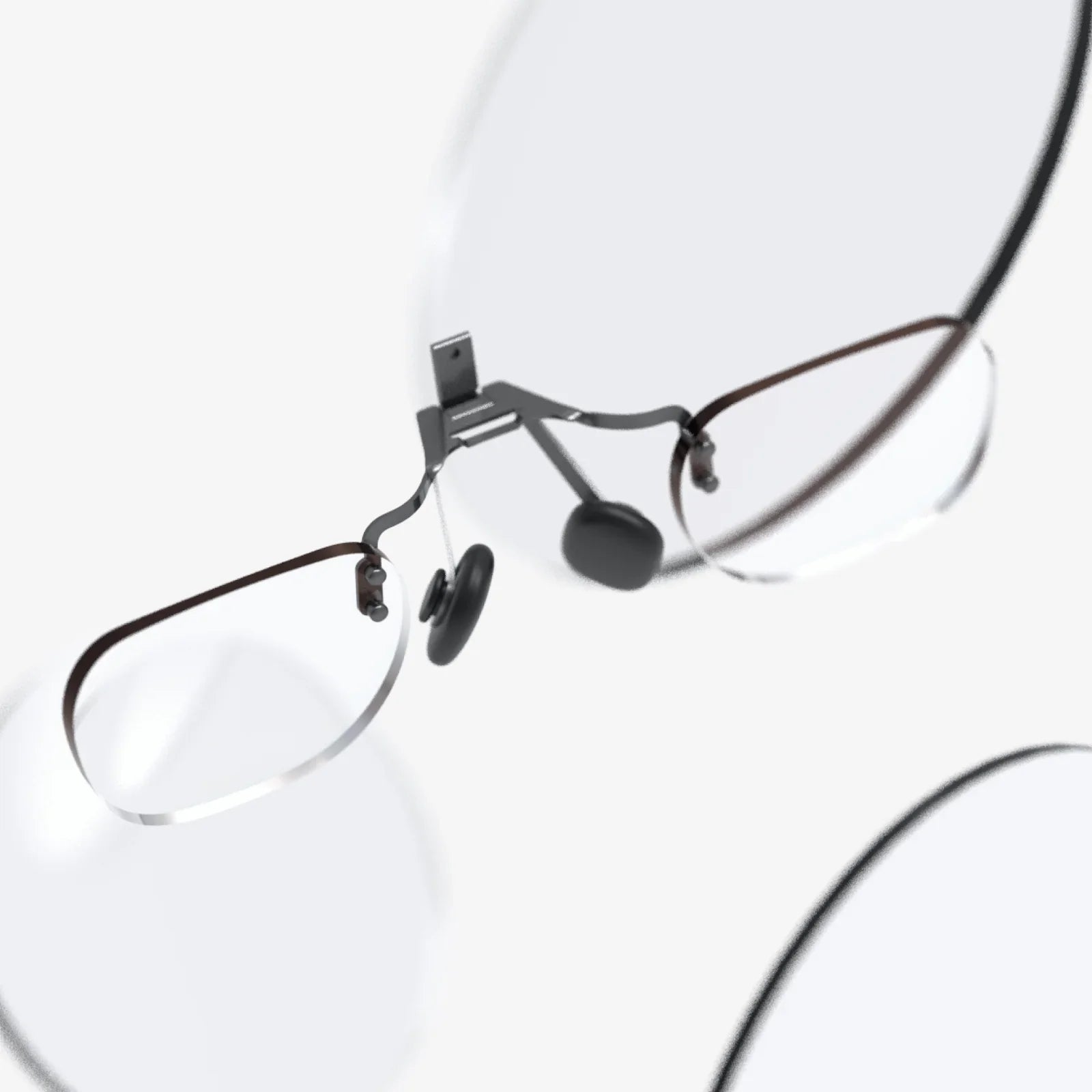
Imagine a world where digital information doesn’t live on a screen in your hand, but is seamlessly woven into the fabric of your reality. Directions float on the pavement ahead of you, a recipe hovers next to your mixing bowl without a smudge, and a colleague from another continent stands in your living room, pointing to a 3D model you’re both designing. This isn't a glimpse into a distant future; it's the promise being delivered today. The era of accessible augmented reality is dawning, and it begins not with a shout, but with a quiet, stylish revolution happening right before our eyes.
The Architectural Marvels in Your Frames
At first glance, the latest generation of devices might look like a particularly stylish pair of spectacles. The true magic, however, is hidden within the sleek frames, representing a monumental leap in miniaturization and optical engineering. Unlike their virtual reality counterparts, which seek to replace your world, these devices are designed to enhance it, and that presents a unique set of technological hurdles that have only recently been overcome.
The core challenge has always been the display. How do you project vivid, bright, high-resolution images onto transparent lenses without bulky components that block your view of the real world? The answer lies in advanced waveguide technology and miniature projectors. Tiny projectors, often using LEDs or lasers, beam light onto specially engineered lenses. These lenses, or waveguides, then use a combination of diffraction gratings, holographic optics, or reflective surfaces to "pipe" this light directly into your eyes. This creates the illusion that digital objects are existing at fixed points in your physical space, from text messages hovering near your doorframe to a life-sized dinosaur stomping through a park.
This optical sorcery is powered by a sophisticated blend of hardware. A constellation of inward and outward-facing cameras, along with depth sensors and inertial measurement units (IMUs), work in concert to understand both you and your environment. They map the room in real-time, understanding the geometry of surfaces, tracking the precise position and movement of your head and eyes, and anchoring digital content so it doesn't drift or jitter. All this processing happens with a level of efficiency that allows for all-day battery life, often managed by a compact companion device that fits in your pocket, handling the heavier computational loads.
Beyond Novelty: A Tool for Modern Life
The question on everyone's mind is: what can I actually do with them? The applications extend far beyond futuristic gaming and flashy filters, penetrating deep into the practicalities of work, learning, and daily convenience.
Revolutionizing the Professional Workspace
For the modern professional, these devices are a productivity powerhouse. Imagine architects and engineers walking clients through 3D building models superimposed onto a vacant lot. Surgeons can have vital signs and procedural guides visible during operations without looking away from the patient. Field technicians can see schematics and receive remote expert guidance overlaid directly on the malfunctioning machinery they are repairing, their hands remaining free to work. This constant access to contextual information eliminates the friction of switching between a physical task and a digital reference, dramatically reducing errors and increasing efficiency.
Transforming Learning and Exploration
Education ceases to be a passive experience. History students can witness historical events unfold around them in their classroom. Biology students can dissect a virtual frog or walk through a beating human heart, understanding scale and function in an intuitive way. Mechanics can learn to repair an engine by following animated instructions that highlight each specific bolt and component. This shift from abstract, 2D learning to immersive, 3D interaction caters to different learning styles and creates powerful, memorable experiences.
Redefining Social Connection and Navigation
Social interaction takes on a new dimension. Video calls are no longer confined to a rectangle on a laptop; the person you're speaking with can appear as a realistic avatar sitting across from you on your sofa, making conversations feel more natural and present. Navigation becomes intuitive, with giant floating arrows painted onto the street or subtle pathway highlights on the sidewalk guiding you to your destination, allowing you to explore a new city without ever staring down at a phone.
The Invisible Infrastructure: Spatial Computing
For this new reality to feel truly seamless, it requires a robust, invisible digital layer on top of our physical world—an concept often called the spatial web or spatial computing. This isn't built by any single company, but is an emerging framework of protocols and services.
At its heart is persistent cloud-anchored content. This means the digital objects and information placed in a location can be stored and experienced by anyone else who visits that spot. A restaurant's menu could float by its entrance, a museum could place informational placards next to each exhibit, and a community could leave virtual art installations in a public square. Your device becomes a window into this persistent digital layer, constantly syncing with the cloud to show you what's relevant in your immediate vicinity.
This ecosystem is fueled by powerful software development kits (SDKs) that allow creators to build experiences without needing to become experts in complex computer vision algorithms. These tools handle the heavy lifting of environmental understanding, letting developers focus on creating engaging content, from practical utilities to breathtaking artistic experiences.
Navigating the New Frontier: Challenges and Considerations
As with any transformative technology, its integration into society comes with a host of questions that we are only beginning to address.
Privacy and the Ethics of Data: Devices that see what you see and hear what you hear collect an unprecedented amount of data about your life, your habits, and your environment. The industry must adopt a paradigm of privacy-by-design, with clear, transparent policies on data collection, usage, and storage. Users must have ultimate control over their information.
The Social Contract: New etiquette norms will need to evolve. Is it rude to wear these during a dinner conversation? How do we indicate when we are recording our surroundings? Navigating these social nuances will be crucial for widespread acceptance.
Accessibility and the Digital Divide: Ensuring this technology is accessible to people with different abilities is paramount. Conversely, there is a risk that its cost could create a new digital divide, where only a privileged few have access to this enhanced layer of information and utility.
Safety and Security: Blending digital content with the real world introduces new safety concerns, from distracted pedestrians to the potential for malicious actors to create dangerous virtual obstacles in the real world. Robust security protocols are non-negotiable.
The Path Forward: From Prototype to Paradigm
We are at the very beginning of this journey. The current generation of devices are the pioneers—the equivalent of the first smartphones. They establish the core functionality and prove the concept is not only viable but desirable. The road ahead will be defined by rapid iteration.
We can expect future iterations to become even lighter, more power-efficient, and offer wider fields of view with higher resolution displays. Battery technology will improve, and more processing will be done on-device for lower latency. The most significant evolution will be in the development of the spatial web's ecosystem. As more developers and creators build for this platform, the "killer app"—the experience that makes the technology indispensable to the masses—will emerge, driving adoption forward at an exponential pace.
This isn't merely about a new gadget; it's about a fundamental shift in how we interact with information. It’s the next major computing platform, following the mainframe, the personal computer, and the smartphone. It promises to collapse the distance between the digital and the physical, making our interactions with technology more human, more intuitive, and more integrated into the flow of our lives.
The screen that has dominated our attention for decades is beginning to fade away, not into obscurity, but into the world around us. The boundary between what is real and what is digital is blurring, creating a new hybrid reality limited only by our imagination. The tools to step into this new layer of existence are no longer prototypes in a lab; they are here, waiting to be experienced, and they are quietly ushering in the next chapter of human-computer interaction.
Share:
AR Screen Protector: The Ultimate Guide to Clarity, Protection, and the Future of Display Technology
Most Exciting AR Glasses Applications Transforming Our World