


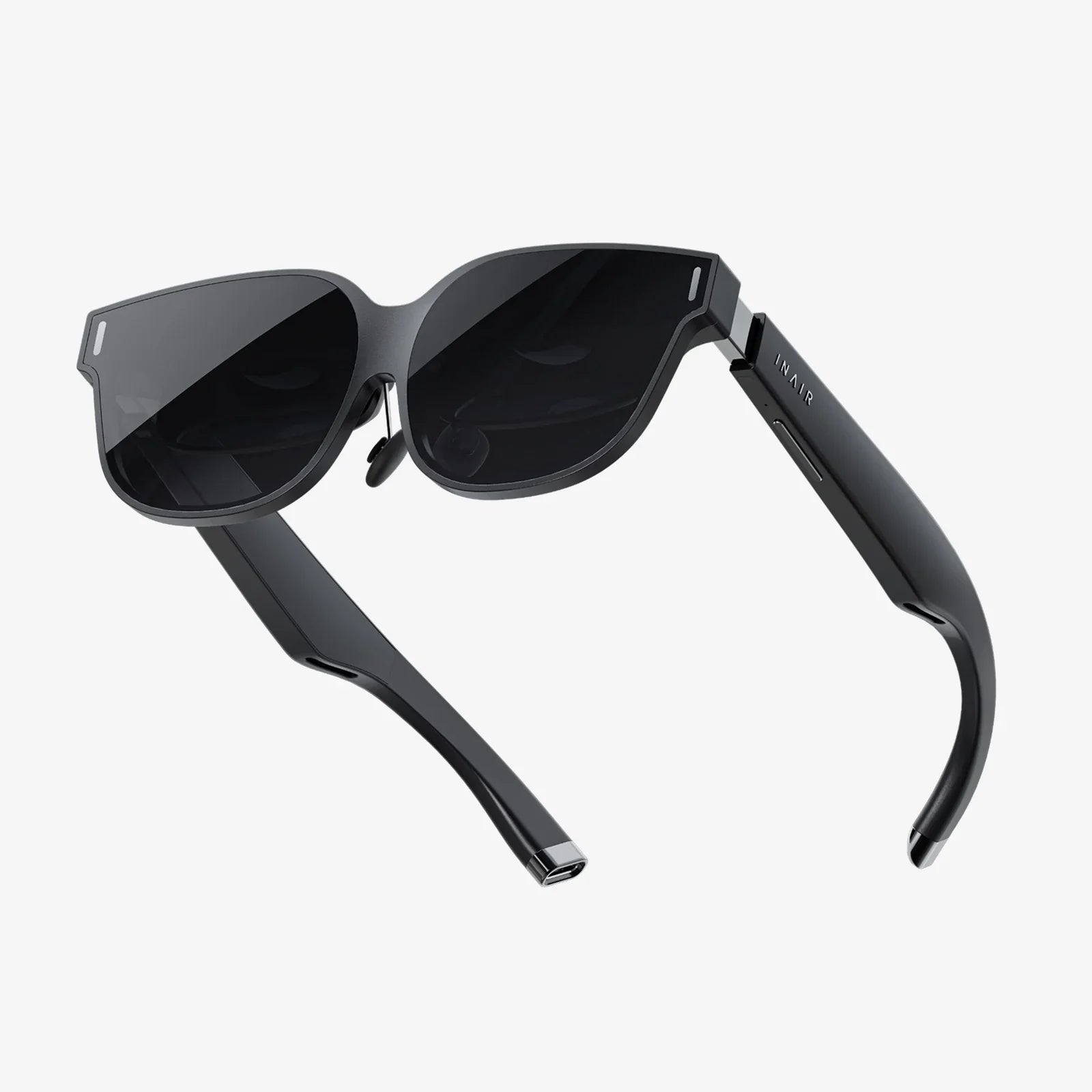
Imagine a world where your entire digital life—your conversations, your entertainment, your navigation, your work—is seamlessly overlaid onto your physical reality, no longer confined to a small, distracting rectangle of glass in your pocket. This isn't a distant science fiction fantasy; it's the palpable future being built in laboratories and startups today. The question is no longer if augmented reality glasses will replace smartphones, but when and how this monumental shift will redefine human-computer interaction forever. The age of looking down at a device is giving way to an era of looking up and out at a world enhanced by invisible, intelligent data.
The Limits of the Glass Slab: Why the Smartphone Must Evolve
For over a decade, the smartphone has been the undisputed king of personal technology. It has condensed cameras, music players, maps, and supercomputers into a single, elegant package. Yet, this very success has revealed its fundamental limitations. The smartphone, by its nature, is an isolating device. It demands our full visual and cognitive attention, creating a barrier between us and the people and environment around us. This phenomenon, often called "presence bleed," where we are physically in one place but mentally elsewhere, is a direct byproduct of the device's design.
Furthermore, the interface is constrained. We are limited to touch and voice, interacting with a 2D representation of information on a flat screen. This is a starkly artificial way to experience data. We don't navigate the real world by pinching and zooming; we move through it, looking at objects, hearing sounds, and using our spatial awareness. The smartphone forces us to translate our rich, 3D reality into a compressed 2D format and back again, a process that is inherently inefficient and disconnected.
The Augmented Promise: A More Natural Human-Computer Interface
Augmented reality glasses propose a radical alternative: instead of pulling a device out of your pocket, you simply wear the computer. The digital world is projected onto your field of vision, contextually aware of your surroundings and available at a glance. This shift represents a move from a pull model of information, where you must actively seek it out on a screen, to a push model, where relevant data finds you, presented in the appropriate spatial context.
This enables a form of computing that is far more intuitive and integrated:
- Spatial Navigation: Instead of staring at a blue dot on a map, arrows and pathways can be painted onto the street in front of you, guiding you effortlessly to your destination.
- Contextual Information: Look at a restaurant, and its reviews and menu hover beside its entrance. Look at a historical monument, and a virtual tour guide appears to explain its significance.
- Persistent Multitasking: Your video call, messages, and notes can appear as fixed panels in your environment, allowing you to engage with content while still maintaining eye contact and awareness of your surroundings.
- Embodied Interaction: Instead of tapping icons, you could use natural hand gestures or voice commands to manipulate virtual objects that feel present in your space.
Converging Technologies: The Pillars of the AR Revolution
For this vision to become a consumer reality, several critical technologies had to mature in parallel. We are now at an inflection point where these pillars are strong enough to support the next computing platform.
1. Waveguide Optics and Micro-LED Displays
The greatest challenge has been creating bright, high-resolution, and energy-efficient displays that are small enough to fit into an eyeglass form factor. Early headsets were bulky and offered a narrow field of view. Advances in waveguide technology—using microscopic gratings to bend light onto the retina—and ultra-dense Micro-LED panels are solving this. These components allow for sleek, socially acceptable glasses that can project vivid images onto the real world without obstructing the user's view.
2. Spatial Computing and Computer Vision
The "intelligence" of AR glasses comes from their ability to understand the environment. This is powered by a suite of sensors—cameras, LiDAR, depth sensors, and inertial measurement units (IMUs)—that constantly scan the surroundings. Sophisticated computer vision algorithms process this data in real-time to create a 3D mesh of the world, recognizing objects, surfaces, and people. This digital understanding of physical space is the bedrock upon which persistent and stable digital content is placed.
3. 5G and Edge Computing
Processing the immense data from these sensors requires immense computational power. While on-device chips are becoming more capable, offloading complex rendering and AI tasks to the cloud is essential. The high bandwidth and low latency of 5G networks are the missing link, enabling a seamless split between the lightweight wearable and powerful remote servers. This ensures a smooth, responsive experience without the glasses becoming heavy and hot from onboard computing hardware.
4. Artificial Intelligence and Machine Learning
AI is the orchestrator. It makes sense of the sensor data, predicts user intent, and manages which information is displayed and when. From real-time language translation overlaid on a conversation to an AI assistant that can retrieve information based on what you're looking at, machine learning models are what will transform AR glasses from a simple display into a truly contextual and predictive companion.
The Social and Ethical Landscape: Navigating a World of Overlays
The transition from private screens to always-on, see-through displays raises profound questions that society must grapple with long before adoption becomes widespread.
Privacy in a World of Constant Sensing
If smartphones raised privacy concerns, AR glasses amplify them a thousandfold. A device that is always looking at the world through cameras is, by definition, always capable of recording. How do we prevent pervasive surveillance? Who has access to the data collected? Clear, hardware-level privacy features—like a physical shutter and obvious recording indicators—and robust legal frameworks will be non-negotiable for public acceptance.
The Digital Divide and Accessibility
Will this technology be a great equalizer or a source of greater inequality? For individuals with disabilities, AR could be transformative, offering real-time captioning for the deaf, enhanced navigation for the visually impaired, or memory aids for those with cognitive conditions. However, the high initial cost could also create a new socio-economic divide between those who can afford a digitally-augmented reality and those who cannot.
Digital Etiquette and Social Norms
New social contracts will need to be written. Is it rude to wear glasses during a conversation? How do we know if someone is recording us? The awkwardness of someone staring at their phone will be replaced by the unease of not knowing what someone is looking at or interacting with behind their lenses. Establishing new norms for attention and interaction will be a critical, organic process as the technology diffuses into culture.
The Path to Ubiquity: From Niche to Necessity
The replacement of the smartphone will not happen overnight. It will be a gradual process of improvement and cultural acclimatization, likely following a trajectory similar to the smartphone's own rise.
- Enterprise and Specialist First: The initial adoption will be in industrial settings—for technicians receiving remote expert guidance, warehouse workers managing inventory, or surgeons visualizing patient data—where the productivity benefits are clear and justify the cost.
- The "Killer App": Consumer adoption will await a specific, must-have application. For smartphones, it was the App Store and the combination of a phone, iPod, and internet communicator. For AR, it could be a revolutionary social media platform, a new genre of immersive gaming, or an indispensable AI assistant that is simply not possible on a flat screen.
- The Form Factor Refinement: The devices must become indistinguishable from regular eyewear—lightweight, all-day battery life (likely through a companion device or innovative charging), and stylish. This is the final hurdle to mass-market appeal.
The glow of the smartphone screen has defined a generation, but its reign is entering its final act. It has primed us for a world of constant connection and instant information, yet its physical form is the last barrier to a truly integrated digital life. Augmented reality glasses are not merely a new product category; they are the logical endpoint of personal computing—a shift from a device we carry to an experience we wear. They promise to dissolve the boundary between the digital and the physical, offering a future where technology enhances our reality instead of distracting us from it. The next time you instinctively reach for your phone, know that you're performing a ritual that your children may never learn, their world already alive with the information they need, displayed right before their eyes.
Share:
Independent Equipment: The Unseen Backbone of Modern Industry and Innovation
Can You Watch Movies with Virtual Reality? The Ultimate Immersive Cinema Experience