


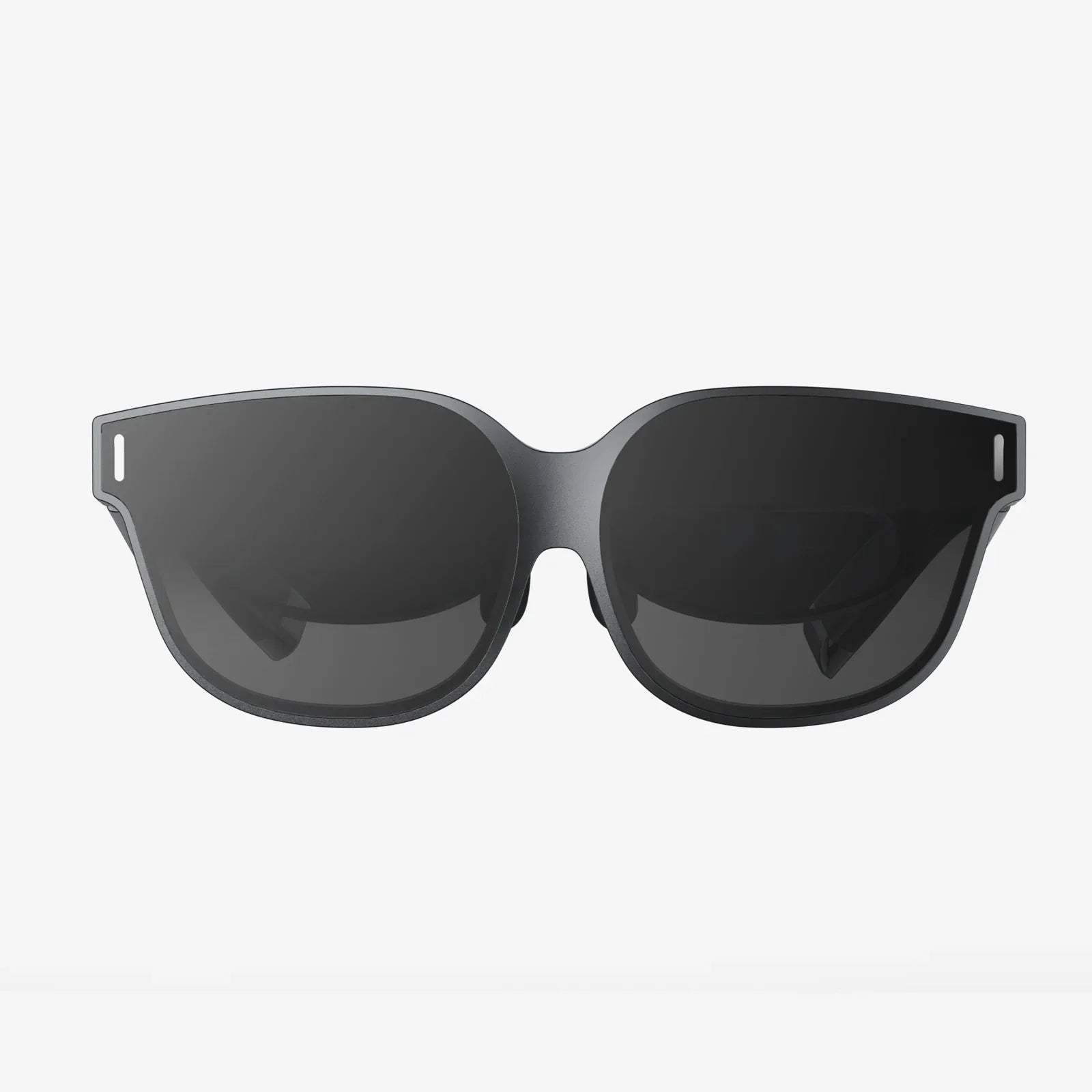
Imagine your entire digital world—every application, browser tab, and video stream—floating crisply in space before you, accessible with a glance, yet completely invisible to anyone else in the room. This is no longer a scene from science fiction; it is the imminent future promised by AR monitor glasses, a technological leap that aims to liberate us from the tyranny of the physical screen and redefine the very nature of work and play.
The Conceptual Leap: From Screens to Spatial Canvases
For decades, our interaction with digital information has been constrained by a simple, physical rectangle. We have made these rectangles thinner, brighter, and sharper, but the fundamental paradigm has remained unchanged: we are tethered to a fixed pane of glass. AR monitor glasses represent a radical departure. Instead of looking at a device, we look through a device into an augmented layer of reality. The goal is not to replicate a single monitor but to create an infinite, malleable canvas that coexists with our physical environment.
The core proposition is profound. These devices project digital images directly onto the user's retina using sophisticated micro-displays and waveguide or holographic optics. The result is the perception of screens of immense size and stunning clarity, hovering in the air at a comfortable focal distance. This solves numerous ergonomic issues associated with traditional monitors, such as neck strain from looking down at laptops or the limited field of view of a standard desktop setup.
Deconstructing the Magic: The Technology Inside the Frames
Creating a convincing virtual display that feels real requires a symphony of advanced technologies working in perfect harmony.
Optical Engine: Painting Light onto the Retina
At the heart of any AR monitor glasses is the optical system. This is arguably the most critical and challenging component to miniaturize effectively. Two primary technologies dominate:
- Waveguide Optics: This technology uses transparent glass or plastic substrates etched with microscopic gratings. Light from a micro-OLED or micro-LED display is injected into the waveguide, "guided" through total internal reflection, and then selectively ejected towards the eye. This allows for a sleek, eyeglasses-like form factor while projecting a large virtual image.
- Birdbath Optics: An older but effective design that uses a combiner (a partially reflective mirror) and a beamsplitter to fold the light path from a micro-display into the user's eye. While often yielding a brighter image, it can result in a slightly bulkier design compared to advanced waveguides.
The holy grail is achieving a wide field of view (FoV) to simulate large screens, high resolution to eliminate the "screen door effect," and a large eyebox to ensure the image remains stable even if the glasses shift slightly on your face. Recent advancements in holographic and diffractive optics are pushing these boundaries further every year.
Micro-Displays: The Tiny Powerhouses
The physical screens inside the glasses are minuscule, often the size of a postage stamp, but they must be incredibly dense and bright. Micro-OLED technology is currently the frontrunner for its perfect blacks, high contrast ratio, and fast response times—essential for text clarity and reducing motion blur. Micro-LED is an emerging challenger, promising even greater brightness and efficiency, which is crucial for use in brightly lit environments.
Spatial Awareness and Tracking
For virtual screens to feel anchored in your space, the glasses must understand their environment. A suite of inward and outward-facing cameras, accelerometers, gyroscopes, and sometimes LiDAR scanners work together for simultaneous localization and mapping (SLAM). This creates a real-time 3D map of the room, allowing digital windows to be pinned to walls or desks. Hand-tracking cameras enable intuitive interaction, letting you resize, move, or close windows with simple gestures, eliminating the constant need for a physical keyboard or mouse.
The Productivity Paradigm Shift: Your Office, Anywhere
The implications for knowledge workers are staggering. The concept of a "portable office" takes on a new meaning.
- Infinite Screen Real Estate: With AR monitor glasses, you are no longer limited by the physical dimensions of your desk. You can have a main coding window centered, your communication apps off to the left, a reference browser to the right, and a video feed above—all without the clutter and cost of multiple physical monitors.
- Contextual Computing: Imagine looking at a physical router and seeing its network status and configuration options overlaid directly on it. Or having a recipe hover next to your mixing bowl as you cook. The device moves computing from a destination to a contextual tool integrated into your task.
- Ultimate Focus and Privacy: By creating a personal visual workspace, these glasses can minimize distractions from your physical surroundings. Furthermore, since the display is only visible to you, they offer unparalleled privacy in open offices or on airplanes, shielding your work from prying eyes.
Beyond the Desk: A Multitude of Use Cases
While productivity is a primary driver, the applications extend far beyond the office.
- Gaming and Entertainment: Gamers can experience immersive overlays and HUDs in their favorite titles, or enjoy a massive, private theater experience anywhere. The potential for localized multiplayer AR games is also immense.
- Remote Assistance and Training: A expert can see what a field technician sees and annotate their real-world view with arrows, diagrams, and notes, guiding them through complex repairs in real-time.
- Accessibility: This technology can offer powerful tools for individuals with visual impairments, potentially magnifying text, enhancing contrast, or providing audio descriptions of the world around them.
The Hurdles on the Road to Ubiquity
Despite the exciting potential, significant challenges remain before AR monitor glasses can replace the ubiquitous monitor.
- Form Factor and Comfort: The current generation often represents a compromise between performance and wearability. Achieving all-day comfort in a package that looks like regular eyewear is the ultimate design challenge. Battery life is also a key constraint, as processing high-resolution graphics and spatial mapping is computationally intensive.
- Visual Fidelity and Latency: The virtual text must be as sharp as a 4K monitor, and the image must remain rock-solid with zero perceptible lag when moving your head. Any jitter or blurriness can lead to eye strain and nausea, breaking the immersion.
- The Social Acceptance Question: Wearing technology on your face in social and professional settings presents a new frontier for etiquette. Will meetings be conducted with everyone wearing glasses? How do we maintain human connection when people can be partially immersed in a digital world?
- Software Ecosystem: The hardware is nothing without a robust operating system and application ecosystem designed for spatial computing. Developers need to rethink user interfaces for a 3D, hands-free environment, moving beyond the familiar windows-and-mouse paradigm.
The Future is Transparent
The trajectory is clear. As optical technology matures, processors become more efficient, and batteries more dense, the AR monitor glasses of tomorrow will be indistinguishable from standard prescription eyewear. They will evolve from a niche productivity tool into a universal personal computing platform, seamlessly blending our digital and physical lives. The disruption will extend beyond just monitor manufacturers to reshape industries like real estate (why need a dedicated office?), furniture (why need a big desk?), and even public space design.
We stand at the precipice of the next major computing shift. The journey began with the command line, evolved to the graphical user interface with the mouse, moved to the touchscreen, and is now accelerating towards a future of invisible, ambient interfaces. AR monitor glasses are not just another gadget; they are the key that will unlock this future, transforming the very air around us into our next great digital canvas and forever changing how we see, interact with, and shape our world.
Share:
Application of Extended Reality: Transforming Industries and Redefining Human Experience
Application of Extended Reality: Transforming Industries and Redefining Human Experience