


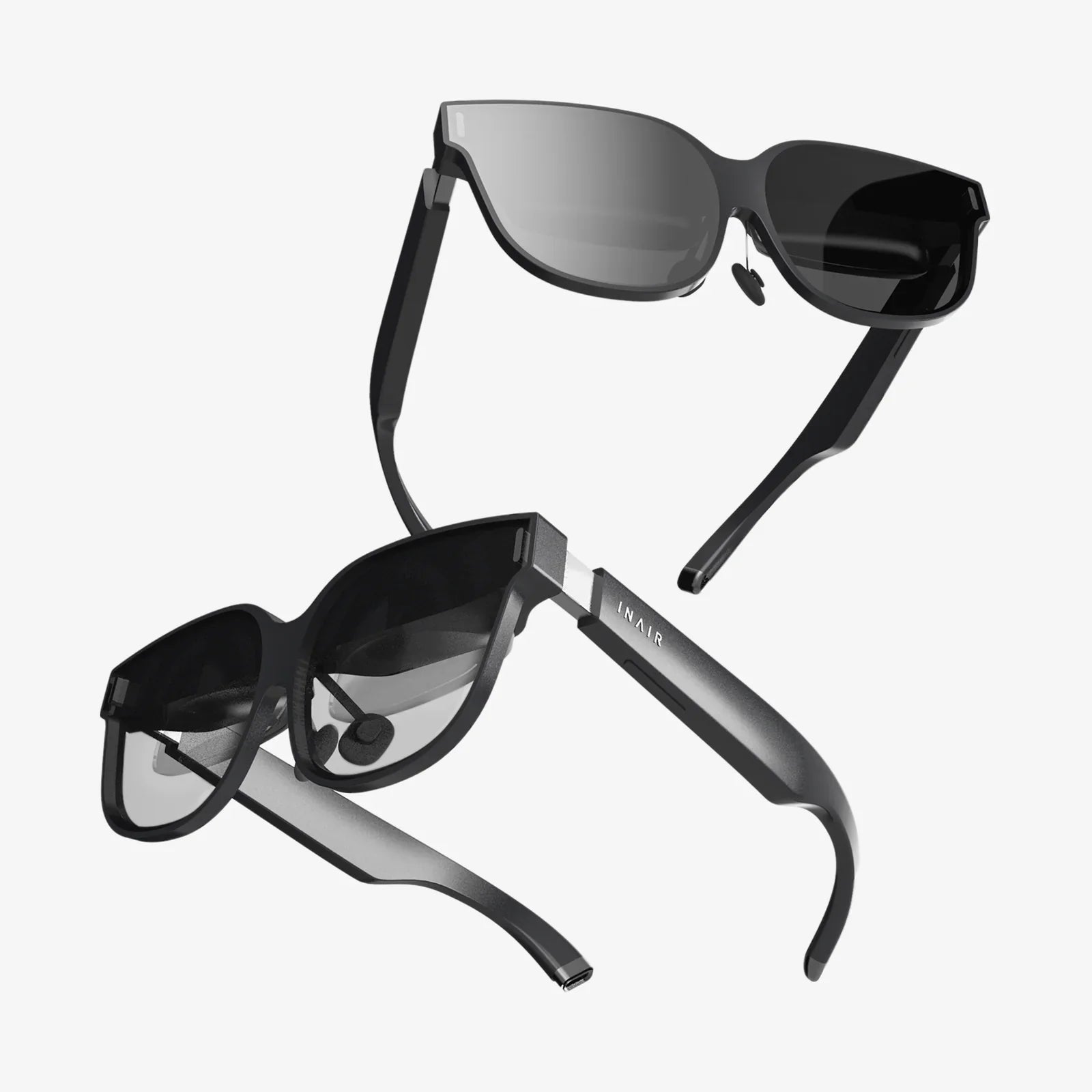
Imagine a world where your computer isn't a box on a desk or a slab in your bag, but a layer of intelligence seamlessly integrated into your field of vision. A world where data, applications, and digital companions coexist with your physical reality, accessible with a glance or a subtle gesture. This is no longer the realm of science fiction; it is the imminent future being forged by the rapid development of AR PC glasses, a technological convergence set to redefine our very relationship with information and computation.
The Convergence of Two Worlds: Understanding AR and the Personal Computer
To appreciate the revolutionary potential of AR PC glasses, one must first understand the two powerful technologies they combine. Augmented Reality (AR) is not Virtual Reality (VR). Where VR seeks to replace your world with a simulated one, AR aims to augment and enrich your existing reality by superimposing digital information—images, text, 3D models—onto your view of the physical environment. The personal computer (PC), in its traditional form, is a distinct, isolated device we interact with directly and intentionally. AR PC glasses represent the dissolution of this boundary. They are the embodiment of what is often termed 'spatial computing' or 'the ubiquitous computer'—processing power and digital content that is everywhere and nowhere at once, contextually aware and immediately accessible.
Beyond the Hype: The Core Technologies Powering AR PC Glasses
The magic of these devices is underpinned by a sophisticated symphony of hardware and software, each component pushing the boundaries of miniaturization and performance.
Optical Systems: Painting Light onto the Real World
The most critical challenge is delivering a bright, high-resolution, and seemingly solid digital image that floats in the user's real-world view. This is achieved through advanced optical systems like Waveguide displays. These are incredibly thin, transparent glass or plastic components that use diffraction gratings to 'pipe' light from a micro-display located at the temple of the glasses into the user's eye. This allows for a sleek, eyeglasses-like form factor without bulky components in front of the face. Other systems, like Birdbath optics, use a combination of mirrors and beam splitters to achieve a similar effect, often resulting in a wider field of view but sometimes a slightly bulkier design.
Sensing the World: Cameras, LiDAR, and Inertial Measurement Units
For the digital overlay to be persistent and interactive, the glasses must understand the world around them with incredible precision. This is accomplished through a suite of sensors:
- Cameras: Multiple high-resolution cameras perform Simultaneous Localization and Mapping (SLAM). They constantly scan the environment to create a real-time 3D depth map, understanding the geometry of rooms, the location of surfaces, and the position of objects.
- LiDAR (Light Detection and Ranging): This sensor fires out invisible laser beams to measure the exact distance to objects, creating an extremely accurate point-cloud map of the surroundings. This is crucial for placing digital objects convincingly on real surfaces.
- Inertial Measurement Units (IMUs): These accelerometers and gyroscopes track the precise movement and rotation of the user's head, ensuring the digital content remains locked in place even as you look around.
Onboard Intelligence: The Brain Behind the Lenses
Processing the immense amount of visual and spatial data from these sensors requires significant computational power. Early AR prototypes often relied on a tether to a powerful external computer. The current generation, however, integrates a System-on-a-Chip (SoC) directly into the glasses frame. These chips are marvels of engineering, packing the CPU, GPU, and dedicated AI processors necessary for real-time computer vision, object recognition, and rendering complex graphics, all while managing stringent power and thermal constraints.
A Day in the Life: Transformative Use Cases and Applications
The theoretical potential of AR PC glasses becomes tangible when applied to everyday scenarios across various sectors.
Revolutionizing the Professional Workspace
The concept of the office is transformed. Instead of being chained to a monitor, a designer could have their toolbars and palettes floating in space around their physical sketchpad. A surgeon could have a patient's vital signs and MRI scans visually overlaid on their body during a procedure. A field engineer repairing complex machinery could see a dynamic, step-by-step manual and torque specifications displayed directly on the components they are working on, with remote experts able to 'draw' annotations into their field of view from thousands of miles away. This isn't just about convenience; it's about augmenting human capability, reducing error, and dramatically increasing efficiency.
Redefining Social Connection and Entertainment
Social media could evolve from a feed on a screen to a shared experience in space. Imagine watching a sports game with a friend who lives in another country, with both of you seeing the same virtual stats and replays hovering over your coffee table. Video games could escape the television and turn your entire living room into a interactive battlefield or puzzle landscape. The passive consumption of media becomes an active, immersive experience, blending narrative elements with your physical environment.
Seamless Daily Navigation and Information Access
The constant need to glance down at a smartphone for directions could vanish. Navigation arrows could be painted onto the road itself, guiding you seamlessly to your destination. Looking at a restaurant could instantly reveal its reviews and menu. A forgotten name at a networking event could be discreetly displayed next to the person's face (with appropriate privacy safeguards). This ambient access to information promises to make us more present in our surroundings, not less, by eliminating the friction of device retrieval and interaction.
Navigating the Obstacles: Challenges on the Path to Adoption
For all their promise, AR PC glasses face significant hurdles before they can achieve widespread consumer adoption.
The Form Factor Conundrum: Balancing Power and Wearability
The ultimate goal is a device that is indistinguishable from regular eyewear—lightweight, comfortable, and socially acceptable to wear all day. Current technology often forces a trade-off between performance and aesthetics. Powerful processors generate heat, high-resolution displays consume battery, and complex optical systems can add bulk. Achieving the desired 'all-day' form factor remains the single greatest engineering challenge for the industry.
The Battery Life Bottleneck
Powering high-performance computing, multiple sensors, and bright displays is incredibly energy-intensive. While battery technology continues to improve, fitting a cell with sufficient capacity into an eyeglass frame is a monumental task. Solutions being explored include novel battery chemistries, aggressive power management through low-power co-processors for always-on tasks, and the potential for offloading heavy computation to a companion device in a user's pocket via a high-speed wireless connection.
The Privacy Paradigm: The Most Sensitive Camera You'll Ever Wear
This is perhaps the most profound societal challenge. A device that is always on your face, seeing what you see, raises immense privacy concerns for both the user and those around them. The potential for constant recording, facial recognition, and data harvesting is unprecedented. Building trust will require a radical rethinking of privacy frameworks. This includes clear, physical indicators when recording is active (like a prominent light), robust on-device data processing that minimizes what is sent to the cloud, and transparent, user-controlled privacy policies. The ethical development of this technology is not an option; it is a prerequisite for its survival.
The Invisible Revolution: A Future Shaped by Contextual Computing
The long-term trajectory of AR PC glasses points toward a fundamental shift in human-computer interaction. We are moving away from the 'direct manipulation' paradigm of the mouse and touchscreen toward a model of 'contextual computing.' The device will understand your environment, your intentions, and your needs, proactively presenting the right information at the right time without requiring a explicit command. It will act as an intelligent filter for the world, highlighting what is important and hiding what is not. This could alleviate information overload and create a more intuitive, fluid, and ultimately more human-centric way of interfacing with the digital universe.
The journey from clunky prototypes to sleek, powerful AR PC glasses is accelerating at a breathtaking pace. While hurdles of design, battery, and profound ethical considerations remain, the direction is clear. We are not merely getting a new screen; we are gaining a new sense. This technology promises to weave the threads of our digital and physical lives into a single, coherent tapestry, augmenting our reality and expanding human potential in ways we are only beginning to imagine. The future is not on your desk; it's right before your eyes.
Share:
Interactive AI Assistant: The Dawn of a New Digital Partnership
Interactive AI Assistant: The Dawn of a New Digital Partnership