


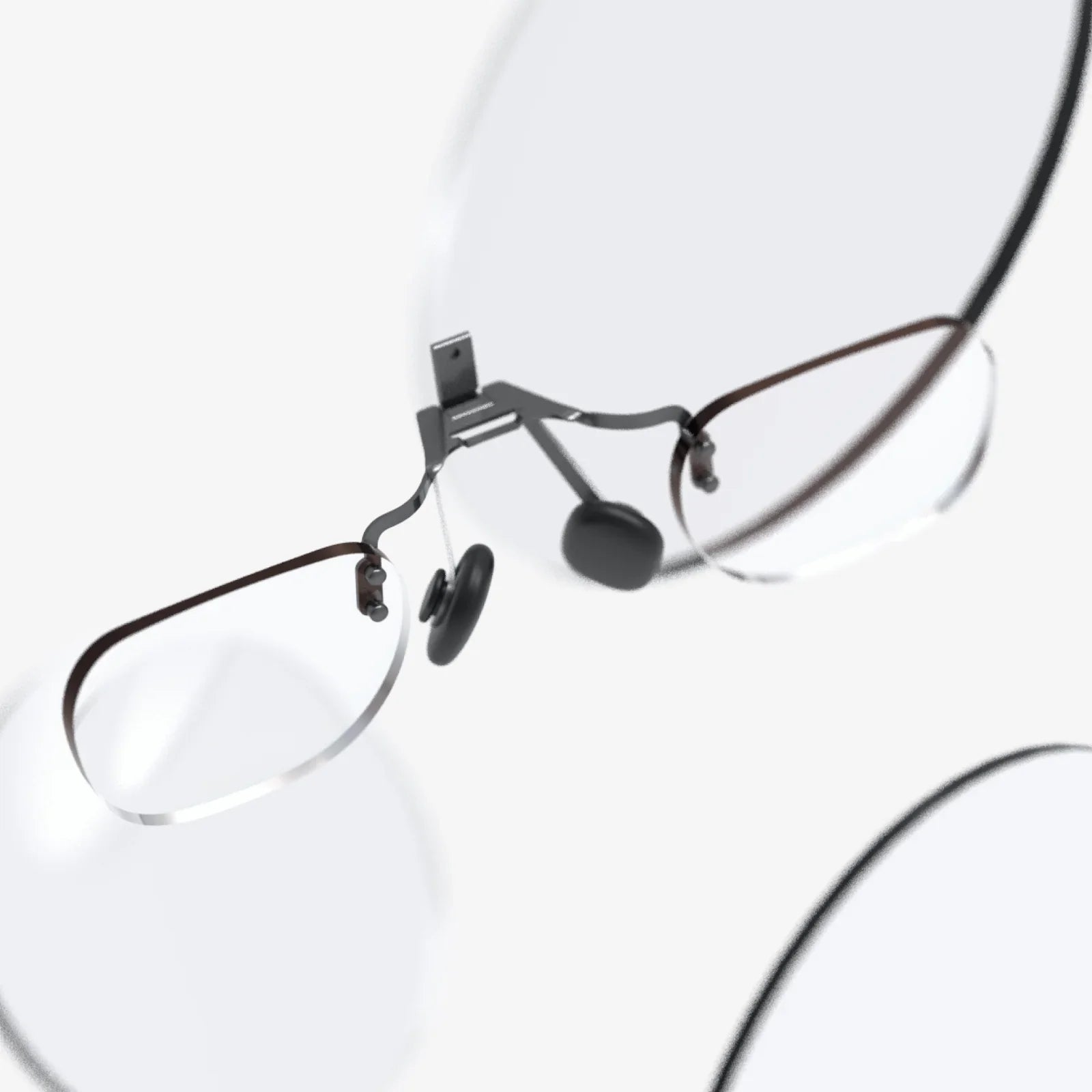
Imagine a world where your field of vision becomes an interactive canvas, where digital information seamlessly blends with physical reality, and where the very way we work, play, and connect is transformed. This is the promise held by a simple yet profound choice: AR vs no AR glasses. The decision to embrace this nascent technology or to stick with traditional, non-augmented eyewear is more than a consumer preference; it's a fork in the road for human-computer interaction. This isn't about a simple product comparison; it's a deep dive into the philosophical and practical implications of augmenting our most primary sense—sight.
The Fundamental Divide: Defining the Experience
At its core, the debate of AR vs no AR glasses hinges on a fundamental question: passive vision versus active vision. Traditional glasses, whether prescription, sunglasses, or blue-light filtering, serve a singular, passive purpose. They are tools for correction, protection, or comfort. They modify the light entering your eyes to provide a clearer, safer view of the world as it is. Their value is in their transparency; they are a window.
Augmented Reality glasses, on the other hand, are inherently active. They are not a window but a lens—a computational one. They are designed to overlay digital information, graphics, and interfaces onto your perception of the real world. This layer, often called the "digital twin" or "spatial computing," aims to enhance, inform, and assist. The goal is not to replace reality but to supplement it, turning the entire world into a potential desktop, a game board, or a data dashboard.
Under the Hood: The Technological Chasm
The difference in purpose creates a vast technological gulf between the two categories. Understanding this engineering marvel is key to appreciating the AR proposition.
The Anatomy of AR Glasses
True AR glasses are a symphony of miniaturized technology. They pack components that are entirely absent in traditional frames:
- Microdisplays and Waveguides: Instead of lenses that merely bend light, AR glasses use complex optical systems. Tiny projectors (often LCoS or MicroLED) beam images onto transparent "waveguide" lenses that pipe the light directly into your retina, creating the illusion that holographic images exist in the space in front of you.
- Sensor Arrays: A suite of sensors is crucial for context. This includes cameras for computer vision (to understand the environment and track hand gestures), depth sensors (LiDAR or time-of-flight) for spatial mapping, accelerometers, gyroscopes, and magnetometers for precise head-tracking.
- Onboard Processing and Connectivity: Unlike simple glasses, AR glasses require significant computational power to run SLAM (Simultaneous Localization and Mapping) algorithms, render graphics in real-time, and process AI-driven commands. This can be housed in the frames themselves or offloaded to a companion device via high-speed wireless connections.
- Audio Systems: Spatial audio is a critical part of the immersive experience, often delivered through bone conduction or tiny directional speakers that provide private sound without earbuds.
The Simplicity of Traditional Glasses
In contrast, traditional glasses are marvels of material science and optical precision, but their technology is static. The innovation lies in lens coatings (anti-reflective, photochromic), advanced materials (lightweight polymers, titanium), and ergonomic design. Their function is isolated and independent of any power source or software update. This simplicity is their greatest strength, offering reliability and accessibility that AR glasses are still striving to achieve.
The Battle of Form and Function: Design & Aesthetics
For decades, eyeglasses have evolved from mere medical devices into core fashion accessories. The industry is built on self-expression, with countless styles, colors, and brands catering to every aesthetic. The goal is often to look good, to complement one's face, and to make a statement.
AR glasses face an immense design challenge: integrating advanced technology without sacrificing style or comfort. Early iterations were often bulky, bizarre, and socially awkward. The holy grail is to create AR glasses that are indistinguishable from high-end traditional frames—a goal that remains elusive. The need to house batteries, chips, and projectors inevitably leads to trade-offs in weight, lens thickness, and temple size. While progress is rapid, the AR vs no AR glasses debate in the fashion sphere is still a lopsided one, heavily favoring the established, minimalist appeal of traditional designs.
Weighing the Scales: Advantages and Limitations
The choice between these two paths is not clear-cut. Each offers a distinct set of pros and cons that cater to different needs and values.
The Case for AR Glasses
- Contextual Information: Imagine looking at a monument and seeing its history pop up, or glancing at a restaurant and instantly seeing its reviews and menu. AR glasses provide real-time, context-aware information without needing to look down at a phone.
- Hands-Free Productivity: For field technicians, surgeons, or warehouse workers, AR can project schematics, instructions, or data directly into their line of sight, freeing their hands for the task and drastically improving efficiency and safety.
- Enhanced Navigation: Digital arrows can be painted onto the street itself, guiding you through a complex airport or a new city with intuitive visual cues, making phone-based maps feel archaic.
- Revolutionized Social Interaction & Entertainment: The potential for shared immersive experiences—from multiplayer games that take over your living room to watching a film on a virtual giant screen—is transformative.
The Case for No AR Glasses (Traditional Eyewear)
- Unobstructed Reality: There is a profound value in experiencing the world directly, without a digital filter. Traditional glasses offer pure, unmediated perception, which many argue is crucial for mindfulness, deep focus, and genuine human connection.
- Simplicity and Reliability: They just work. There are no batteries to charge, no software to update, no connectivity issues, and no risk of digital distractions pulling you out of the moment.
- Comfort and Fashion: With decades of refinement, traditional frames offer unparalleled comfort, lightweight designs, and a vast array of styles to suit any taste, often at a fraction of the cost of high-end AR gear.
- Privacy and Social Norms: AR glasses, with their always-on cameras and sensors, raise significant privacy concerns for the wearer and those around them. Traditional glasses present no such ethical dilemmas and are socially accepted everywhere.
Beyond the Hype: Practical Applications and Use Cases
The theoretical advantages of AR become concrete in specific professional and personal scenarios. In industrial settings, the value proposition is already being proven. An architect can walk through a construction site and see the planned plumbing and electrical lines superimposed on the bare concrete. A medical student can practice procedures on a holographic patient. For the average consumer, the use cases are emerging more slowly but are equally compelling: following a recipe with instructions floating beside the mixing bowl, translating foreign text in real-time as you look at a street sign, or receiving subtle turn-by-turn directions while keeping your eyes on the road during a bike ride. The AR vs no AR glasses question here is about utility versus simplicity. Does the specific task benefit enough from augmentation to justify the technology's overhead?
The Human Factor: Privacy, Ethics, and Society
This discussion cannot exist in a technological vacuum. The widespread adoption of always-on, camera-equipped AR glasses perched on our faces presents societal challenges we are only beginning to grapple with. The privacy implications are staggering. Will we need new laws and social norms to prevent unauthorized recording? Will facial recognition become ubiquitous, eroding public anonymity? There is also the risk of a new digital divide—not just between those who can and cannot afford the technology, but between the augmented and the un-augmented in terms of access to information and capabilities. Furthermore, the potential for constant distraction and information overload could impact mental health and our ability to be present. Choosing no AR glasses can be a conscious decision to opt out of these potential pitfalls, a vote for a less mediated, more private existence.
Gazing into the Crystal Ball: The Future of Vision
The trajectory is clear: the technology will become smaller, more powerful, more affordable, and more stylish. The line between AR and traditional glasses will inevitably blur. We may see a future where "smart lenses" can be inserted into standard frames, allowing users to toggle augmentation on and off as needed. The ultimate endpoint might be contact lenses or even neural interfaces that bypass external wearables entirely, making the choice invisible. However, for the foreseeable future, the dichotomy remains. The decision will be based on individual needs: Does your life or work demand a constant stream of contextual digital information? Or is your priority clarity, simplicity, and an unfiltered experience of the world?
The journey toward ubiquitous computing is accelerating, and it will be fought on the bridge of your nose. The outcome of the great AR vs no AR glasses debate will ultimately determine not just what we see, but how we choose to live within the reality we share. The power to augment our world is immense, but so is the value of seeing it, truly and completely, just as it is.
Share:
How to Make 3D Video for VR: The Ultimate Creator's Guide
Virtual Reality in 20 Years: A Glimpse into the Pervasive Digital Epoch