


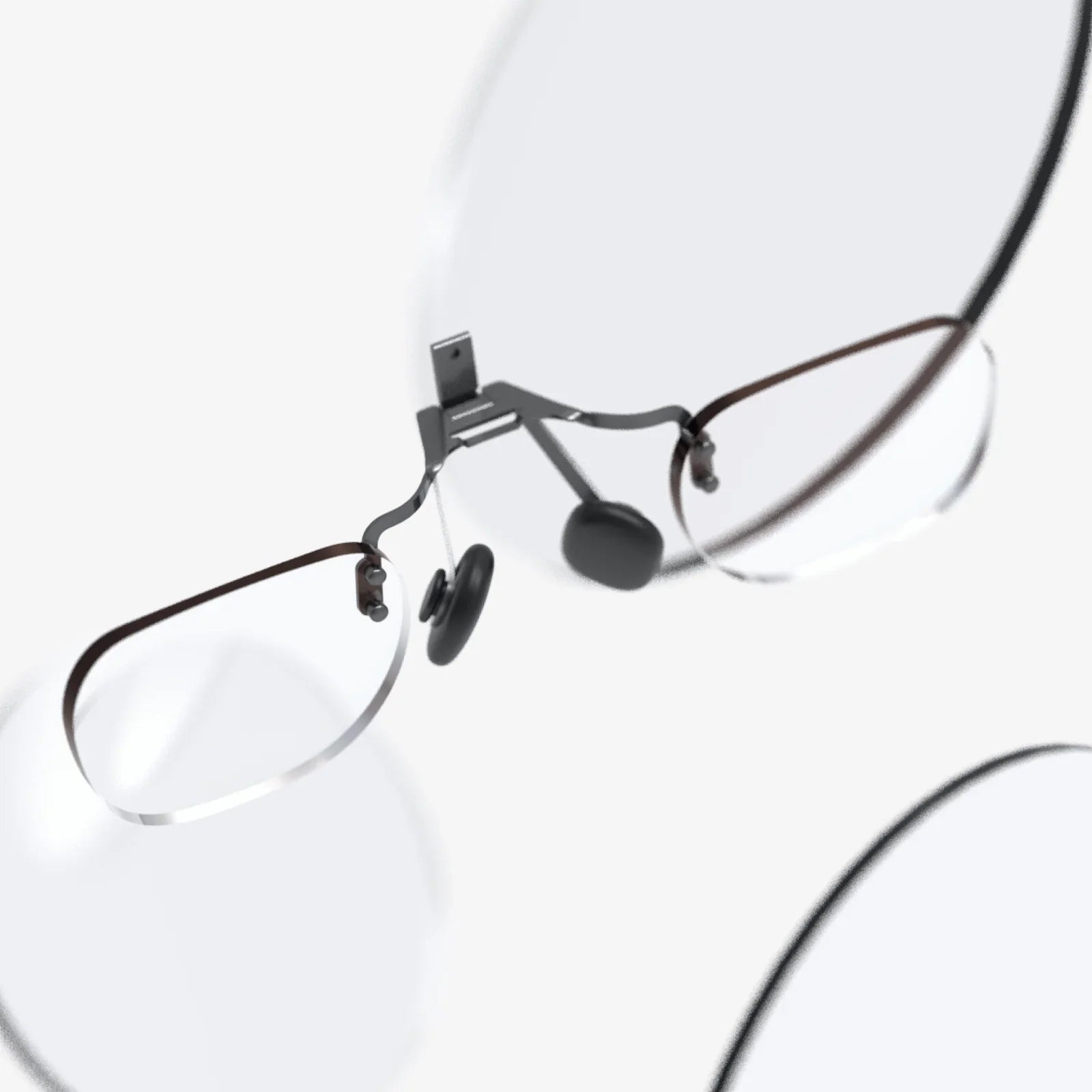
Imagine a world where digital information overlays your morning commute, highlighting the best coffee shops and translating street signs in real-time. Now, envision being instantly transported from your living room to the surface of Mars, feeling the awe of an alien landscape. These aren't scenes from a distant sci-fi future; they are the competing, and converging, promises of AR and VR glasses, two technologies locked in a battle to redefine our very perception of reality. The choice isn't just about hardware; it's about how we will work, play, and connect tomorrow.
Defining the Digital Divide: Augmentation Versus Immersion
At their core, AR (Augmented Reality) and VR (Virtual Reality) glasses serve fundamentally different purposes, a distinction that dictates their design, technology, and use cases.
AR glasses are designed to be a layer of digital enhancement on top of the real world. Think of them as sophisticated, see-through smart displays worn on your face. They use cameras and sensors to understand your environment and then project images, data, and 3D models onto the lenses, allowing you to see both the physical space and the digital overlays simultaneously. The goal is not to remove you from your surroundings but to enrich them with contextually relevant information.
In stark contrast, VR glasses are isolation chambers for the senses. Their primary objective is to fully immerse you in a completely computer-generated environment. By blocking out the physical world with opaque displays placed inches from your eyes, they create a convincing illusion of being somewhere else entirely. This total immersion is achieved through a combination of high-resolution screens, precise head-tracking, and immersive audio, effectively tricking your brain into accepting the virtual world as real.
Under the Hood: A Technological Breakdown
The differing philosophies of AR and VR necessitate distinct technological architectures. Understanding these differences is key to appreciating their capabilities and limitations.
The Architecture of Immersion: VR Glasses
VR technology is primarily focused on creating a high-fidelity, lag-free visual and auditory experience to maintain the illusion of presence—the feeling of actually being inside the virtual world.
- Display Technology: VR headsets use two high-resolution, fast-refresh-rate displays (one for each eye) or a single display split for stereoscopic vision. Key considerations here are pixel density to avoid the "screen-door effect" and a high refresh rate (90Hz and above) to prevent motion sickness.
- Tracking Systems: To make the virtual world respond naturally, VR systems employ intricate tracking. This includes rotational tracking (using gyroscopes and accelerometers) and positional tracking, which can be handled by external base stations or internal-outward-facing cameras (inside-out tracking).
- Lens Technology: Custom fresnel or pancake lenses are used to focus the image from the close-up screens onto your retina, creating a wide field of view that sells the immersion.
- Compute Power: High-end VR experiences are incredibly demanding, often requiring a powerful external computer or a sophisticated, self-contained system-on-a-chip to render complex 3D environments in real-time.
The Architecture of Enhancement: AR Glasses
AR technology is arguably more complex because it must seamlessly blend the real and the digital. This requires a profound understanding of the user's environment in real-time.
-
Display and Waveguides: The biggest challenge for AR is projecting an image onto a transparent lens. Solutions include:
- Waveguides: Tiny, transparent lenses that use diffraction or reflection to pipe light from a micro-display on the temple to the user's eye. This is the most common method in modern AR glasses.
- Micro-LEDs: An emerging technology where minuscule, incredibly bright LEDs are placed directly on the lens, offering superior brightness and efficiency.
- Sensing and Understanding the World: AR glasses are packed with sensors—cameras, depth sensors (LiDAR, time-of-flight), and microphones. Their job is to constantly scan the environment to create a spatial map, understand surfaces, and identify objects. This is known as simultaneous localization and mapping (SLAM).
- Processing: The sensor data must be processed instantly to anchor digital content accurately in the real world. This requires specialized processors for computer vision and AI tasks, often located directly on the glasses or paired with a powerful companion device.
The Battle of Applications: Transforming Industries and Lives
The true value of these technologies is revealed not in their specs, but in their transformative applications across various sectors.
Where VR Reigns Supreme: Total Immersion
VR's strength lies in scenarios where complete control over the user's audiovisual experience is a benefit.
- Gaming and Entertainment: This is VR's flagship domain. It offers unparalleled immersion, allowing users to step inside their favorite games, explore fantastical worlds, and experience 360-degree movies as if they were there.
- Training and Simulation: From training surgeons for complex procedures without risk to preparing soldiers for combat scenarios or teaching astronauts to spacewalk, VR provides a safe, controlled, and repeatable environment to practice high-stakes skills.
- Virtual Tourism and Real Estate: Explore the pyramids of Giza or walk through a potential new home on another continent without leaving your chair. VR can democratize access to experiences and locations that are otherwise inaccessible.
- Therapy and Rehabilitation: VR is being used to treat phobias (like fear of heights or flying) through controlled exposure therapy. It's also a powerful tool for physical rehabilitation, turning exercises into engaging games.
Where AR Excels: Enhancing the Everyday
AR's power is in its ability to make the real world smarter and more efficient.
- Industrial and Field Service: Technicians can see schematics overlaid on machinery they are repairing, receive remote expert guidance with annotations drawn directly into their field of view, and access manuals hands-free.
- Healthcare: Surgeons can visualize patient data like CT scans projected onto the surgical site, nurses can find veins more easily, and medical students can learn anatomy on interactive 3D holograms.
- Navigation: AR can revolutionize wayfinding, with arrows and directions painted onto the road ahead, rather than on a separate 2D map.
- Retail and Design: Try on clothes, visualize how a new sofa will look in your living room, or see how a new paint color would change a room—all before making a purchase.
- Communication and Collaboration: Imagine video calls where participants appear as life-like holograms in your room, able to interact with and manipulate 3D models together as if they were physically present.
The Convergence: The Blurring Line and the Mixed Reality Future
The narrative of AR vs VR is increasingly becoming outdated. The future lies in a spectrum of experiences often referred to as Mixed Reality (MR) or Spatial Computing. Modern devices are already blurring the lines.
High-end VR headsets now feature high-resolution color passthrough cameras. This allows them to function as AR devices by displaying a live video feed of your surroundings with digital elements added on top. While this "video-see-through" AR is different from the optical-see-through of dedicated AR glasses, it creates a powerful MR experience, merging the immersion of VR with the context of AR.
Conversely, advanced AR glasses are gaining more immersive capabilities, potentially able to dim their lenses to block out the world for more focused, VR-like digital interactions when needed. The ultimate goal is a single device that can slide seamlessly along the reality-virtuality continuum, adapting to the user's needs at any given moment.
Choosing Your Reality: Factors to Consider
For a consumer or enterprise buyer today, the choice depends heavily on the primary use case.
- Choose VR if: Your goal is complete escapism, deep immersion in games and virtual experiences, or you need a fully controlled environment for training and simulation. Be prepared for a device that is often bulkier and isolates you from your immediate surroundings.
- Choose AR if: You need to stay connected to the real world while accessing digital information. It's for enhancing productivity, providing contextual data, and assisting with real-world tasks in fields like manufacturing, medicine, and logistics. The form factor is trending towards something resembling everyday eyewear.
Considerations of cost, comfort, battery life, and ecosystem (available apps and software) are also critical deciding factors.
The journey of AR and VR glasses is far from over; it's accelerating. We are moving towards a future where these devices will become as ubiquitous as smartphones, transforming from niche gadgets into fundamental tools for how we perceive and interact with information. The ultimate winner won't be AR or VR in isolation, but the flexible, powerful blend of both that will quietly weave itself into the fabric of our daily lives, forever changing the meaning of what is "real." The next time you look at a pair of glasses, you might not just be seeing a vision aid, but a portal to an entirely new dimension of human experience.
Share:
Glasses That Show Phone Screen: The Future of Personal Computing is on Your Face
Define Augmented Reality in Media: The Digital Layer Reshaping Our World