


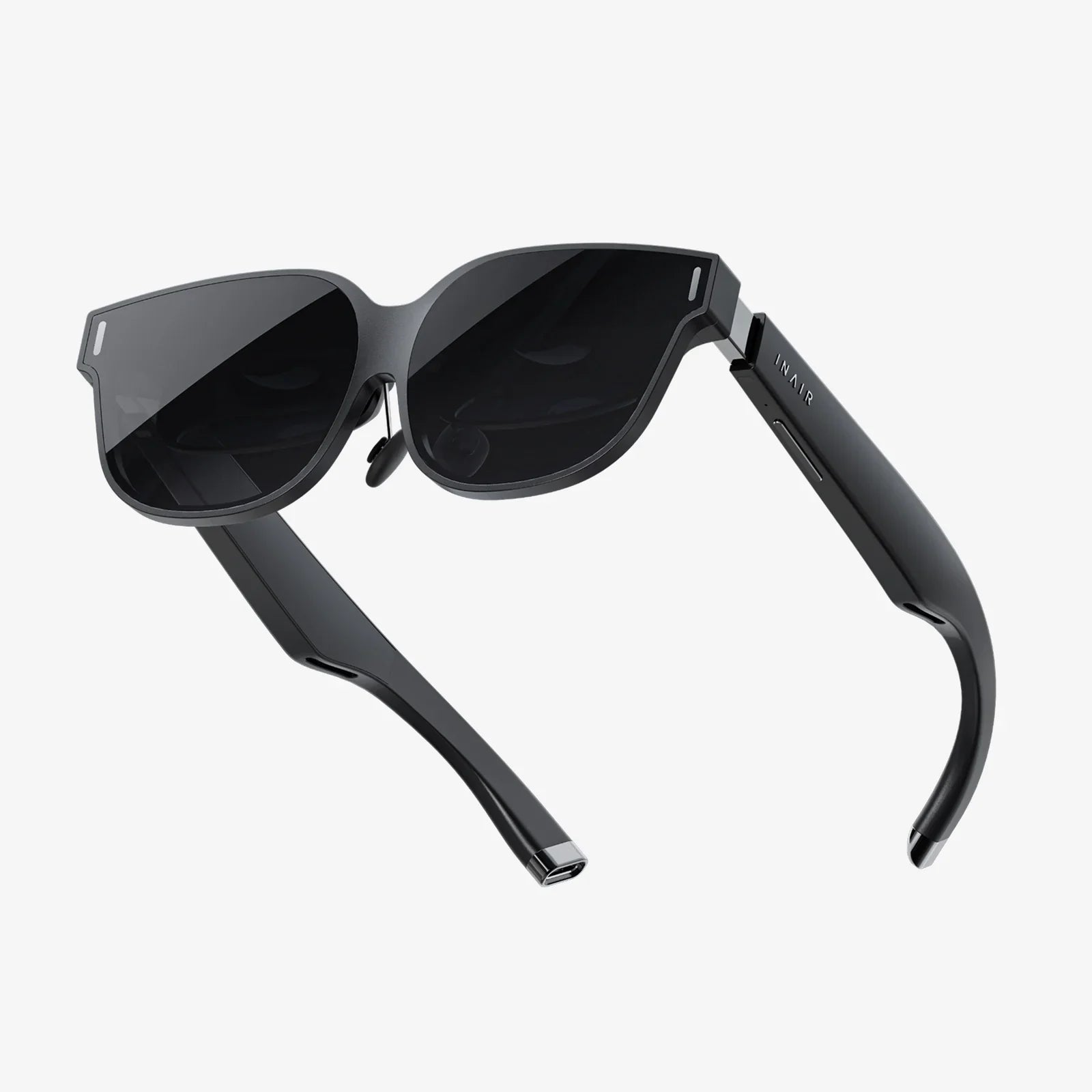
Imagine a world where information doesn't confine itself to the palm of your hand but instead, elegantly and seamlessly, overlays the world around you. A world where directions are painted onto the sidewalk, a foreign language translates in real-time on a restaurant menu, and the history of a monument unfolds before your eyes as you gaze upon it. This is the promise of augmented reality (AR), a technology poised to fundamentally reshape our interaction with the digital and physical realms. But the critical question remains: what will be the vehicle for this revolution? Will it be the smartphones we already own, or are we on the cusp of a more intimate, more immersive paradigm shift? The answer may very well lie on the bridge of our noses. The journey to answer whether smart glasses are the future of augmented reality is a fascinating exploration of technology, human behavior, and the very fabric of society.
The Evolution of Augmented Reality: From Clunky to Compelling
To understand the potential of smart glasses, we must first trace the arc of augmented reality itself. The concept is not new; its roots stretch back decades to the first head-up displays in military aircraft, which projected crucial flight data onto the cockpit canopy, allowing pilots to keep their "heads up" and focused on their mission. For years, AR was largely the domain of industrial and enterprise applications—complex, expensive systems used for training, manufacturing, and complex repair tasks. These systems were powerful but inaccessible to the average consumer.
The catalyst for change arrived with the smartphone. By harnessing powerful processors, high-resolution cameras, and sophisticated sensors, our handheld devices became the first true mass-market AR platforms. Suddenly, millions could experience AR through their screens, playing games that placed digital creatures in their living rooms or using apps to visualize new furniture in their homes. This smartphone-based AR, often called "see-through AR" because users view the world through the device's camera feed, served as a crucial proof of concept. It demonstrated a massive public appetite for blended reality experiences. However, it also highlighted significant limitations. Holding a phone aloft is ergonomically unsustainable, creating a literal barrier between the user and their environment. It is, by its very nature, a fragmented and isolating experience.
Defining the Dream: The Promise of True Augmented Reality
True, immersive augmented reality aspires to be something far more profound than a phone-based trick. Its ideal form is characterized by three core principles:
- Spatial Awareness and Persistence: Digital objects must understand and respect the geometry of the physical world. A virtual character should walk behind your real sofa, not float on top of it. These objects should also persist in space, meaning you could leave the room and return to find them exactly where you left them.
- Contextual Relevance: The information presented must be timely, useful, and directly related to what you are looking at or doing. AR should feel like a natural extension of your cognition, not a distracting overlay.
- Seamless Interaction: Engaging with the digital layer should feel intuitive, moving beyond touchscreens to include voice commands, hand gestures, eye tracking, and even subtle neural inputs.
This vision of AR is not merely a convenience; it is a tool with the potential to enhance human capability across nearly every facet of life. The question is not if this future is desirable, but what form factor is best suited to deliver it.
The Case for Smart Glasses: The Unrivaled Platform
Proponents argue that smart glasses are not just an option for delivering AR; they are the inevitable and only logical endpoint. Their advantages are rooted in human physiology and the desire for frictionless technology.
Ubiquity and Always-On Accessibility
Glasses are worn on the face, positioned directly in front of our primary sensory inputs: our eyes and ears. This positioning makes them the most personal and always-available computer we could ever wear. Unlike a phone that must be retrieved from a pocket, unlocked, and pointed, smart glasses offer instant, hands-free access to information. This always-on, low-friction interaction is essential for AR to become a utility rather than a novelty. Checking the weather could be as simple as glancing at the sky, with the forecast subtly appearing in the corner of your vision.
A More Natural and Immersive Experience
By projecting light directly onto the retina (as with waveguide optics) or using micro-displays, smart glasses create the illusion that digital content exists within your real field of view. This is known as "optical see-through AR," and it is far superior to the "video see-through" of phones. It preserves your natural vision, depth perception, and peripheral awareness, making the blend of real and virtual feel more cohesive and less jarring. This fosters a deeper sense of immersion and presence, crucial for both entertainment and serious applications.
Revolutionizing Professional and Industrial Sectors
The value proposition for smart glasses is already being proven in the enterprise world. In fields like manufacturing, technicians use them to view schematics and receive remote expert guidance hands-free while repairing complex machinery. In healthcare, surgeons can visualize patient data, such as MRI scans, superimposed directly onto their field of view during procedures. In logistics, warehouse workers can see picking instructions and inventory data, dramatically increasing efficiency and accuracy. In these high-stakes, hands-on environments, the utility of smart glasses is undeniable and is driving rapid technological advancement and adoption.
The Formidable Challenges: Barriers to a Glass-Centric Future
Despite the compelling vision, the path to smart glasses becoming the dominant AR platform is littered with significant obstacles that must be overcome.
The Technological Hurdles
The core challenge is a profound one: packing the computational power of a smartphone into a frame that weighs mere ounces, all while managing heat dissipation and battery life. This requires monumental advances in miniaturization, chip design, and power efficiency. Furthermore, the optical systems—the waveguides, projectors, and combiners that create the visual illusion—must become cheaper to produce, brighter for outdoor use, and offer a wide field of view without being bulky. These are immense feats of engineering and materials science that are still in active development.
The Social Hurdle: The "Glasshole" Stigma
Perhaps the most unpredictable challenge is social acceptance. Early attempts at consumer smart glasses famously faltered, in part, due to a public backlash centered on privacy concerns and social awkwardness. The term "Glasshole" entered the lexicon, embodying the fear of a wearer secretly recording conversations or being perpetually distracted. For smart glasses to succeed, they must be designed to be socially graceful. This means clear indicators of when recording is active, designs that are fashionable and customizable rather than techy and uniform, and user interfaces that don't encourage anti-social behavior, like ignoring someone in front of you. They must become a normalized piece of apparel, akin to wireless earbuds, which also faced initial skepticism before becoming ubiquitous.
Privacy, Security, and the Ethical Quagmire
The always-on, sensor-rich nature of smart glasses presents a privacy dilemma of unprecedented scale. These devices will likely feature always-listening microphones and always-watching cameras, constantly scanning the environment. This raises critical questions: Who has access to this data? How is it stored and used? What prevents malicious actors from hijacking these devices? The industry will need to establish ironclad security protocols and transparent, user-centric data policies. Furthermore, society will need to develop new etiquettes and potentially new laws to govern recording in public and private spaces, balancing utility with the fundamental right to privacy.
The Road Ahead: A Future of Convergence, Not Replacement
It is unlikely that the future will be a simple binary where smart glasses completely obliterate the smartphone. A more probable scenario is one of convergence and coexistence. Smartphones will likely evolve into powerful personal computing hubs that we carry with us, handling the heavy processing for our glasses, which act as our elegant, ambient interface to the digital world. We might use our phones for deep, focused tasks and our glasses for quick, contextual, and hands-free interactions. This symbiotic relationship would leverage the strengths of both devices.
The ultimate success of smart glasses will depend on their ability to solve real human problems in a way that feels magical, not intrusive. The killer application may not be a game or a gimmick, but a profound enhancement to everyday tasks: effortless navigation, instant language translation, enhanced memory and learning, or deeper connection with others through shared AR experiences.
The journey to perfecting smart glasses is a marathon, not a sprint. It will require relentless innovation not just in hardware, but in software, content creation, and social design. It will demand a conversation that involves not just engineers and designers, but ethicists, policymakers, and the public at large. The potential reward is a transformation in human-computer interaction as significant as the graphical user interface or the mobile touchscreen. We are not just building a new device; we are designing a new layer of reality itself. The view through those lenses will redefine what it means to live, work, and connect in the 21st century and beyond. The future is not just something we will see; it's something we will wear.
Share:
Digital vs Interaction Design: Unraveling the Core of Modern User Experience
Digital vs Interaction Design: Unraveling the Core of Modern User Experience