


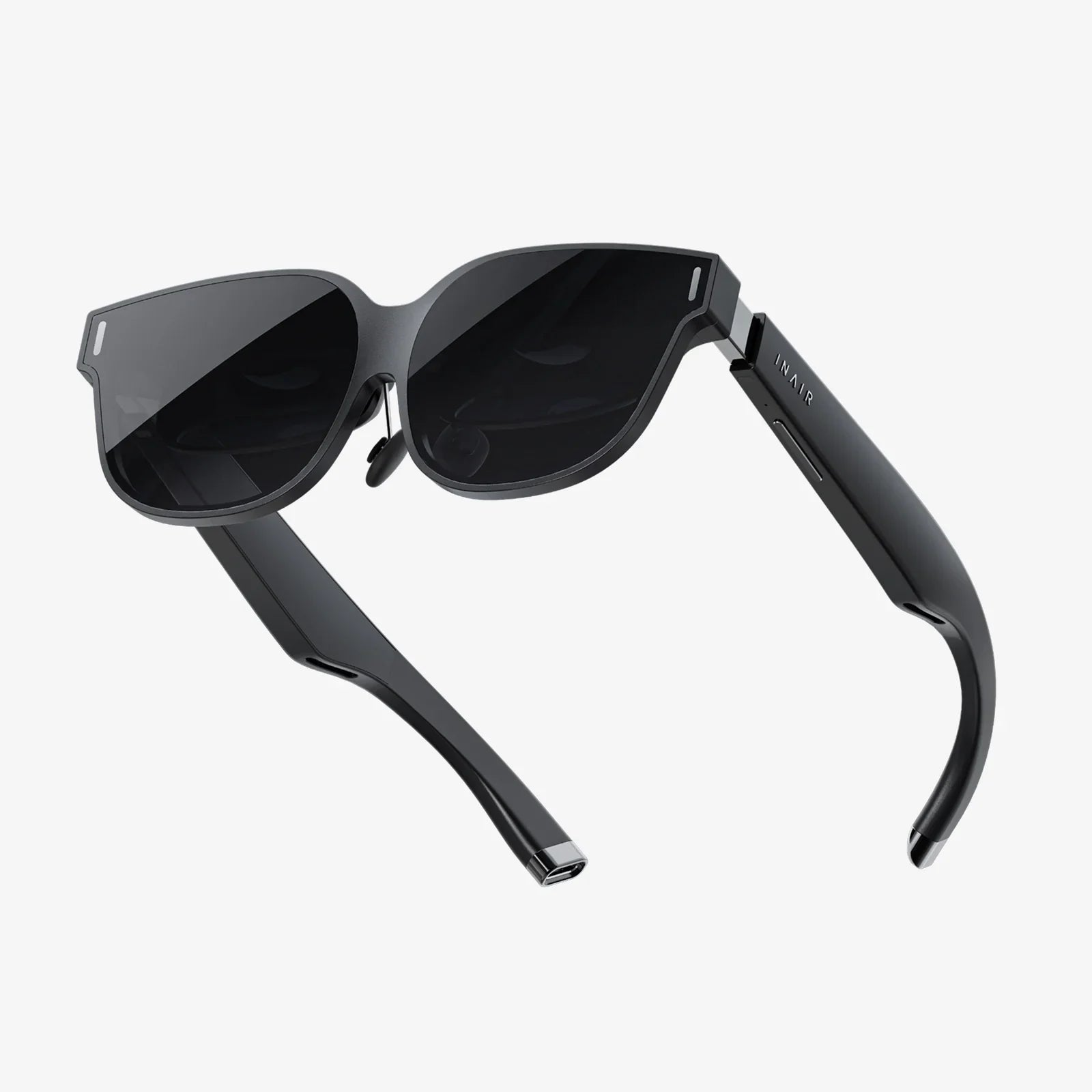
Imagine a world where information doesn’t live on a screen in your hand, but is seamlessly woven into the fabric of your reality. Where the line between the digital and the physical not only blurs but disappears, offering a layer of intelligence, context, and connection to everything you see and do. This is the promise of augmented reality AI glasses, a technological convergence that is poised to move from science fiction to mainstream reality, fundamentally altering how we work, learn, socialize, and perceive the world around us. This isn't just an incremental upgrade to our devices; it's a paradigm shift for human-computer interaction.
The Confluence of Two Revolutionary Technologies
To understand the potential of augmented reality AI glasses, one must first appreciate the powerful synergy of the two core technologies that define them. They are more than the sum of their parts; each amplifies the capabilities of the other to create something truly transformative.
The Augmented Reality Canvas
Augmented Reality (AR) provides the visual canvas. Unlike Virtual Reality (VR), which seeks to replace the real world with a simulated one, AR aims to supplement and enhance it. Early forms of AR, experienced through smartphone cameras, offered a glimpse of this potential but were inherently limited. The user was always aware they were looking through a device at a screen. True AR, as envisioned through dedicated glasses, projects digital imagery directly onto the user's retina or into their field of view using waveguides and micro-displays. This creates the illusion that holographic objects, data, and interfaces are part of the physical environment, anchored to specific locations and surfaces. This requires staggering advancements in optics, display technology, spatial mapping, and miniaturization to create a device that is both powerful and socially acceptable to wear.
The Artificial Intelligence Engine
If AR provides the canvas, then Artificial Intelligence (AI) is the artist, the curator, and the intelligent guide. Raw AR, without intelligence, is merely a projector. It can display information, but it cannot understand context, intent, or relevance. This is where AI, particularly modern machine learning and computer vision models, becomes indispensable. The AI engine in smart glasses performs several critical functions in real-time:
- Scene Understanding: The glasses' cameras continuously capture the environment. AI algorithms analyze this visual data to identify objects, people, text, and spatial geometry. It doesn't just see a "chair"; it understands the chair's position in 3D space, its type, and its relationship to other objects.
- Contextual Awareness: By combining visual data with other sensors—GPS, inertial measurement units (IMUs), microphones—the AI builds a rich, contextual model of the user's situation. It knows if you're in a kitchen, a workshop, a museum, or a busy street. It can understand your gaze, your gestures, and even your voice commands as a method of interaction.
- Intent Prediction and Information Filtering: This is the true magic. The AI must act as a proactive assistant, determining what information is relevant to you at any given moment and presenting it in an unobtrusive way. It needs to predict what you might need before you even ask for it. For instance, looking at a complex piece of machinery might bring up a schematic; glancing at a restaurant might show reviews from your friends; conversing with a colleague in a foreign language could provide real-time subtitles.
The fusion of these technologies creates a continuous, interactive feedback loop between the user and their enhanced environment. The glasses see what you see, the AI understands it, and the AR display presents a useful augmentation, all within milliseconds.
Beyond Novelty: Transformative Applications Across Industries
The potential applications for this technology extend far beyond gaming and entertainment. They promise to revolutionize entire sectors by providing workers with instant, hands-free access to information and expert guidance.
Revolutionizing the Frontline Workforce
Perhaps the most immediate and impactful use case is in industrial and field service settings. For a technician repairing a malfunctioning wind turbine, AR AI glasses can overlay animated repair instructions directly onto the equipment, highlight specific components with visual cues, and allow a remote expert to see their view and annotate the real world to guide them. This reduces errors, slashes training time, and empowers a single technician to perform complex tasks that previously required a team. Similarly, in logistics, warehouse workers can be guided on optimal picking routes with visual indicators overlaid on shelves, instantly verifying items and streamlining the entire supply chain. In healthcare, surgeons could have vital signs, 3D anatomical models, or surgical checklists displayed in their periphery without looking away from the patient.
Redefining Social Connection and Communication
AR AI glasses have the potential to become the most personal communication device ever created. Imagine a video call where the participant appears as a life-sized, realistic hologram sitting across from you in your living room, able to share and manipulate 3D models as if they were physically present. Real-time translation could break down language barriers not just in text, but in spoken conversation, with subtitles appearing near a person's face as they speak. For individuals with visual or hearing impairments, the technology could describe scenes, identify people, or amplify and transcribe sounds, acting as a powerful sensory aid.
The Future of Learning and Exploration
Education will be transformed from a passive to an immersive, interactive experience. A student learning about ancient Rome could walk through a digitally reconstructed Forum on their school playground. A mechanics student could take apart and reassemble a virtual engine hovering over their desk. Museum exhibits could come alive, with historical figures narrating their stories next to their artifacts. This form of contextual, experiential learning leverages spatial memory and could dramatically improve comprehension and retention.
The Invisible Interface: A New Paradigm for Computing
The evolution of personal computing has been a journey of abstraction and immersion. We moved from command-line interfaces (CLI) to the graphical user interface (GUI), which gave us the desktop metaphor and the mouse. Then came touchscreens, which made computing more direct and intuitive. AR AI glasses represent the next step: the invisible, ambient user interface (UI).
In this new paradigm, the UI is not confined to a rectangle of glass. It is spatial, dynamic, and context-sensitive. Instead of opening an app, you might simply look at an object and issue a voice command or perform a subtle gesture. A recipe could appear floating next to your mixing bowl, a navigational arrow could be painted onto the sidewalk in front of you, and your daily calendar could be a persistent, semi-transparent overlay in the corner of your vision. This shift promises to free us from the tyranny of the smartphone screen, allowing us to engage with digital content while remaining fully present in the physical world. It marks a move from "looking at" a computer to "living with" an intelligent assistant.
The Thorny Path Forward: Challenges and Ethical Imperatives
For all their promise, the widespread adoption of augmented reality AI glasses is fraught with significant technological, social, and ethical hurdles that must be addressed.
Technological Hurdles
The dream device—one that is lightweight, all-day comfortable, socially acceptable, visually stunning, and powerful—does not yet exist. Key challenges include:
- Battery Life: Processing high-fidelity AR and complex AI models is incredibly power-intensive. Innovations in low-power chipsets and battery technology are crucial.
- Display and Optics: Creating bright, high-resolution, wide-field-of-view displays that are small enough to fit into an eyeglass form factor remains a monumental challenge in physics and engineering.
- Thermal Management: All that computing power generates heat, which is difficult to dissipate in a device worn on the face.
- The "Perfection" Problem: Latency must be imperceptible, and digital objects must be perfectly tracked and anchored to the real world to avoid user discomfort or nausea.
The Privacy Paradox
This is arguably the most significant barrier. A device that sees and hears everything you do is a privacy advocate's nightmare. The potential for constant, pervasive surveillance—both by corporations and governments—is unprecedented. The ethical collection, storage, and use of this data are paramount. Solutions will need to be built on a foundation of radical transparency and user control. Features like physical camera shutters, clear activity indicators, and robust on-device processing (where data is analyzed locally instead of being sent to the cloud) will be essential to build trust.
Social Acceptance and the Digital Divide
Will people want to wear technology on their faces? Will conversations feel natural if one person is wearing glasses that are recording or displaying information? New social norms and etiquette will need to evolve. Furthermore, there is a risk that such powerful technology could exacerbate the digital divide, creating a new class of information-haves and have-nots. The cost of entry must be managed to prevent a new form of inequality based on access to augmented intelligence.
A Glimpse into the Ambient Future
The journey towards mainstream augmented reality AI glasses will be iterative. Early devices will likely be targeted at specific enterprise applications, where the ROI is clear and the social constraints are looser. These professional use cases will serve as the testing ground, refining the technology and driving down costs. Consumer versions will follow, evolving from bulky prototypes to increasingly sleek and capable form factors over the next decade.
We are moving towards a future of "ambient computing," where technology recedes into the background of our lives, and intelligence becomes an omnipresent, utility-like layer enhancing our natural human capabilities. The goal is not to escape reality into a digital world, but to make our reality richer, more informative, and more efficient.
The smartphone defined the last 15 years of technological interaction, centralizing our digital lives into a single device we constantly check. The next era won't be about a better screen; it will be about removing the screen altogether, allowing the digital and physical to coexist seamlessly. Augmented reality AI glasses are the key to unlocking this future—a future where the world itself becomes the interface, and our reality is limited only by our imagination. The revolution won't be televised; it will be projected directly onto our retinas, changing everything we see, and everything we are capable of, forever.
Share:
Augmented Reality Glasses Games: The Future of Play is Transparent
2025 Augmented Reality Glasses: The Dawn of a Seamless Digital Layer Over Reality