


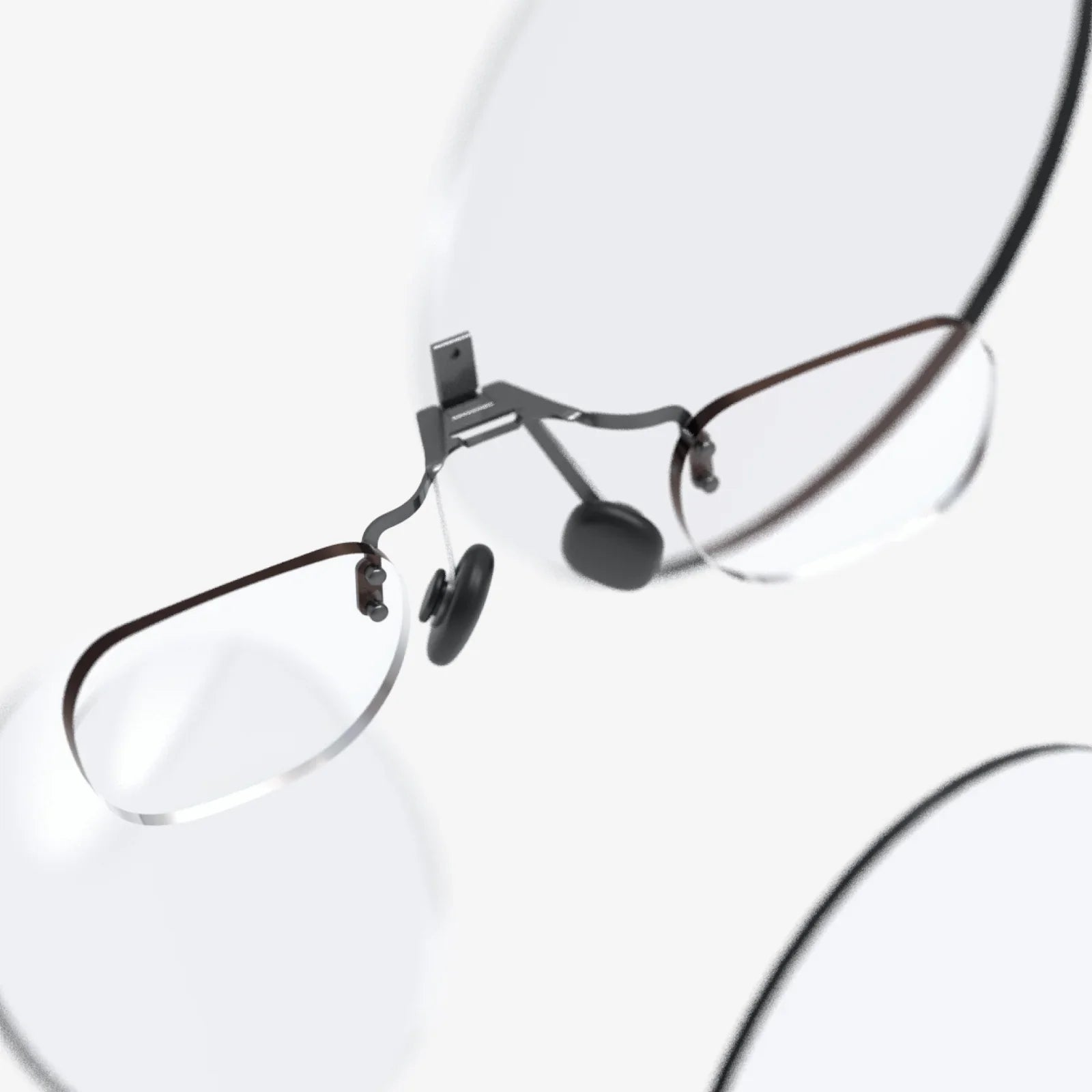
Imagine looking through your everyday glasses and seeing a world transformed—directions painted onto the sidewalk, the name of a passerby you met last year, a virtual sculpture standing proudly in a public square. This isn't a distant sci-fi fantasy; it's a reality being built today, not through bulky, expensive headsets, but through a quiet revolution: the augmented reality glasses attachment. This unassuming piece of technology promises to be the great democratizer of AR, turning the billions of existing glasses and sunglasses into gateways to the metaverse, and it’s poised to change everything.
The Core Concept: Enhancement Over Replacement
At its heart, an augmented reality glasses attachment is a self-contained module that clips or magnetically attaches to a standard pair of prescription glasses or sunglasses. Unlike dedicated AR headsets, which are all-in-one devices, an attachment operates on a principle of modularity. It contains the essential technological components for AR—micro-displays, waveguides, sensors, a battery, and a processing unit—while leveraging the familiar form factor of the glasses you already own and trust.
The philosophy is one of subtle enhancement rather than obtrusive replacement. It answers a critical user concern: people are often hesitant to swap their personally styled, comfortable eyewear for a single-function, tech-heavy device. An attachment sidesteps this entirely, offering a 'have your cake and eat it too' solution. You maintain your personal style, your perfect fit, and the primary function of vision correction or sun protection, while gaining a powerful digital layer of information and experience on demand.
Deconstructing the Technology: How the Magic Works
The magic of seeing digital images superimposed onto the real world is achieved through a sophisticated interplay of components miniaturized into the attachment's compact form.
The Optical Engine: Projecting the Digital World
This is the core of the experience. Tiny micro-displays, often based on technologies like MicroLED or LCoS (Liquid Crystal on Silicon), generate the images. These images are then directed into an optical combiner, typically a waveguide. This is a flat, transparent piece of glass or plastic with nano-scale etchings that acts like a holographic film. It 'bends' the light from the micro-display and directs it precisely into the user's eye, all while allowing ambient light from the real world to pass through unimpeded. The result is a crisp, bright digital overlay that appears to exist in the world in front of you.
Sensing the World: Cameras and Sensors
For the digital overlay to be contextually relevant and stable, the attachment must understand its environment. This is handled by a suite of sensors. Miniature cameras perform simultaneous localization and mapping (SLAM), building a real-time 3D map of the surroundings to anchor digital objects persistently. An inertial measurement unit (IMU)—containing accelerometers and gyroscopes—tracks the precise movement and orientation of your head. Depth sensors can gauge the distance to objects, and ambient light sensors adjust the display's brightness for optimal visibility. This sensor fusion creates a seamless blend between the digital and the physical.
Processing and Power: The Brain and Battery
All this data requires significant number-crunching. A compact, energy-efficient system-on-a-chip (SoC) inside the attachment handles the complex tasks of computer vision, spatial tracking, and rendering graphics. Powering this system is a small but mighty battery, often using lithium-polymer chemistry, designed to deliver several hours of continuous use. Efficient power management is paramount, balancing performance with the thermal and size constraints of the small form factor.
Interaction Paradigms: Beyond the Touchscreen
Interacting with a floating screen on your glasses requires new methods beyond the tap and swipe. Attachments employ innovative input systems:
- Voice Commands: A built-in microphone array allows for hands-free control using natural language, filtering out background noise to hear the user clearly.
- Touchpad: A small, discreet touch surface on the attachment itself enables swipe and tap gestures.
- Hand Tracking: The outward-facing cameras can track the user's hand movements, allowing them to 'grab' and manipulate virtual objects with gestures in mid-air.
- Head Gestures: Simple nods or shakes of the head can be used to confirm or dismiss notifications.
A World of Applications: Beyond Novelty
The true power of the augmented reality glasses attachment lies not in the technology itself, but in its transformative applications across countless domains.
Revolutionizing Enterprise and Field Work
This is where the technology is making its most immediate impact. For a technician repairing a complex piece of machinery, an attachment can project schematics, highlight specific components, and provide step-by-step animated instructions overlaid directly onto the equipment. For a warehouse worker, it can display optimal picking routes and instantly verify items with visual recognition, dramatically increasing efficiency and reducing errors. In healthcare, a surgeon could see vital signs and 3D surgical plans in their field of view without looking away from the patient. The hands-free, context-aware nature of the technology is a perfect fit for the modern workforce.
Redefining Navigation and Exploration
Imagine walking through a foreign city with turn-by-turn directions painted onto the streets themselves, or looking at a restaurant to instantly see its reviews and menu highlights. Tourists could gaze at a historical monument and see it restored to its former glory through their glasses. The attachment turns the entire world into an interactive, informative map, making exploration more intuitive and enriching.
Enhancing Social Connection and Accessibility
Future software could use facial recognition (with strict privacy controls) to subtly display the name and key details of someone you're talking to, a boon for networking events or for those with memory difficulties. For the hard of hearing, real-time speech-to-text transcription could be displayed as captions during a conversation, breaking down communication barriers. It has the potential to become a powerful tool for social accessibility and connection.
The Future of Entertainment and Gaming
While current gaming is dominated by dedicated VR headsets, AR attachments offer a more social and mobile alternative. They could enable tabletop games with digital characters battling it out on your coffee table, or location-based adventures where players hunt for virtual creatures hidden in local parks. Watching a sports game at a stadium could be enhanced with player stats and replays floating above the field, all through your own sunglasses.
Navigating the Challenges: The Road Ahead
Despite its immense potential, the path for the augmented reality glasses attachment is not without significant hurdles.
The Form Factor Conundrum
The ultimate goal is invisibility. The current challenge is balancing battery life, processing power, and display brightness against size, weight, and heat. The ideal attachment must be so light and small that the user forgets it's there. Achieving this requires breakthroughs in miniaturization, battery energy density, and computational efficiency.
The Privacy Imperative
A device with always-on cameras raises legitimate privacy concerns. The industry must adopt a privacy-by-design approach. This includes clear physical indicators when the camera is active, robust data encryption, on-device processing for sensitive information like facial recognition, and transparent user controls over what data is collected and how it is used. Building public trust is non-negotiable for widespread adoption.
Building the Ecosystem
Hardware is useless without software. A thriving ecosystem of developers needs to be cultivated to create the killer apps that will drive consumer and enterprise demand. This requires robust software development kits (SDKs), cloud services for persistent AR content, and clear use cases that demonstrate undeniable value.
A Comparative Glimpse: Attachment vs. All-in-One
It's important to distinguish this category from dedicated AR glasses.
| Feature | Augmented Reality Glasses Attachment | Dedicated AR Glasses |
|---|---|---|
| Cost | Potentially lower, as it leverages existing eyewear | Typically higher, as it includes the frame and lenses |
| Style & Personalization | High; works with the user's chosen glasses | Limited to available designs and prescriptions |
| Adoption Barrier | Low; feels like an upgrade, not a replacement | Higher; requires a switch to a new device |
| Technical Performance | Can be constrained by size/weight limitations | Potentially higher, with more space for tech |
| Target Audience | Mass market, everyday users, enterprises | Early adopters, specific enterprise verticals |
This isn't a winner-takes-all market. Both form factors will likely coexist, serving different needs and preferences. The attachment, however, holds a unique key to mass-market adoption.
The Invisible Revolution
The most profound technologies are those that weave themselves into the fabric of everyday life until they are indistinguishable from it. The augmented reality glasses attachment embodies this principle. It doesn't seek to change what we wear on our faces; it seeks to augment what we experience through them. By building upon the familiar, it offers a less intimidating, more accessible, and more personal path into augmented reality. It’s the bridge from our analog present to a digitally-enhanced future, and it’s a bridge being built to fit perfectly on the pair of glasses you’re already wearing. The next time you put them on, just imagine what you might see.
Share:
Popular Wearable Technology: From Fitness Trackers to the Future of Connected Living
Augmented Reality Glasses Device: The Invisible Revolution Reshaping Our World