


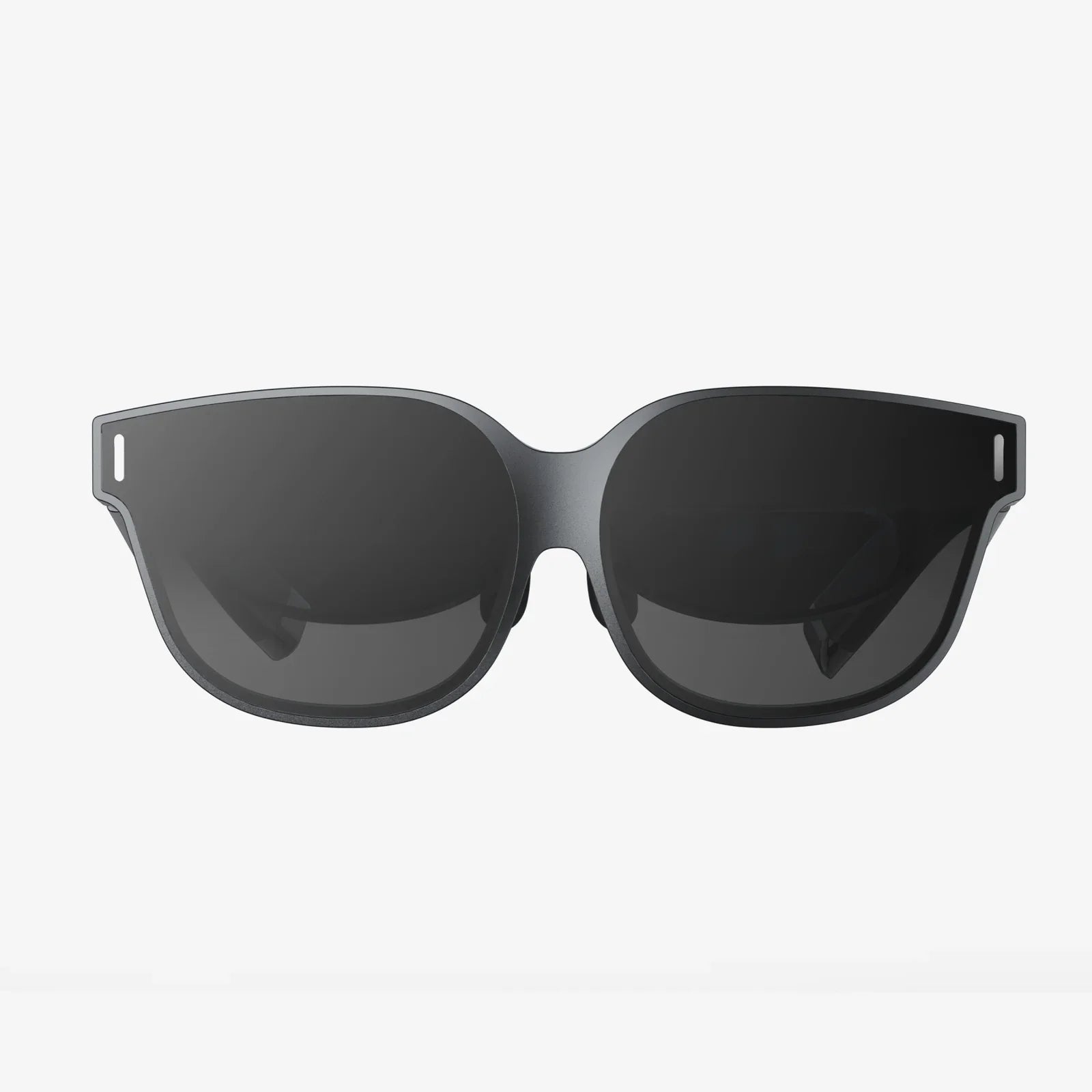
Imagine a world where digital information doesn’t just live on a screen in your hand, but is seamlessly woven into the very fabric of your reality. Where instructions for assembling complex machinery float helpfully in your field of view, where historical figures narrate the ruins you’re exploring, and where a virtual pet dragon genuinely perches on your colleague’s desk during a video call. This is the promise, the potential, and the profound shift heralded by the advent of consumer-ready augmented reality goggles. This isn't science fiction; it's the next frontier of human-computer interaction, and it’s arriving faster than many anticipate.
The Core Technology: How AR Goggles Create a Blended World
At their essence, augmented reality goggles are sophisticated wearable computers designed to overlay digital content—images, video, text, and 3D models—onto the user’s view of the real world. Unlike virtual reality, which seeks to replace reality entirely, AR aims to supplement and enhance it. This magic is achieved through a complex symphony of hardware and software components working in perfect harmony.
The journey begins with a suite of advanced sensors. Cameras continuously scan the environment, while depth sensors and LiDAR (Light Detection and Ranging) systems fire out invisible lasers to map the geometry, distance, and surfaces of the physical space with millimeter precision. This creates a real-time 3D map, allowing digital objects to understand the world they are being placed into—so a virtual character can convincingly sit on your real couch, and a digital tennis ball can bounce off your actual wall.
Simultaneously, an Inertial Measurement Unit (IMU)—comprising accelerometers and gyroscopes—tracks the precise movement and rotation of your head with incredible speed and accuracy. This ensures the digital overlay remains locked in place as you move, preventing a disorienting lag or drift that would shatter the illusion.
The final, and perhaps most crucial, act is the display. This is where the real technological marvel lies. Most high-end systems use a form of waveguide or holographic optical projection. In simple terms, micro-displays generate the images, which are then bounced through a series of tiny, transparent lenses or gratings etched into the glass of the goggles before being projected directly into the user’s eyes. This creates the perception that the bright, high-resolution digital content is existing out in the world, at various depths, while still allowing the user to see their natural surroundings clearly. Advanced software and powerful onboard processors act as the conductor, orchestrating all these inputs and outputs in real-time to create a stable, convincing, and interactive augmented experience.
Beyond Novelty: The Transformative Applications
While the concept might conjure images of gaming and entertainment, the true power of AR goggles lies in their potential for utility and transformation across nearly every professional field.
Revolutionizing Enterprise and Industry
In manufacturing and complex machinery repair, technicians can use AR goggles to see step-by-step holographic instructions overlaid directly onto the engine or assembly they are working on. They can pull up schematics hands-free, connect with a remote expert who can see their view and annotate the real world to guide them, and drastically reduce errors and training time. Architects and interior designers can walk through full-scale 3D models of their creations long before a single brick is laid, allowing for immersive client presentations and design iterations. Logistics and warehouse workers can have order-picking information and optimal navigation routes displayed in their vision, dramatically increasing efficiency and accuracy.
Redefining Healthcare and Medicine
The applications in medicine are nothing short of revolutionary. Surgeons can have critical patient vitals, ultrasound data, or 3D anatomical models projected into their field of view during procedures, eliminating the need to look away at monitors. Medical students can practice complex surgeries on detailed holographic cadavers. Furthermore, AR goggles can serve as powerful assistive technology, helping individuals with visual impairments by highlighting obstacles, amplifying contrasts, and reading text from signs aloud in real-time.
Reshaping Education and Training
Education will move from passive learning to active, experiential discovery. Instead of reading about ancient Rome, students can walk through a digitally reconstructed Forum right in their classroom. Chemistry students can manipulate hazardous virtual chemicals without any risk. Mechanics-in-training can practice taking apart and reassembling a holographic transmission countless times before touching real, expensive equipment. This learning-by-doing in a simulated, yet realistic, environment has the potential to unlock deeper understanding and retention.
Enhancing Social Connection and Remote Work
AR goggles promise to evolve telepresence from flat video calls into a feeling of genuine shared presence. Instead of looking at a grid of faces on a screen, colleagues from around the world could appear as realistic avatars or holograms in your living room, able to collaborate on a 3D model of a new product design as if they were physically there. This spatial computing paradigm could dissolve geographical barriers for collaboration, making remote work more nuanced, personal, and effective.
The Other Side of the Lens: Challenges and Ethical Considerations
For all its promise, the path to widespread adoption of AR goggles is fraught with significant technological, social, and ethical hurdles that must be thoughtfully addressed.
The Hardware Hurdle
Currently, achieving high-fidelity, wide-field-of-view AR in a comfortable, socially acceptable, and affordable form factor remains the paramount challenge. Early devices often face a trade-off between power and size, battery life and capability, or visual fidelity and cost. Creating glasses that are as lightweight, stylish, and unobtrusive as everyday eyewear, yet pack the computing power of a high-end laptop, is the holy grail that engineers are racing toward.
The Privacy Paradox
This is perhaps the most pressing concern. AR goggles, by their very nature, are equipped with always-on cameras and microphones that constantly scan the user’s environment. This raises profound questions about surveillance, data ownership, and consent. Who has access to the continuous video feed of your life? How is that data stored, analyzed, and used? Could it be used for unauthorized advertising or even government monitoring? The potential for a dystopian future where our every interaction is recorded and parsed by corporations is a legitimate fear that must be mitigated through robust, transparent privacy frameworks and ethical design principles from the outset.
The Social and Psychological Impact
What does it mean for human interaction when people are partially immersed in a digital layer during conversations? Will we develop new social etiquette for when it is appropriate to use such devices? There is a risk of further atomization, where individuals retreat into personalized digital realities even while physically together. Furthermore, the blurring line between real and virtual could have psychological effects, potentially leading to a form of dissociation or difficulty engaging with an un-augmented world. The constant stream of notifications and information could also exacerbate digital addiction and overwhelm our attention spans.
The Digital Divide and Accessibility
As with any transformative technology, there is a risk that AR goggles could initially be a luxury product, creating a new kind of digital divide between those who can afford to access this enhanced layer of reality and those who cannot. This could lead to inequalities in education, job opportunities, and access to information. Ensuring the technology is developed with accessibility as a core principle, not an afterthought, is crucial to prevent the exclusion of people with disabilities.
The Future Vision: Where Do We Go From Here?
The current generation of AR goggles are the equivalent of the clunky mobile phones of the 1980s—impressive for their time, but a mere glimpse of the sleek, powerful, and ubiquitous smartphones to come. The trajectory points toward devices that are lighter, more powerful, and eventually, indistinguishable from regular glasses.
In the near future, we can expect improvements in battery technology, perhaps leveraging ultra-capacitors or new energy-dense chemistries, to enable all-day use. Display technology will advance to offer wider fields of view, higher resolution, and more realistic occlusion—where digital objects can convincingly pass behind real-world objects. User interfaces will evolve beyond hand gestures and voice commands to include more intuitive methods like neural input, reading subtle electrical signals from the brain to allow for control by mere thought.
Long-term, the goal is the development of true contextual and ambient intelligence. Your AR glasses will not just display information, but will understand your context, anticipate your needs, and provide relevant information without you even asking. They will become an indispensable personal assistant, memory aid, and creative tool, seamlessly integrated into the periphery of your perception until the technology itself fades into the background, leaving only the enhanced capability.
The journey of the augmented reality goggle is just beginning. It is a tool of immense power, capable of reshaping reality as we know it. Its ultimate impact—whether it becomes a force for universal empowerment or a new vector for inequality and control—will not be determined by the technology itself, but by the choices we make as developers, policymakers, and users in designing and integrating it into the very fabric of our society. The blend is coming; it is our collective responsibility to ensure it’s a future we all want to see.
Share:
VR Glasses for Work: The Dawn of the Immersive Office and Its Revolutionary Potential
Augmented Reality Market Growth: A Comprehensive Analysis of the Digital Revolution