


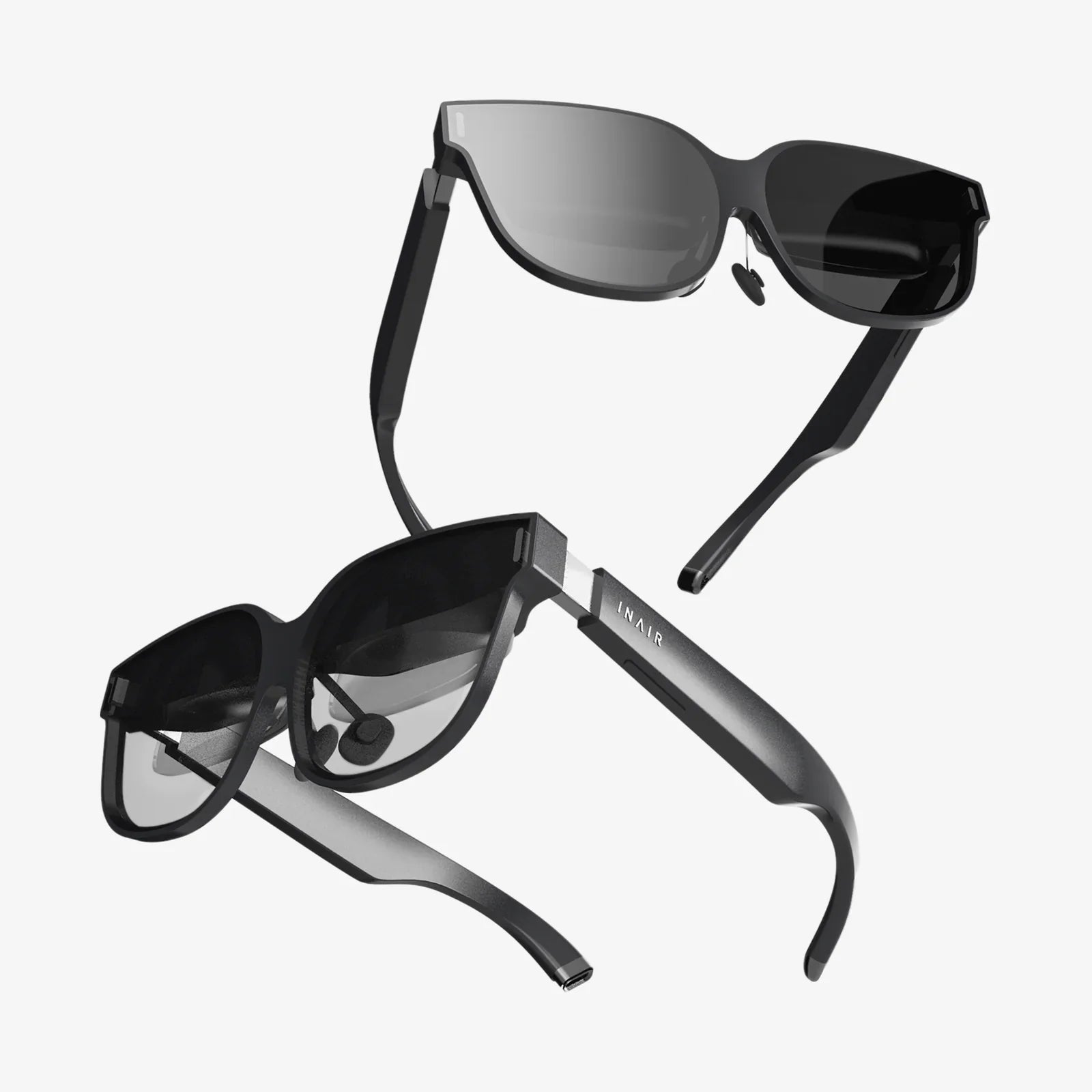
Imagine a world where digital information doesn’t live on a screen in your hand or on your desk, but is instead painted onto the very fabric of reality. Instructions for assembling complex machinery float in mid-air, pointing directly to the parts you need. The history of the building you’re walking past is displayed on its facade, narrated by a virtual guide. A colleague from another continent stands in your living room, their holographic form gesturing to a 3D model you can both manipulate. This is the promise, and the impending reality, of advanced augmented reality VR glasses—a technology not of isolation, but of profound connection and context. We are standing on the precipice of a paradigm shift in human-computer interaction, one that will make the smartphone revolution look like a mere prelude.
Beyond the Hype: Defining the True Nature of AR Glasses
To understand the transformative potential of this technology, we must first move beyond the simplistic view of it as merely a wearable display. At its core, augmented reality (AR) through advanced glasses is about contextual computing. It is a system designed to understand the world around you and provide the right information, at the right time, in the right place. Unlike virtual reality (VR), which seeks to replace your reality with a digital one, AR aims to enhance and augment your existing reality.
The hardware required to achieve this seamless blend is extraordinarily complex. Modern AR glasses are packed with a suite of sophisticated sensors, including:
- High-Resolution Cameras: These act as the eyes of the device, continuously scanning the environment to understand spatial geometry, track surfaces, and identify objects.
- Depth Sensors (LiDAR/ToF): These project invisible dots or lasers to measure the precise distance to every surface in the room, creating a real-time 3D map of your surroundings. This is crucial for placing digital objects so they appear locked in place.
- Inertial Measurement Units (IMUs): Comprising accelerometers and gyroscopes, these track the precise movement and rotation of your head with millimetre accuracy, ensuring the digital overlay doesn’t lag or jitter.
- Advanced Displays: Using technologies like waveguides, micro-LEDs, or holographic optics, these tiny projectors beam light directly into your eyes, creating the illusion that digital images exist in the real world at various focal depths.
All this sensor data is processed by powerful, miniaturized chips that run complex algorithms for simultaneous localization and mapping (SLAM). This is the magic trick: the glasses are constantly building a map of the unknown environment while simultaneously tracking their own position within it. This allows a virtual dinosaur to convincingly walk across your real coffee table, knowing exactly where the table begins and ends.
The Architectural and Industrial Metamorphosis
While consumer applications capture the imagination, it is in enterprise and industrial settings where AR glasses are already delivering staggering returns on investment and fundamentally changing workflows. The value proposition here is undeniable: providing hands-free access to critical information and expert guidance directly within the worker’s field of view.
In manufacturing and complex assembly, technicians no longer need to constantly look down at paper manuals or tablet screens. With AR glasses, digital work instructions are superimposed onto the machinery itself. An arrow can point to the exact bolt that needs tightening, a video can demonstrate the correct installation procedure right on the part, and safety warnings can flash if a worker approaches a hazardous area. This not only drastically reduces errors and training time but also significantly improves workplace safety.
For architects, engineers, and construction professionals, the implications are profound. They can don a pair of glasses and walk through a building site, seeing the architect’s 3D BIM model perfectly overlaid onto the unfinished steel and concrete. They can verify that plumbing and electrical conduits are being run according to plan before the drywall goes up, identifying costly conflicts months before they would traditionally be discovered. This ability to "see through walls" is revolutionizing project management, reducing waste, and ensuring fidelity to the original design intent.
Remote assistance is another killer application. A field service technician faced with a broken piece of equipment can stream their live view to an expert thousands of miles away. That expert can then draw annotations—arrows, circles, notes—that appear pinned to the real-world equipment in the technician’s view, guiding them through the repair step-by-step. This democratizes expertise, reduces travel costs, and minimizes equipment downtime from days to mere hours.
Redefining the Human Experience: Social and Educational Frontiers
The impact of AR glasses will extend far beyond the factory floor, seeping into the very ways we learn, communicate, and socialize. Education, often constrained by the limits of textbooks and 2D screens, will be utterly transformed. Imagine a history class where students can witness a historical event unfold around them as a holographic play, or a biology lesson where they can walk around a life-sized, beating human heart, peeling back layers to see the ventricles and arteries. This shift from passive learning to active, immersive exploration will cater to diverse learning styles and make complex subjects intuitively understandable.
The concept of social interaction and presence will also be redefined. Current video calls are a poor facsimile of face-to-face conversation; we lose the nuance of body language and shared space. AR glasses promise "holoportation"—the ability to project a photorealistic, 3D avatar of a person into your environment in real-time. You could have a business meeting with three colleagues from different countries, all appearing to sit around your table. Families separated by geography could share everyday moments, like reading a bedtime story, as if they were in the same room. This has the potential to alleviate the profound sense of isolation that can come with physical distance.
Navigation and exploration will become effortless. Instead of holding up a phone and following a blue dot on a map, directions will be painted onto the sidewalk ahead of you. Points of interest will be highlighted as you walk through a new city, with reviews and historical facts floating beside restaurants and monuments. Language barriers could dissolve, with real-time translation subtitles appearing under a speaking person’s face.
The Invisible Elephant in the Room: Challenges and Ethical Considerations
For all its promise, the path to ubiquitous AR adoption is fraught with significant technological, social, and ethical challenges that society must confront. The first and most obvious hurdle is the hardware itself. For true all-day wearability, AR glasses must become as lightweight, comfortable, and socially acceptable as a standard pair of eyeglasses. The technology must become virtually invisible. This requires massive breakthroughs in battery life, display technology, and thermal management (preventing the device from overheating).
However, the most profound challenges are not technical, but human and ethical. The concept of the "attention economy" will reach a new zenith. If companies can place virtual advertisements on every physical surface you look at, how do we prevent a dystopian nightmare of visual spam and information overload? Who controls this digital layer of reality? The potential for distraction is also immense; walking down a street with digital notifications constantly vying for your attention poses serious safety risks to both the user and those around them.
The privacy implications are staggering. AR glasses, by their very nature, are constantly capturing video and audio of their surroundings. This raises a host of alarming questions: Where is this data stored? Who has access to it? How is it used? The potential for pervasive surveillance, either by corporations or governments, is unprecedented. Clear regulations and robust, privacy-by-design frameworks must be established before this technology becomes mainstream. Furthermore, the digital divide could widen into a chasm, creating a world of AR "haves" who enjoy an information-rich reality and "have-nots" who are left with an un-augmented, and therefore disadvantaged, existence.
Gazing into the Crystal Ball: The Next Decade and Beyond
The journey of AR glasses is just beginning. The current generation of devices are the equivalent of the brick-sized mobile phones of the 1980s—clunky, expensive, and limited to specific use cases. But the trajectory is clear. We will see rapid iteration towards smaller, more powerful, and more affordable devices.
In the near term, we can expect glasses to become a companion device to our smartphones, handling specific AR tasks. The next phase will see them becoming standalone computing platforms in their own right, potentially replacing the smartphone for many tasks. Further out, the technology may evolve beyond glasses altogether. Research into direct retinal projection, neural interfaces, and even smart contact lenses suggests that the ultimate goal is to have the digital layer be truly seamless and invisible, accessible with a mere thought.
The true killer application for AR might not be a single app, but rather the platform itself—the ability to persistently anchor digital information to the physical world. This creates a shared, collaborative canvas for humanity, a living encyclopedia layered on top of our reality. It could become the primary way we interact with the burgeoning Internet of Things, controlling our smart homes with a glance, or visualizing the data from millions of connected sensors.
The revolution ushered in by augmented reality VR glasses won't be announced with fanfare; it will creep into our lives, application by application, until one day we look up and realize we can no longer imagine a world without this digital sixth sense. It promises to amplify human potential, break down barriers of distance and understanding, and give us new tools to solve the world's most complex problems. But it also demands a new level of digital literacy, ethical consideration, and societal consensus. The future is not something we enter; it's something we create. And with AR glasses, we are being handed the tools to paint that future directly onto the canvas of our world, for better or for worse. The question is no longer if this future will arrive, but what we will choose to build when it does.
Share:
Augmented Reality Glasses for Work: The Dawn of the Immersive Office
AR Augmented Reality Glasses: The Invisible Revolution Reshaping Our World