


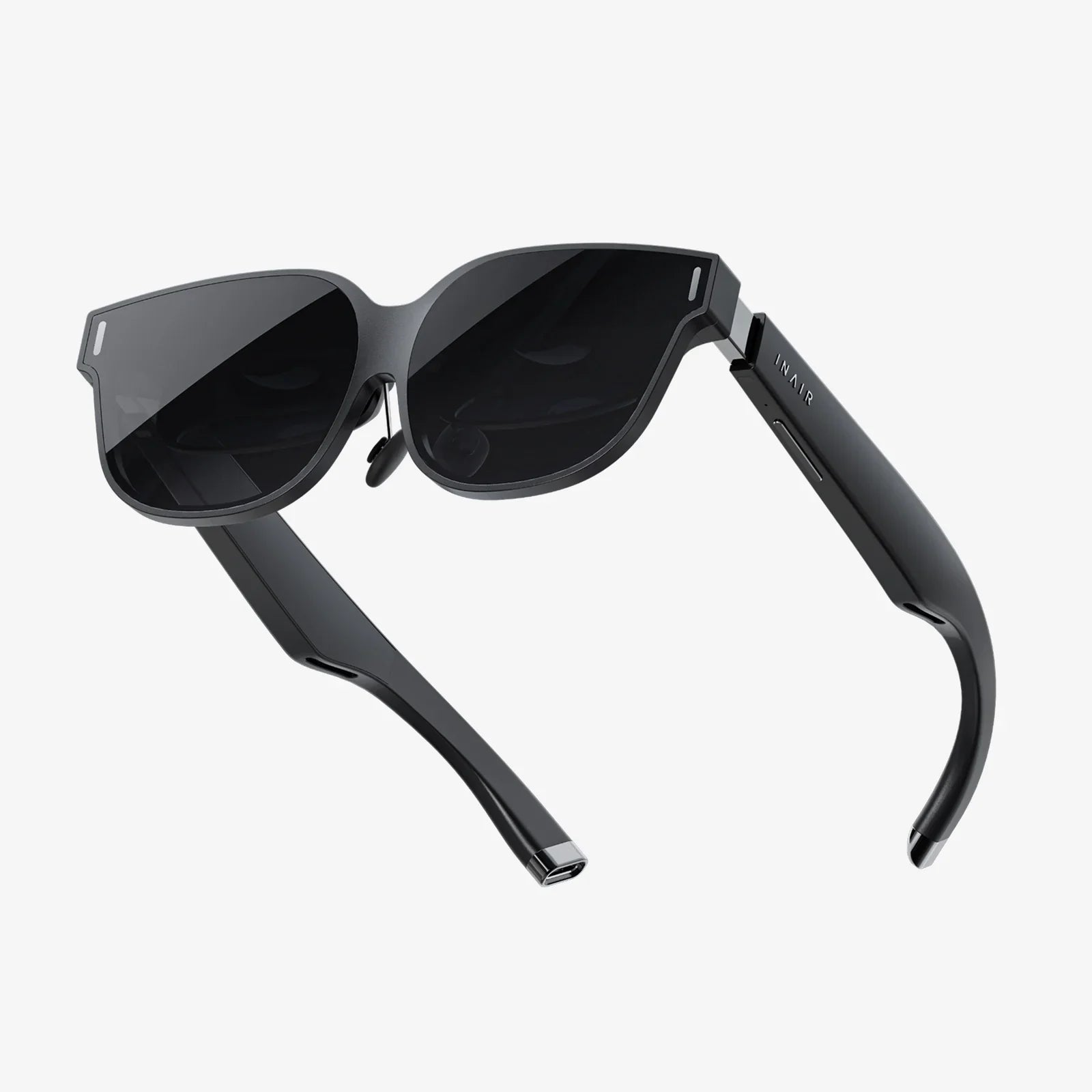
Imagine a world where your morning run is guided by a virtual coach floating beside you, where the history of the building you pass is narrated by a digital historian only you can see, and your workspace is an infinite, multi-monitor setup projected onto your empty desk. This is not a distant science fiction fantasy; it is the imminent future being unlocked by a new class of wearable technology: augmented VR glasses. This revolutionary fusion of immersive virtual environments with context-aware digital overlays on our physical world promises to be the most transformative computing platform since the smartphone, and it’s poised to change everything we know about work, play, and human connection.
The Confluence of Realities: Defining the Technology
For years, virtual reality (VR) and augmented reality (AR) have existed on parallel, yet distinct, technological paths. VR headsets transport users to entirely computer-generated environments, offering deep immersion at the cost of isolating them from their physical surroundings. AR devices, often in the form of simpler glasses or even smartphone screens, overlay digital information like directions or notifications onto the real world, but typically lack a deeply immersive quality.
Augmented VR glasses represent the synthesis of these two approaches. They are advanced headsets that utilize a combination of sophisticated hardware to create a seamless blend of real and virtual:
- High-Resolution Passthrough Cameras: Instead of simple transparent lenses, these devices use outward-facing cameras to capture the user's environment in real-time, reconstructing it digitally with stunning clarity and low latency.
- Powerful Spatial Computing: Onboard sensors, including LiDAR, depth sensors, and inertial measurement units (IMUs), constantly map the physical space, understanding the geometry of rooms, the position of objects, and the user's precise location within it.
- Immersive Displays: High-density micro-OLED displays project both fully virtual scenes and digital holograms onto the user's view of the passthrough video feed, ensuring virtual objects appear solid, occluded by real-world objects, and locked in place.
- Intuitive Interaction: Control is achieved through a combination of hand-tracking, eye-tracking, voice commands, and optional controllers, allowing users to manipulate digital content as naturally as they would physical objects.
The magic lies in the software. Advanced computer vision algorithms and artificial intelligence work in tandem to understand the context of the user's environment. The device doesn't just see a table; it recognizes it as a surface. It identifies walls, windows, and even other people, allowing for believable and persistent interactions between the digital and the physical.
Beyond Novelty: Transformative Applications Across Industries
The true power of augmented VR glasses is not in the technology itself, but in its practical applications. It is a foundational tool that will redefine procedures and create new possibilities across numerous sectors.
Revolutionizing the Professional Workspace
The concept of the office is being dismantled. With augmented VR glasses, knowledge workers can create their ideal digital workspace anywhere. A single, lightweight headset can replace multiple physical monitors, projecting a vast, customizable screen layout onto any blank wall. Colleagues from across the globe can appear as life-like avatars in your living room, able to collaboratively manipulate 3D models, architectural plans, or complex data visualizations that are anchored to your coffee table. For design and engineering, technicians can see schematics and step-by-step instructions overlaid directly onto the machinery they are repairing, drastically reducing errors and training time. This technology promises to make remote collaboration more expressive and productive than ever before, bridging the gap between physical presence and digital convenience.
A New Paradigm for Education and Training
Learning will leap off the page and into three-dimensional space. Medical students will be able to practice intricate surgical procedures on hyper-realistic virtual patients, with guidance from an AI tutor, before ever touching a scalpel. History classes can become immersive experiences, with students walking through digitally reconstructed ancient Rome, witnessing events unfold around them. Mechanics-in-training can see the internal workings of an engine superimposed over a physical block, understanding complex systems intuitively. This experiential learning model caters to various learning styles and provides safe, repeatable, and cost-effective training for high-stakes professions.
Redefining Social Connection and Entertainment
The social implications are profound. Instead of flat video calls, friends and family could share a virtual space, watching a movie on a virtual big screen as if they were in the same theater, or playing board games on a real table with digital pieces. Live events, from concerts to sporting matches, could be experienced from the best seat in the house from the comfort of your home, with real-time stats and interactive elements floating around the action. Gaming will evolve into a mixed-reality playground where your entire home becomes the level, with virtual creatures hiding behind your furniture and gameplay mechanics that interact with your physical environment.
Enhancing Daily Life and Accessibility
The utility extends into mundane daily tasks. Navigation can be transformed with arrows painted onto the sidewalk, and floating signposts pointing the way. Shopping could involve seeing how a new piece of furniture would look in your room at actual scale before purchase. For individuals with visual or hearing impairments, these devices could offer powerful assistive capabilities, highlighting obstacles, amplifying sounds, or providing real-time captions for conversations happening around them.
Navigating the Obstacles: Challenges on the Path to Adoption
Despite the exciting potential, the path to mainstream adoption of augmented VR glasses is fraught with significant technological and social hurdles that must be overcome.
- Hardware Limitations: Current devices, while impressive, are often still too bulky, heavy, and power-hungry for all-day wear. Achieving a form factor that is socially acceptable and comfortable—akin to standard eyeglasses—requires major breakthroughs in miniaturization, battery technology, and heat dissipation.
- The Visual Fidelity Gap: For the illusion of mixed reality to be perfect, the passthrough video quality must be indistinguishable to the human eye. This requires cameras and displays with incredibly high resolution, dynamic range, and minimal latency to avoid motion sickness. We are not quite there yet.
- The Killer App Question: While many compelling use cases exist, the platform likely needs one defining "killer application"—a use so compelling that it drives mass consumer adoption, much like email and the web did for the personal computer.
- The Privacy Conundrum: These devices, by their very nature, are data collection machines. They have cameras and microphones that are always on, continuously scanning and interpreting your environment. This raises monumental questions about data ownership, consent, and surveillance. Who has access to this data? How is it stored and used? The potential for misuse is staggering and requires robust, forward-thinking regulation and transparent policies from manufacturers.
- Social Acceptance and Digital Divide: Wearing a conspicuous headset in public may face social resistance. Furthermore, there is a risk that the high cost of early technology could exacerbate a new "digital divide," creating a gap between those who can afford to augment their reality and those who cannot.
The Ethical Landscape: Designing a Responsible Future
The development of augmented VR glasses is not merely a technical challenge; it is an ethical imperative. As we build this new layer onto reality, we must be intentional about the world we are creating.
How do we prevent the creation of endless, personalized filter bubbles that alter our perception of shared reality? Could persistent advertising and notifications lead to a new form of attention capitalism, more invasive than anything we've seen before? The potential for distraction is also immense; walking down the street immersed in a digital overlay poses clear safety risks to oneself and others.
These questions do not have easy answers. They require collaboration between technologists, ethicists, policymakers, and the public to establish norms and guardrails before the technology becomes ubiquitous. The goal must be to design systems that prioritize human well-being, promote shared experiences, and protect individual autonomy and privacy from the ground up.
The journey of augmented VR glasses is just beginning. From clunky prototypes to sleek, powerful devices, the progress has been rapid. We are moving from a era of isolationist virtual reality and simple smartphone-based augmentation into a new age of spatial computing—one where our digital and physical lives are woven together into a single, continuous tapestry. The devices on the horizon are the key to unlocking this synthesis. They promise to augment not just our reality, but our human potential, changing how we learn, work, create, and connect in ways we are only starting to imagine. The boundary between the real and the virtual is dissolving, and a new, blended world is waiting to be explored.
Share:
Augmented Reality Market Size 2025: A Deep Dive into the Future of Digital Interaction
AR VR Integration: The Seamless Convergence Reshaping Reality