


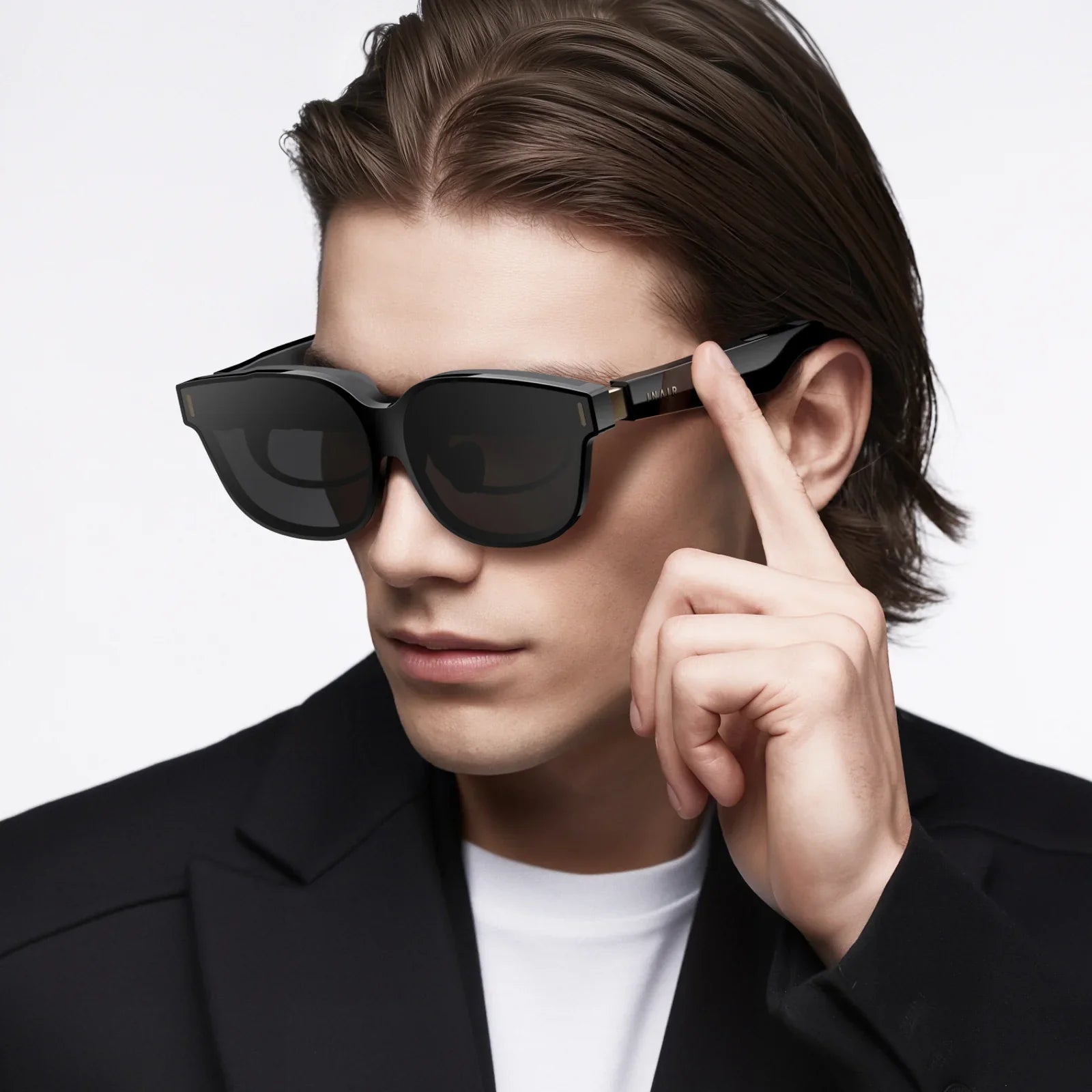
Imagine a world where digital information doesn't live on a screen in your hand, but is seamlessly painted onto the canvas of your reality. Where directions float on the street in front of you, the history of a monument unfolds before your eyes, and a colleague from another continent stands in your living room, discussing a 3D model you can both touch and manipulate. This is the promise of augmented and extended reality, a future not of science fiction, but of imminent technology, all delivered through a pair of sleek, sophisticated AR XR glasses. The quest for the perfect pair is more than a search for a gadget; it's a journey to find the key that unlocks a new layer of human-computer interaction.
Beyond the Hype: Defining AR, VR, and the Emergence of XR
To understand what makes for the best AR XR glasses, we must first cut through the acronyms and marketing jargon. The spectrum of immersive technologies is often grouped under the umbrella term Extended Reality (XR), which encompasses everything from fully digital to digitally-enhanced real worlds.
Virtual Reality (VR) is the most immersive, completely replacing your field of vision with a computer-generated environment. It transports you elsewhere, typically using a fully enclosed headset.
Augmented Reality (AR) overlays digital content—images, text, 3D models—onto the real world. The best AR glasses allow you to see your physical environment clearly, with digital elements anchored within it. Think of it as a heads-up display for life.
Mixed Reality (MR) is a more advanced subset of AR where digital objects don't just overlay the real world but can interact with it. A virtual ball in MR could bounce off your real table and roll behind your real sofa, with the glasses understanding the geometry and physics of your space.
Extended Reality (XR) is the catch-all term for this entire spectrum. When we talk about the "best XR glasses," we are often referring to devices capable of high-fidelity AR and MR experiences, blending the lines between worlds.
The Core Technologies Powering Modern AR XR Glasses
The magic of these devices isn't magic at all; it's a symphony of advanced hardware and software working in perfect harmony. Several key technologies differentiate premium devices from mere novelties.
Optical Systems: Waveguides vs. Birdbath
How do you project an image from a tiny display into your eye while still allowing you to see the world? This is the central challenge of AR optics. The two dominant solutions are:
- Waveguide Displays: Considered the gold standard for sleek, consumer-ready glasses. This technology uses microscopic gratings on a clear piece of glass or plastic to "pipe" light from a projector on the temple into your eye. The result is a thin lens form factor and a bright, clear image. Different types exist, including Diffractive Waveguides (often used in larger-scale production) and HoloWaveguides (a more advanced, efficient variant).
- Birdbath Optics: This design uses a beamsplitter (the "birdbath") to reflect the image from a micro-OLED display into your eye while allowing ambient light to pass through. It often produces richer colors and higher contrast but can result in a slightly bulkier optical module compared to advanced waveguides.
Spatial Mapping and Tracking: The Digital Nervous System
For digital objects to feel real, they must understand your environment. This is achieved through a suite of sensors:
- Cameras: Multiple monochrome and RGB cameras continuously scan the room to build a 3D depth map.
- LiDAR (Light Detection and Ranging): A scanner that fires out laser pulses to measure the exact distance to surfaces, creating a highly accurate digital mesh of the space. This allows for precise occlusion, where virtual objects can be hidden behind real-world furniture.
- IMUs (Inertial Measurement Units): Accelerometers and gyroscopes track the precise movement and rotation of your head with minimal latency, preventing motion sickness.
- Eye Tracking: Cameras that monitor where your pupils are pointing. This enables intuitive interaction (just look at a button to select it), dynamic foveated rendering (where only the spot you're looking at is rendered in full detail to save processing power), and more realistic avatars in social settings.
Processing Power: The Brain Behind the Beauty
All this sensor data must be processed in real-time. Some glasses rely on a tethered connection to a powerful smartphone or computer. The best standalone AR XR glasses, however, pack a dedicated processing unit—often a customized version of a mobile system-on-a-chip—capable of handling the immense computational load of simultaneous localization and mapping (SLAM), rendering complex 3D graphics, and running AI algorithms for hand and voice recognition.
What Truly Makes for the "Best" AR XR Glasses?
The "best" device is not a single product but the one that best fits a specific set of needs and priorities. Evaluating them requires looking at a matrix of factors.
1. Visual Fidelity: Seeing is Believing
- Field of View (FoV): This is the angular size of the digital window you see. A small FoV feels like looking through a postage stamp, while a wide FoV (50 degrees and above) is far more immersive, filling more of your vision.
- Resolution and Brightness: The image must be sharp and, crucially, bright enough to be visible in various lighting conditions, especially outdoors. A dim display will wash out in sunlight.
- Text Legibility: A critical test for productivity. Can you read a browser window or a text message clearly without straining your eyes?
2. Form Factor and Comfort: The All-Day Test
Technology that isn't comfortable is technology you won't use. The ideal form factor approaches the weight, size, and style of regular eyeglasses. Factors include weight distribution, padding, adjustability, and whether they can accommodate prescription lenses. Can you realistically wear them for a four-hour work session or a long commute?
3. Interaction Paradigms: How You Command the Digital
How do you interact with the interface? The most compelling glasses support a combination of methods:
- Hand Tracking: Using onboard cameras to track your fingers, allowing you to pinch, select, and drag virtual elements with intuitive gestures.
- Voice Control: A natural and powerful tool for issuing commands and dictating text.
- Complementary Controller: A handheld device for precise input, often preferred for gaming and detailed 3D design work.
4. Battery Life and Performance: Untethered Freedom
For standalone devices, battery life is paramount. Does the battery last for a full workday, or does it need a recharge at lunch? Is the battery pack integrated or external? Performance must be smooth and stable; any lag or jitter in the display can break immersion and cause discomfort.
5. Software Ecosystem: The Platform is the Product
The hardware is nothing without the software. A robust ecosystem includes:
- A strong app store with dedicated productivity, creative, and entertainment applications.
- Robust developer tools that make it easy for creators to build compelling experiences.
- Platform commitment from the manufacturer, indicating ongoing support and updates.
The Real-World Applications: More Than Just Games
The value of AR XR glasses extends far beyond consumer entertainment. They are poised to revolutionize numerous industries.
Revolutionizing Enterprise and Productivity
This is where the technology is currently having the most significant impact. Imagine technicians receiving schematics and instructions overlaid on the machinery they are repairing, hands-free. Architects and engineers walking clients through immersive 3D models of unbuilt structures. Warehouse workers seeing optimal picking routes and inventory information without glancing at a scanner. The gains in efficiency, accuracy, and safety are profound.
Transforming Design and Creativity
Artists can sculpt in 3D space as if working with virtual clay. Interior designers can place true-to-scale virtual furniture in a client's empty room to test layouts and styles. Filmmakers can use AR glasses as digital viewfinders, seeing CGI characters and environments on the physical set in real-time.
Enhancing Social Connection and Telepresence
The ultimate goal for communication is feeling like you're in the same room. AR XR glasses can capture your facial expressions and eye movements to create a hyper-realistic avatar, making remote collaboration and social gatherings feel significantly more present and authentic than a flat video call.
Navigating the World with Contextual Awareness
Tourism, navigation, and learning are ripe for disruption. Walking through a city, you could see historical facts pop up about buildings. Following walking directions, a path could be drawn on the sidewalk in front of you. Learning a new skill like cooking or mechanics could involve interactive instructions overlaid on your tools and ingredients.
Navigating the Trade-Offs: The Current Landscape
As of today, no single device perfectly excels in all categories. The market presents a series of compelling trade-offs. Some devices prioritize a lightweight, fashionable form factor but may have a narrower field of view. Others offer immense processing power and a stunning visual experience but come with a higher price tag and a design geared more towards developers and enterprises than everyday consumers. The "best" choice is a personal calculus of these trade-offs, balancing visual immersion, comfort, battery life, and software support against your primary use case and budget.
Gazing into the Future: Where Do We Go From Here?
The trajectory of AR XR glasses is one of rapid miniaturization and capability expansion. We are moving toward devices that are indistinguishable from regular eyeglasses, with full-day battery life, expansive fields of view, and even more intuitive interaction models powered by advanced AI. The line between the digital and the physical will continue to blur, creating new paradigms for work, play, and human connection that we are only beginning to imagine.
The journey to find the perfect pair of AR XR glasses is an active exploration of this bleeding edge. It requires looking past the specs and understanding how the technology feels on your face and integrates into your life. The right device won't feel like a piece of hardware; it will feel like an extension of your own perception, unlocking a world of information and experience that has, until now, remained just out of sight. The future is not something we will watch on a screen—it's something we will step into, and it starts with the glasses on your nose.
Share:
Prescription Gaming Glasses: The Ultimate Tool for Enhanced Performance and Eye Comfort
What Are AI Glasses Used For: A Deep Dive Into The Wearable Tech Revolution