


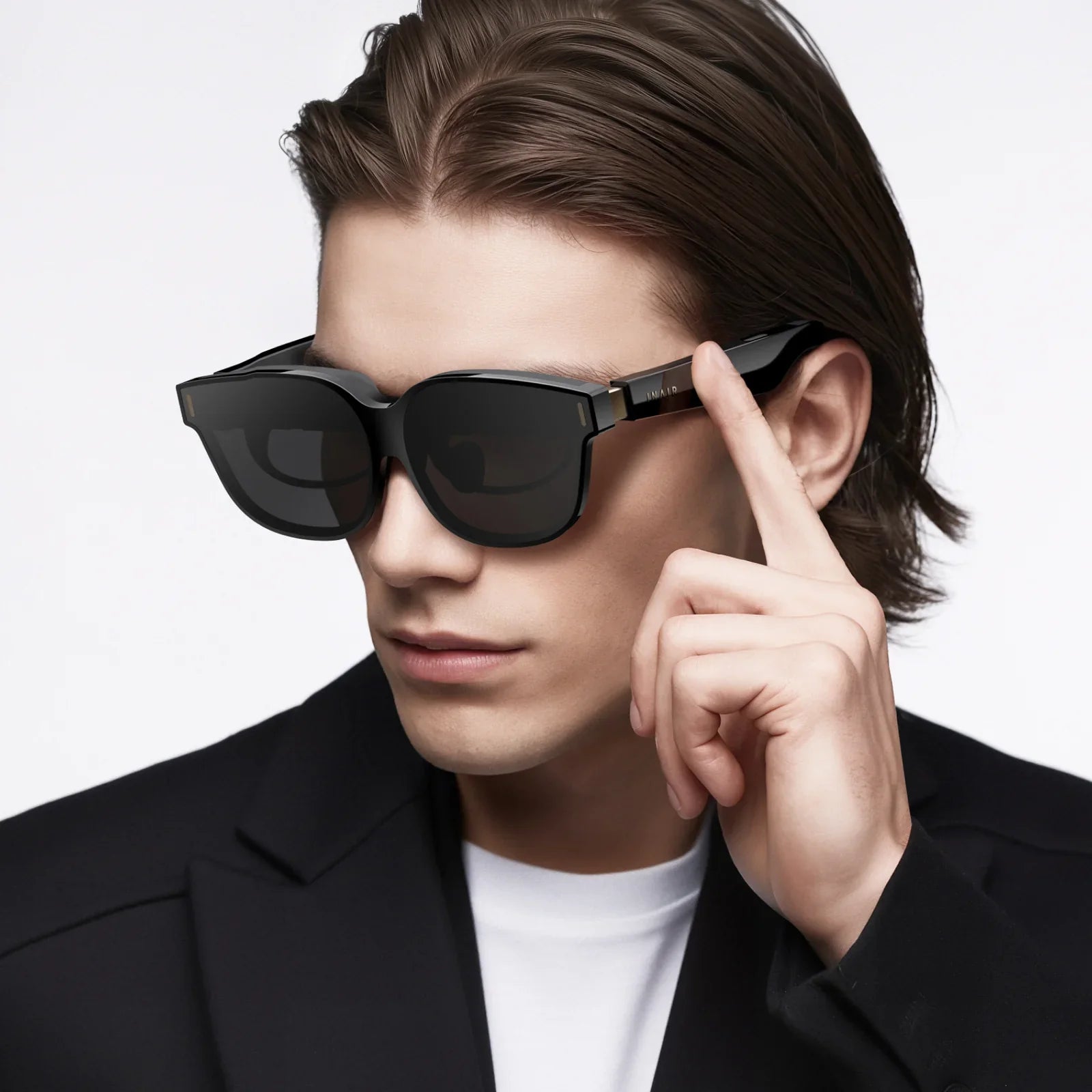
Imagine a world where digital information doesn't just live on a screen but is seamlessly woven into the fabric of your physical reality, where holographic instructions float over a complex engine you're repairing, and virtual colleagues sit across from you at your real desk. This is the promise of merged reality, and it's arriving not in some distant future, but today, through a new generation of sophisticated eyewear. The quest for the best MR glasses is about more than just buying a gadget; it's about choosing a portal to a new way of working, creating, and interacting. The technology has evolved from clunky prototypes to sleek, powerful devices that are beginning to redefine our relationship with both the digital and physical worlds, making this the perfect time to dive in and understand what makes a pair of MR glasses truly exceptional.
Demystifying Merged Reality: More Than Just a Buzzword
Before we can identify the 'best,' we must first understand what we're looking for. Merged Reality (MR) exists on a spectrum between the entirely real and the completely virtual. It's often used interchangeably with Augmented Reality (AR), but there's a crucial distinction. While AR overlays simple digital information—like a navigation arrow or a Pokemon—onto the real world, MR involves more complex interactions. True MR glasses understand the geometry of your environment, allowing digital objects to be occluded by real-world furniture, respond to physical surfaces, and interact with you and your space in a believable way. They blend the immersive, interactive nature of Virtual Reality (VR) with the grounded context of the real world, creating a single, unified experience.
The core technology enabling this magic is a combination of advanced sensors, powerful processors, and sophisticated software. Cameras and depth sensors, like LiDAR, constantly scan the environment to build a detailed 3D map. Inside-out tracking allows the device to understand its own position in space without external sensors. This spatial awareness is what separates MR from simpler AR experiences. Furthermore, the development of specialized chipsets has been pivotal, moving the intense computational workload from a tethered computer to the glasses themselves, enabling true untethered freedom and making the technology far more accessible and practical for everyday use.
The Hallmarks of Excellence: What to Look For in the Best MR Glasses
Not all MR devices are created equal. The best ones excel across several key categories, balancing performance, comfort, and utility. When evaluating any pair of MR glasses, these are the critical factors to consider.
Visual Fidelity and Display Technology
This is arguably the most important aspect. The quality of the digital overlay directly impacts the sense of immersion and practicality. Key metrics include:
- Field of View (FoV): A wider FoV means a larger digital canvas and less of a "looking through a letterbox" effect. It's crucial for immersive applications.
- Resolution and Pixels-Per-Degree (PPD): High resolution ensures text is crisp and graphics are sharp, reducing screen-door effects and eye strain.
- Brightness and Contrast: The displays must be bright enough to be visible in various lighting conditions, especially outdoors, while maintaining deep blacks for good contrast.
- Passthrough Quality: For devices that use video passthrough (showing the real world via cameras), low latency and high-resolution cameras are essential to avoid nausea and provide a natural view.
Comfort and Form Factor
The best technology is useless if it's uncomfortable to wear. The ideal device feels like a natural extension of the user.
- Weight Distribution: Weight should be evenly distributed across the head, not putting excessive pressure on the nose or cheeks.
- Ergonomics: Adjustable headbands, interchangeable facial interfaces, and prescription lens options are signs of a user-centric design.
- Thermal Management: The device should remain cool and quiet during operation, avoiding distracting fans or uncomfortable heat on the face.
- The trend is toward sleeker, more socially acceptable designs that resemble premium sunglasses, moving away from the bulky, goggle-like look of early prototypes.
Performance and Processing Power
MR is computationally intensive. Smooth, responsive experiences require serious hardware.
- Processor: A dedicated, powerful XR chipset is a significant advantage over modified mobile processors, offering better graphics, AI acceleration, and power efficiency.
- Tracking Accuracy: Precise head and hand tracking is non-negotiable for interaction. This includes controller tracking and, ideally, advanced hand-tracking without controllers.
- Battery Life: All-day battery life remains a challenge. The best solutions offer a balance of all-day usage, hot-swappable batteries, or efficient power management that extends use for key tasks.
Software Ecosystem and Developer Support
Hardware is nothing without software. A robust ecosystem is what brings the device to life.
- Operating System: A dedicated, intuitive OS designed for spatial computing is crucial for navigation and multitasking.
- App Library: A healthy library of professional and consumer applications, from 3D design tools to immersive training modules, defines the device's utility.
- Developer Tools: Strong SDK support encourages developers to build and optimize apps specifically for the platform, ensuring a steady stream of new content.
- Cross-Platform Compatibility: The ability to interact with existing ecosystems (e.g., file systems, cloud services) and other devices enhances productivity.
The Transformative Applications: Where MR Glasses Shine
The value of MR glasses is proven in their application. They are moving beyond novelty into becoming essential tools in specific verticals.
Enterprise and Industrial Design
This is currently the strongest use case. Engineers, architects, and designers use MR glasses to visualize 3D models at full scale, overlaying blueprints onto construction sites, or following animated repair guides with hands-free, step-by-step instructions superimposed directly on the machinery. This reduces errors, improves training efficiency, and drastically cuts down on the need to consult physical manuals or distant experts.
Remote Collaboration and Telepresence
MR glasses are redefining "remote work." Instead of a grid of faces on a flat screen, collaborators can join as photorealistic avatars or holograms in your physical space. They can see what you see, annotate the air around a physical prototype, and interact with 3D models together as if they were in the same room. This creates a sense of presence and context that video calls simply cannot match, making it invaluable for complex design reviews and problem-solving sessions.
Healthcare and Medical Training
Surgeons can overlay patient data, like MRI scans, directly onto their field of view during procedures. Medical students can practice complex surgeries on detailed holographic anatomies, gaining valuable experience in a risk-free environment. The technology also shows promise in physical therapy, providing patients with interactive guides for exercises, and in mental health treatment, creating controlled, immersive environments for therapy.
Creative Arts and Entertainment
Artists are using MR as a new medium, sculpting virtual statues in their living room or painting with light in three-dimensional space. For entertainment, the potential is vast—from interactive storytelling where narratives unfold around you to watching a movie on a virtual Imax screen pinned to your wall. Gaming becomes a truly physical experience, transforming your entire home into a game board.
Navigating the Trade-Offs: The Current State of the Market
As of today, there is no single pair of MR glasses that is objectively the "best" for everyone. The market is maturing rapidly, but choices still involve significant trade-offs, primarily between three pillars: capability, comfort, and cost.
Some devices prioritize raw power and visual fidelity, offering stunning experiences but often at the expense of a larger form factor, higher weight, and a premium price tag that positions them firmly as professional tools. These are the workhorses for enterprise and development.
Another segment of the market prioritizes accessibility and social acceptance. These devices are lighter, sleeker, and more affordable, designed for all-day wear and consumer use. However, they may have a narrower field of view, less processing power, or more limited tracking capabilities, focusing on core productivity and communication tasks rather than high-end 3D visualization.
The holy grail—a device that is powerful, comfortable, and affordable—is the target every manufacturer is racing toward. We are seeing rapid convergence, with professional devices becoming sleeker and consumer devices becoming more powerful with each generation. The pace of innovation suggests this ideal device is not far off, but for now, identifying the "best" MR glasses is a deeply personal calculation based on your specific needs, budget, and tolerance for being an early adopter.
Gazing into the Future: Where Do We Go From Here?
The trajectory of MR technology is incredibly exciting. We can expect continued miniaturization, with waveguides and micro-LED displays leading to glasses that are virtually indistinguishable from regular eyewear. Advances in AI will make interactions more intuitive, allowing the glasses to anticipate our needs and understand context on a deeper level. The concept of the "spatial web" will mature, where digital information is anchored to locations and objects in the real world, accessible to anyone with the right glasses. Furthermore, neural interface research, though far off, hints at a future where we might interact with these digital layers through thought alone.
This evolution will gradually shift MR from a specialized tool to a universal companion device, potentially replacing our smartphones, laptops, and televisions with a single, contextual interface layered over our reality. It will redefine how we learn, work, socialize, and experience entertainment, blurring the lines between our digital and physical lives until they are one and the same.
The journey to find the perfect pair of MR glasses is a journey into the next era of computing. It requires careful consideration of the current landscape, a clear understanding of your own use cases, and an excitement for the possibilities that lie just over the horizon. This isn't just about the technology you can buy today; it's about choosing your window into a world being remade before our eyes, a world where the digital and physical finally dance together as one.
Share:
Glasses Mr Price: A Visionary Guide to Affordable Eyewear
How to Turn Off a VR Headset: The Ultimate Guide to Proper Shutdown