


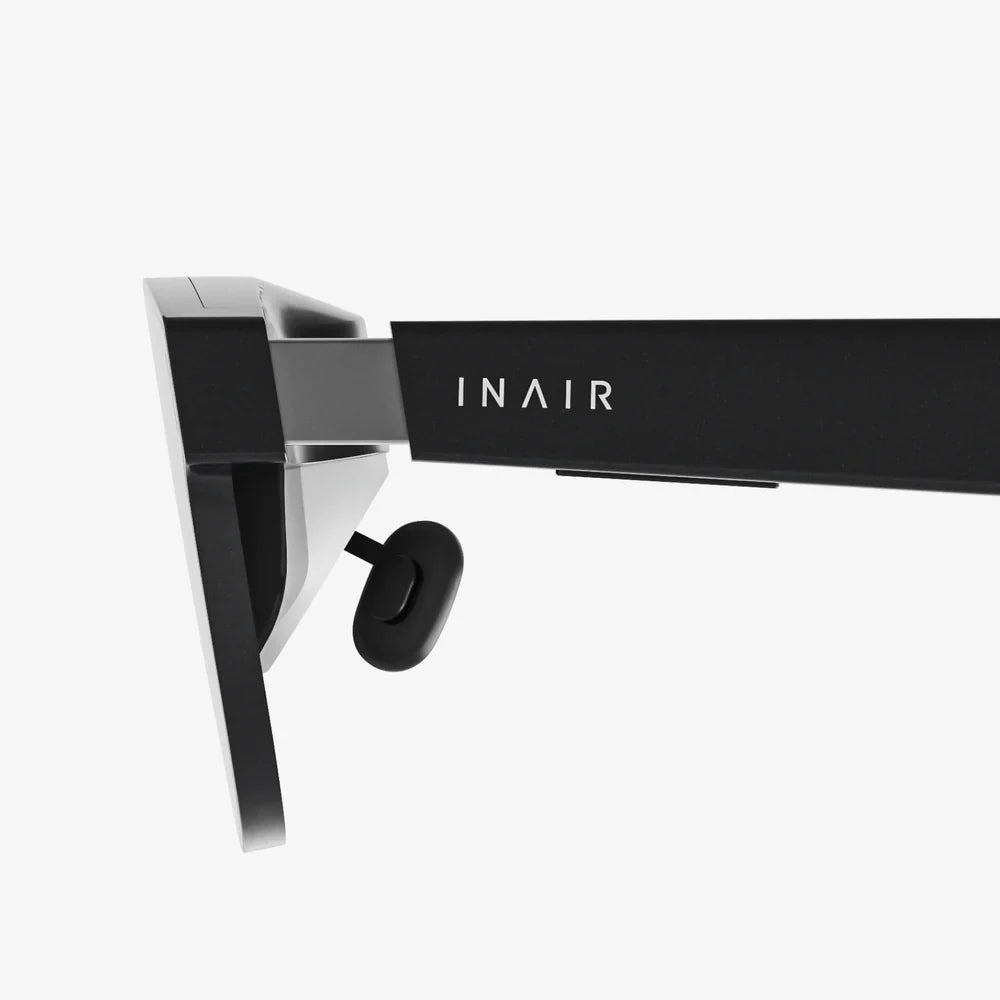
Imagine a world where digital information doesn’t live on a screen in your hand but is seamlessly woven into the fabric of your reality. This is the promise of smart eyewear, a frontier of technology that is rapidly evolving from science fiction into tangible reality. But with terms like AR, VR, MR, and XR being tossed around, it’s easy to get lost in the acronyms. For anyone looking toward the next wave of computing, understanding the fundamental difference between AR and XR glasses is not just a matter of semantics—it’s the key to unlocking the potential of how we will work, play, and interact with the world around us.
Demystifying the Acronyms: A Lexicon of Reality
Before we can contrast the glasses themselves, we must first define the realities they create. It's a spectrum of experiences, each with its own unique relationship between the physical and the digital.
Augmented Reality (AR): The Digital Overlay
Augmented Reality (AR) is the technology that superimposes computer-generated digital content—images, text, 3D models, animations—onto the user’s real-world view. The core principle of AR is additive enhancement. It takes your existing environment and layers information on top of it without obscuring your vision. Think of a navigation arrow floating on the road in front of you, a recipe card hovering next to your mixing bowl, or a dinosaur seemingly stomping through your living room. The real world remains the primary stage; the digital elements are the supporting actors. AR experiences can be delivered through smartphones and tablets, but for a truly hands-free and immersive experience, dedicated AR glasses are the ultimate goal.
Virtual Reality (VR): The Total Escape
It’s crucial to briefly mention Virtual Reality (VR) to understand the full spectrum. VR is the polar opposite of pure AR. Instead of enhancing the real world, it replaces it. Using a fully opaque headset that blocks out your physical surroundings, VR transports you to a completely computer-simulated environment. Whether you’re exploring a fantasy landscape, conducting a virtual meeting, or playing an immersive game, you are entirely disconnected from your actual location. VR is about presence in a digital world.
Mixed Reality (MR): The Blended Frontier
Sitting between the pure digital overlay of AR and the total immersion of VR is Mixed Reality (MR). MR is a more advanced form of augmentation where digital objects don’t just appear on top of the real world but appear to exist within it. They can be occluded by real-world objects (e.g., a virtual character hiding behind your real sofa), interact with physical surfaces (e.g., a virtual ball bouncing on your real floor), and respond to environmental lighting and physics. MR requires sophisticated sensors and cameras to deeply understand and map the geometry of the surrounding space. It’s the difference between a flat, floating ghost and a solid, interactive entity that believes it is in your room.
Extended Reality (XR): The Umbrella Term
This brings us to our final and most encompassing term: Extended Reality (XR). XR is not a specific type of technology but rather a catch-all category that includes AR, VR, MR, and any other future realities that blend the physical and digital universes. It represents the entire spectrum from the completely real to the entirely virtual. If AR, VR, and MR are distinct colors, XR is the entire rainbow.
The Core Divide: AR Glasses vs. XR Glasses
Now, with our definitions clear, the difference between the glasses becomes evident. It is primarily a difference of scope and capability.
AR Glasses are a subset of devices designed specifically to deliver an Augmented Reality experience. Their primary function is to see-through displays that project information onto transparent lenses or waveguides. Their design philosophy is centered on contextual awareness—providing useful information while keeping the user engaged with their environment. They are often lightweight, designed for all-day wear, and prioritize battery life and social acceptability (looking as close to regular glasses as possible).
XR Glasses is a broader term used to describe a more capable class of wearable devices that can function across the reality spectrum. While they can perform standard AR tasks, their hardware is typically more advanced, often featuring passthrough camera technology. Instead of looking through a transparent lens, these devices use external cameras to capture the real world and display it on internal screens, alongside digital content. This method allows them to toggle between high-fidelity AR, more immersive MR experiences, and even limited VR functionality by digitally recreating the user's surroundings. They are often more powerful, but this can come at the cost of size, weight, battery life, and price.
Under the Hood: A Technical Breakdown
The experiential difference is driven by significant divergences in their hardware architecture.
Display Technology: See-Through vs. Passthrough
This is the most fundamental technical distinction.
- AR Glasses (Optical See-Through): These devices use optical combiners, like waveguides or holographic lenses, to project light containing digital images directly into the user’s eye while allowing ambient light from the real world to pass through. The user sees the real world directly, with digital elements superimposed. This method offers high clarity for the real world and is generally more comfortable for long-term use as it mimics natural vision.
- XR Glasses (Video Passthrough): These devices block natural light. They use a array of outward-facing cameras to capture a live video feed of the user's environment. This feed is then combined with digital content and displayed on internal micro-OLED or LCD screens in front of the user's eyes. This method provides immense flexibility, allowing for features like dynamic occlusion (digital objects hiding behind real ones), and the ability to alter or completely replace the real-world view (veering into VR). However, it can suffer from latency (a lag between your movement and the video update), lower resolution than real sight, and can cause visual fatigue or motion sickness in some users.
Sensing and Tracking: Context vs. Comprehension
Both types of glasses require sensors, but their complexity differs.
- AR Glasses typically rely on a standard suite including an IMU (Inertial Measurement Unit) for basic head tracking, a depth sensor or LiDAR for understanding the rough geometry of a space, and cameras for simple gesture recognition. Their goal is to place content stablely in the world.
- XR Glasses require a much more robust sensor array—high-resolution RGB cameras, depth sensors, time-of-flight sensors, and sometimes even LiDAR scanners. This suite works together to create a high-fidelity, real-time 3D map of the environment (a process called spatial mapping). This deep understanding allows for complex environmental interactions, precise occlusion, and physics-based engagement between digital and physical objects, which is the hallmark of true Mixed Reality.
Processing Power: Efficiency vs. Performance
The computational demands follow the sensor and display complexity.
- AR Glasses often prioritize efficiency and thermal management to enable all-day wearability. They may use a streamlined onboard processor or offload heavier computing tasks to a paired smartphone or a dedicated processing puck.
- XR Glasses frequently house processors that are closer to those found in powerful laptops. The task of processing multiple high-resolution video feeds, performing real-time 3D reconstruction, and rendering complex 3D graphics is immensely computationally intensive, requiring dedicated, powerful chips that generate more heat and consume more power.
The User Experience: How It Feels to Wear the Future
These technical differences manifest in profoundly different user experiences.
AR Glasses: The Discreet Assistant
Wearing a pair of well-designed AR glasses feels like having a subtle, intelligent assistant constantly at your periphery. Information feels like it’s part of the world. You can maintain eye contact in conversations, walk around confidently without fear of bumping into things, and use them for hours without discomfort. The experience is grounded and contextual. The digital layer is helpful but never overwhelming, designed to keep you present in your actual life.
XR Glasses: The Powerful Portal
Donning a pair of XR glasses is a more overtly technological experience. It feels like looking through a powerful portal into a blended world. The digital elements can be more vivid and feel more “real” because they can interact with your environment in believable ways. You can have a life-sized virtual screen for work that feels solid and anchored to your wall, or play a game where virtual creatures take cover behind your actual furniture. However, the experience can feel more isolating, and the potential for visual artifacts or latency can remind you that you are looking at a mediated reality.
Applications and Use Cases: Shaping Industries
The choice between AR and XR capabilities isn’t about which is better, but which is right for the task at hand.
Where AR Glasses Excel
- Enterprise & Field Service: Providing technicians with hands-free schematics, remote expert guidance, and part information overlaid on machinery.
- Logistics & Warehousing: Showing pickers the most efficient routes and highlighting items on shelves, dramatically improving fulfillment speed and accuracy.
- Everyday Navigation & Information: Displaying walking directions, translation subtitles over street signs, or notifications without requiring a phone.
- Subtle Social Communication: Lightweight, glasses-style wearables could eventually display captions during conversations or provide low-profile alerts.
Where XR Glasses Shine
- Advanced Design & Engineering: Allowing architects and engineers to interact with life-sized, holographic 3D models of their creations, making changes in real-time.
- Immersive Training & Simulation: Training surgeons with virtual organs that respond to incisions or preparing soldiers for complex missions in a photorealistic, simulated environment.
- Next-Generation Remote Collaboration: Not just video calls, but shared virtual workspaces where participants can manipulate 3D models as if they were in the same room.
- High-Fidelity Entertainment: Transforming any room into a immersive gaming arena or a private cinema with a screen of any size.
The Road Ahead: A Converging Future
The line between AR and XR glasses is blurring and will continue to do so. We are on a path toward a single, unified device. The ultimate goal is a pair of glasses that are as socially acceptable, lightweight, and power-efficient as today's best AR glasses but with the full passthrough and contextual understanding of today's XR headsets. Breakthroughs in display technology (like holographic optics), semiconductor design, and battery efficiency will be required to get there.
In the meantime, the market will likely stratify. There will be a place for simpler, task-specific AR glasses focused on enterprise and all-day wearability. Alongside them, more powerful XR glasses will cater to professionals and enthusiasts who need the highest level of immersion and interaction, accepting the trade-offs in form factor. Understanding the difference empowers you to choose the right tool for your digital transformation, whether you're a developer building the next killer app, an enterprise leader seeking efficiency, or simply a curious consumer ready to step into the next dimension of computing.
Your next computer might not be in your pocket or on your desk, but on your face, and its view of the world—whether simply augmented or fully extended—will redefine the very nature of reality itself. The race to own your field of vision is on, and the ultimate winner will be the technology that disappears, leaving only magic in its place.
Share:
Metaverse VR AR Market Size Projections Signal a Paradigm Shift in Global Tech
Mixed Reality Updates Today: A New Dawn for Digital Interaction