


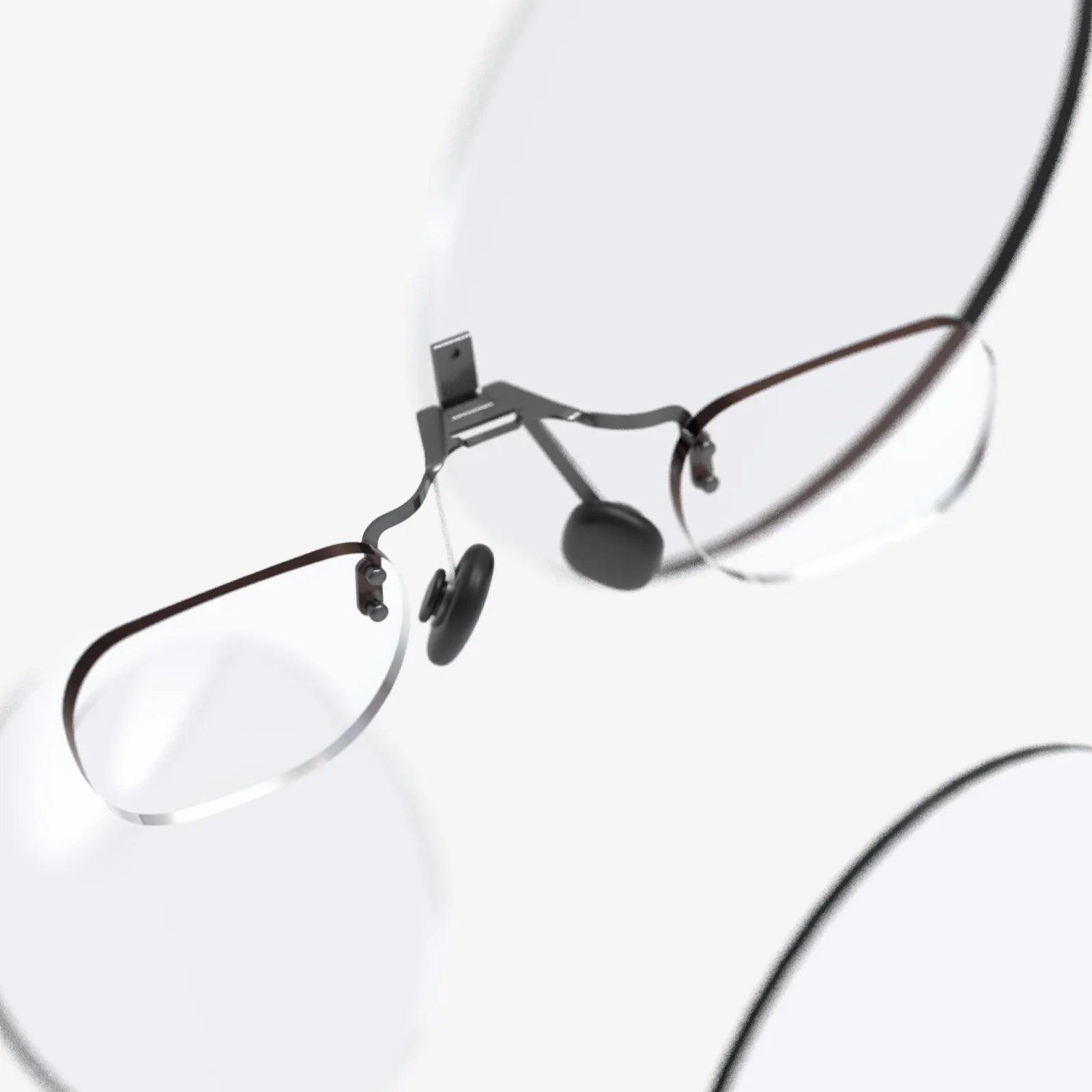
Imagine a world where the digital and the physical are no longer separate realms viewed through different devices, but a single, unified experience viewed through a pair of sleek, ordinary-looking glasses. This is the promise, the potential, and the profound shift offered by glasses with screens in them. This isn't science fiction; it's a rapidly accelerating technological reality poised to change how we work, learn, socialize, and perceive the world around us. The journey from clunky prototypes to socially acceptable wearables is underway, and its destination is nothing short of a revolution in human-computer interaction.
The Architectural Marvel: How Do They Actually Work?
The magic of these devices lies in their ability to project a high-resolution digital image that appears to float in the user's field of view, all while remaining transparent enough to see the real world. This feat of optical engineering is achieved through several key components working in concert.
At the heart of the system are micro-displays, incredibly small and bright screens, often utilizing OLED or MicroLED technology for their superior contrast and color reproduction. These tiny displays act as the digital image source. The challenge then becomes taking that image and putting it in front of the user's eye without a bulky, opaque screen blocking their vision. This is where waveguide technology comes into play.
Waveguides are essentially transparent lenses embedded with microscopic structures that act like a complex maze of mirrors. Light from the micro-display is injected into the edge of the waveguide. As it travels through this transparent substrate, the embedded structures diffract or reflect the light, bouncing it along a precise path until it is finally directed into the user's pupil. The result is a sharp, stable image that seems to exist in space several feet away, superimposed over the user's natural surroundings. This technology allows for a sleek form factor that closely resembles standard eyewear.
Supporting this optical engine is a suite of sensors that make the experience interactive and contextual. High-resolution cameras track eye movement, allowing for intuitive control—looking at an icon to select it, for instance. Inertial Measurement Units (IMUs) track head position and movement, while depth sensors and spatial scanners map the physical environment in real-time. This enables digital objects to be anchored to real-world surfaces, creating a persistent augmented reality. All of this is powered by sophisticated on-board processors and software that fuse this sensor data to understand the user's context and intent, all while managing battery life efficiently.
Beyond Novelty: Transformative Applications Across Industries
The true value of this technology is revealed not in its specs, but in its practical applications, which are already beginning to reshape entire professions and hobbies.
The Future of Work and Productivity
For professionals, smart glasses can create an infinitely expansive digital workspace. Imagine an architect walking through a construction site, seeing the digital blueprints overlaid directly onto the unfinished structure, identifying potential clashes between systems before they become costly errors. A surgeon could have vital signs, 3D anatomical models, or guidance from a remote specialist visible during a procedure, keeping their focus on the patient instead of looking away at a monitor. For field technicians repairing complex machinery, interactive manuals and remote expert guidance can be streamed directly into their line of sight, with arrows and annotations pointing to specific components. This hands-free access to information dramatically increases efficiency, reduces errors, and enhances safety.
Redefining Social Connection and Entertainment
The social and entertainment implications are equally staggering. Video calls could evolve from staring at a grid of faces on a screen to having life-sized, photorealistic holograms of participants sitting in your living room, creating a sense of presence that video conferencing cannot match. Gaming will leap out from the television and into our physical spaces, transforming a living room into a fantasy dungeon or a park into an interactive battlefield. Watching a sports game could allow fans to pull up real-time stats for any player they look at, or choose from multiple camera angles simply by glancing around the stadium. This technology promises a more immersive, personalized, and shared form of entertainment.
A New Paradigm for Learning and Navigation
For education, the potential is boundless. A student studying astronomy could point their glasses at the night sky and see constellations, planets, and satellites labeled and animated. A history class could take a field trip to an ancient ruin and see digital reconstructions of the buildings as they once stood, populated by virtual inhabitants. Language learners could receive real-time subtitles for conversations in a foreign language, or see the names of objects translated when they look at them. Navigation will move beyond a phone screen, with directional arrows painted onto the street and contextual information about local businesses appearing as you walk by them, creating a truly intuitive and heads-up way to explore the world.
The Inevitable Challenges: Privacy, Social Etiquette, and the Digital Divide
With such transformative power comes a host of complex challenges that society must proactively address. The most pressing concern is privacy. Devices with always-on cameras and microphones, capable of recording and analyzing everything the user sees and hears, represent a unprecedented surveillance capability. The potential for misuse by individuals, corporations, or governments is significant. Clear and robust regulations, transparent user controls, and obvious indicators when recording is active will be essential to building public trust. The very concept of consent in public spaces may need to be redefined.
Furthermore, the social etiquette of wearing such devices is uncharted territory. Will it be considered rude to wear them during a conversation, much like looking at your phone is today? How will we know if someone is recording us? The potential for distraction is also a serious concern; walking or driving while interacting with a complex digital overlay could pose significant safety risks. Finally, the cost of early-adopter technology threatens to create a new digital divide, where access to this powerful layer of information and augmentation is available only to those who can afford it, potentially exacerbating existing social and economic inequalities.
Gazing Into the Crystal Ball: The Future of Seamless Computing
The current generation of devices is merely the first step. The trajectory points toward glasses that are indistinguishable from fashionable prescription eyewear, with all-day battery life and ever-increasing processing power. The user interface will evolve from clumsy hand gestures and voice commands to a more seamless integration with our biology. Brain-computer interfaces, though far off, could eventually allow us to control digital elements with our thoughts alone.
The long-term goal is ambient computing—where technology fades into the background of our lives, contextually aware and proactively helpful without being obtrusive. The device itself ceases to be the focus; instead, it becomes an invisible conduit to a digitally augmented reality. The distinction between 'online' and 'offline' will blur into irrelevance as the digital layer becomes a constant, integrated part of our perception.
The emergence of glasses with integrated screens is more than just another product launch; it is a fundamental shift in our relationship with technology. It moves computing from something we hold in our hands and look down at, to something we wear and look through. It promises to untether us from our devices and reconnect us with the physical world, all while enriching it with a limitless stream of contextually relevant information. The path forward is fraught with technical hurdles and profound ethical questions, but the destination is a future where our reality is whatever we choose to make it. The screen is disappearing, and in its place, a new world is coming into focus.
Share:
Best Screen Glasses for Women: A Definitive Guide to Digital Eye Wellness
AI in Augmented Reality: The Invisible Engine Powering a New World