


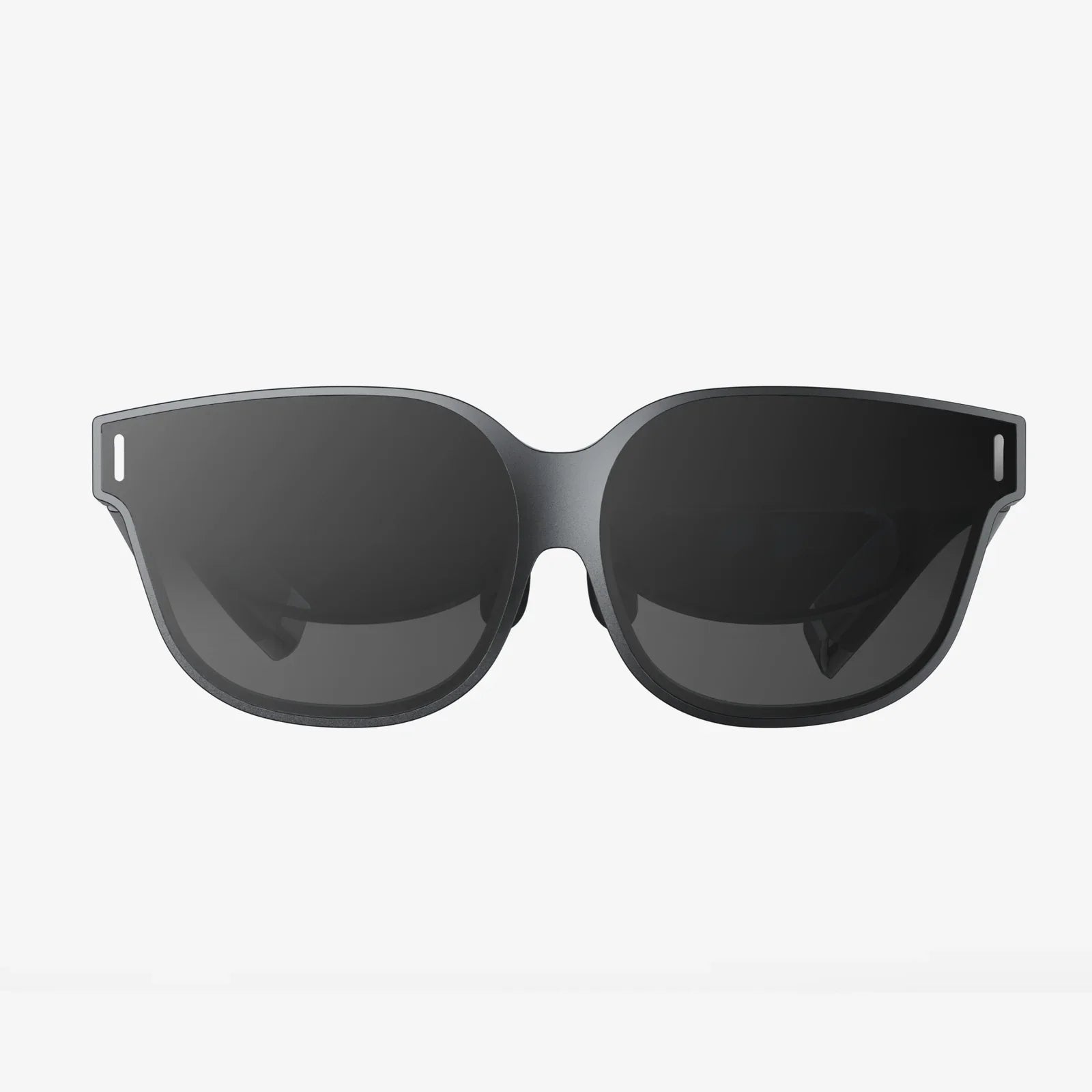
Imagine a world where digital information doesn't live on a screen in your hand or on your desk, but is seamlessly woven into the very fabric of your physical reality. Directions float on the road ahead of you, a recipe hovers beside your mixing bowl without a smudge, and a colleague from across the globe appears as a lifelike hologram sitting across your coffee table. This is the promise of good AR glasses, a technology transitioning from clunky prototype to a powerful, personal portal to a blended world. The era of staring down at a device is ending; the age of looking up and out into an augmented world is beginning.
The Anatomy of "Good": What Truly Defines Quality AR Glasses?
Not all AR glasses are created equal. The market is filled with a spectrum of devices, from simple smart glasses that display notifications to full-fledged spatial computers. So, what separates a forgettable gadget from a truly good, even revolutionary, pair of AR glasses? It’s a delicate and complex interplay of several critical factors.
Visual Fidelity: The Quest for Digital Light
The single most important feature of any AR glasses is the quality of the display. It’s not just about resolution; it’s about how digital light is superimposed onto the real world. A good display must achieve several difficult feats simultaneously. It must be high-resolution enough that text is crisp and graphics are sharp, eliminating the distracting screen-door effect of early models. It requires a high contrast ratio so that virtual images remain visible even in bright sunlight, not washed out and ghostly. Furthermore, it needs a large field of view (FoV). A narrow FoV is like looking through a tiny mail slot at the digital world, constantly reminding you of the technology's limitations. A good FoV allows digital objects to exist naturally in your peripheral vision, creating a far more immersive and believable experience.
Comfort and Form Factor: The Invisible Computer
The most powerful AR glasses in the world are useless if you don’t want to wear them. Comfort is king. Good AR glasses must be lightweight, well-balanced, and ergonomically designed for extended wear. They shouldn’t cause pressure on the nose or ears. This is intimately tied to the form factor. The holy grail is a pair of glasses that look and feel as normal as possible—perhaps slightly bulkier than traditional eyewear, but not so outlandish that you’d be embarrassed to wear them to a coffee shop. The goal is to make the technology recede, becoming an almost invisible conduit for information, not a glaring head-mounted billboard.
Spatial Awareness and Tracking: Understanding the World
For digital content to feel like it truly exists in your space, the glasses must understand that space with incredible precision. This is achieved through a suite of advanced sensors, including cameras, depth sensors (like LiDAR), and inertial measurement units (IMUs). This sensor fusion allows for accurate 6DoF (Six Degrees of Freedom) tracking. This means the glasses understand not just which way you’re looking (rotation), but exactly where you are in the room (translation). When you walk around a virtual object, it stays locked in place. When you place a digital clock on your real wall, it stays there. This robust spatial mapping is what prevents the digital world from jittering, drifting, or feeling disconnected from reality.
Audio: The Other Half of Immersion
Immersive AR is not a purely visual experience. Spatial audio is a critical, yet often overlooked, component. Good AR glasses incorporate bone conduction or tiny directed speakers that beam sound directly into your ears without blocking ambient noise. This allows a holographic person speaking to you to sound like they are actually standing in front of you, or for a notification to gently ping from your left side. This 360-degree soundscape completes the illusion and provides crucial contextual cues without isolating you from your environment.
Intuitive Interaction: Beyond the Touchpad
How do you interact with a interface that floats in the air? Good AR glasses move beyond simple touchpads on the temple. They offer a multimodal approach: voice commands for simple queries, hand tracking for natural, direct manipulation of holograms (pinching, dragging, resizing), and gaze tracking for subtle menu navigation. The interaction paradigm should feel intuitive and magical, reducing the cognitive load rather than adding to it. You should be able to control the digital world as naturally as you interact with the physical one.
The Engine Behind the Experience: Core Technologies Powering AR
Delivering on these promises requires cutting-edge technology working in perfect harmony. Several key innovations have made modern good AR glasses possible.
Waveguide Optics: The Magic Lens
This is the core technology that makes sleek form factors possible. Waveguides are transparent lenses etched with microscopic patterns that channel light from a projector on the temple into your eye. They act like a secret highway for light, allowing you to see bright digital images while still seeing the world clearly through the lens. Advancements in waveguide manufacturing, including holographic and surface relief gratings, are crucial for improving FoV, brightness, and clarity while reducing cost.
Power and Processing: The Onboard Brain
Processing the immense data from sensors, running complex simultaneous localization and mapping (SLAM) algorithms, and rendering high-fidelity graphics requires serious computational power. The challenge is packing this into the glasses without turning them into a overheating, heavy brick. Some glasses rely on a wired connection to a powerful processing unit (like a smartphone or a dedicated compute puck), while more advanced standalone models integrate sophisticated chipsets and AI accelerators directly into the frame, trading some power for ultimate freedom and mobility.
Computer Vision and AI: The Seeing Mind
The raw sensor data is useless without intelligence to interpret it. This is where computer vision and artificial intelligence come in. AI algorithms are used for scene understanding—differentiating a table from a chair, recognizing a face, or reading text. They enable persistent digital content, so your virtual notes can stay on your real refrigerator day after day. This AI-powered contextual awareness is what will ultimately allow AR glasses to become proactive assistants, offering the right information at the right time without being asked.
Transforming Industries and Redefining Daily Life
The potential applications for good AR glasses stretch far beyond cool demos and gaming. They are poised to become the next major computing platform, revolutionizing entire sectors.
The Future of Work and Remote Collaboration
Imagine a mechanic seeing a schematic overlaid on the engine they are repairing, with an expert from another country able to draw arrows and circles directly into their field of view to guide them. Architects and interior designers could walk clients through full-scale 3D models of a building before a single brick is laid. For remote work, AR glasses enable a sense of true presence. Instead of a grid of faces on a screen, colleagues can be rendered as realistic avatars in your physical space, gathered around a virtual whiteboard that everyone can interact with. This has the power to bridge the physical distance that traditional video calls cannot.
Revolutionizing Education and Training
Learning becomes experiential. Medical students can practice complex procedures on detailed holographic anatomy. History students can witness historical events unfold around them. Mechanics-in-training can learn to dismantle and reassemble complex machinery with step-by-step instructions anchored to each part. This learning-by-doing, in a risk-free augmented environment, dramatically accelerates comprehension and retention.
Enhancing Navigation and Accessibility
Turn-by-turn navigation can be projected onto the sidewalk itself, eliminating the need to constantly look down at a phone. For individuals with visual impairments, AR glasses can amplify contrast, recognize and announce objects or people, and read out text from signs and menus, granting a new level of independence. This technology can literally help people see the world in a new way.
A New Canvas for Entertainment and Social Connection
Entertainment will be unshackled from the rectangle. Imagine watching a sports game with live stats floating beside the players, or having a movie play across your entire living room wall. Social media could evolve from a feed into a shared experience where you and a friend on the other side of the world can leave digital notes and drawings for each other in a shared augmented space, creating a new layer of persistent, playful communication.
Navigating the Challenges: The Path Forward
Despite the incredible progress, the journey to perfect, ubiquitous AR is not without its significant challenges. Battery life remains a major constraint, with powerful graphics and sensors draining small batteries quickly. There are serious and valid concerns about privacy and data security, as a device that is always watching and listening raises profound questions. The potential for digital distraction on a whole new scale is real, and the social etiquette of wearing such devices in public is yet to be written. Furthermore, creating a robust and compelling ecosystem of apps and experiences is essential for moving beyond a niche product to a mainstream necessity.
The true magic of good AR glasses lies not in replacing our reality, but in enhancing it, making us more capable, connected, and informed. They represent a fundamental shift in our relationship with technology, from something we hold to something we wear, from a tool we use to a layer of our perception. We are standing on the brink of this new era, and the view through these lenses is going to be extraordinary.
Share:
How to Use AR Glasses: A Complete Guide to Unlocking Augmented Reality
How to Use AR Glasses: A Complete Guide to Unlocking Augmented Reality