


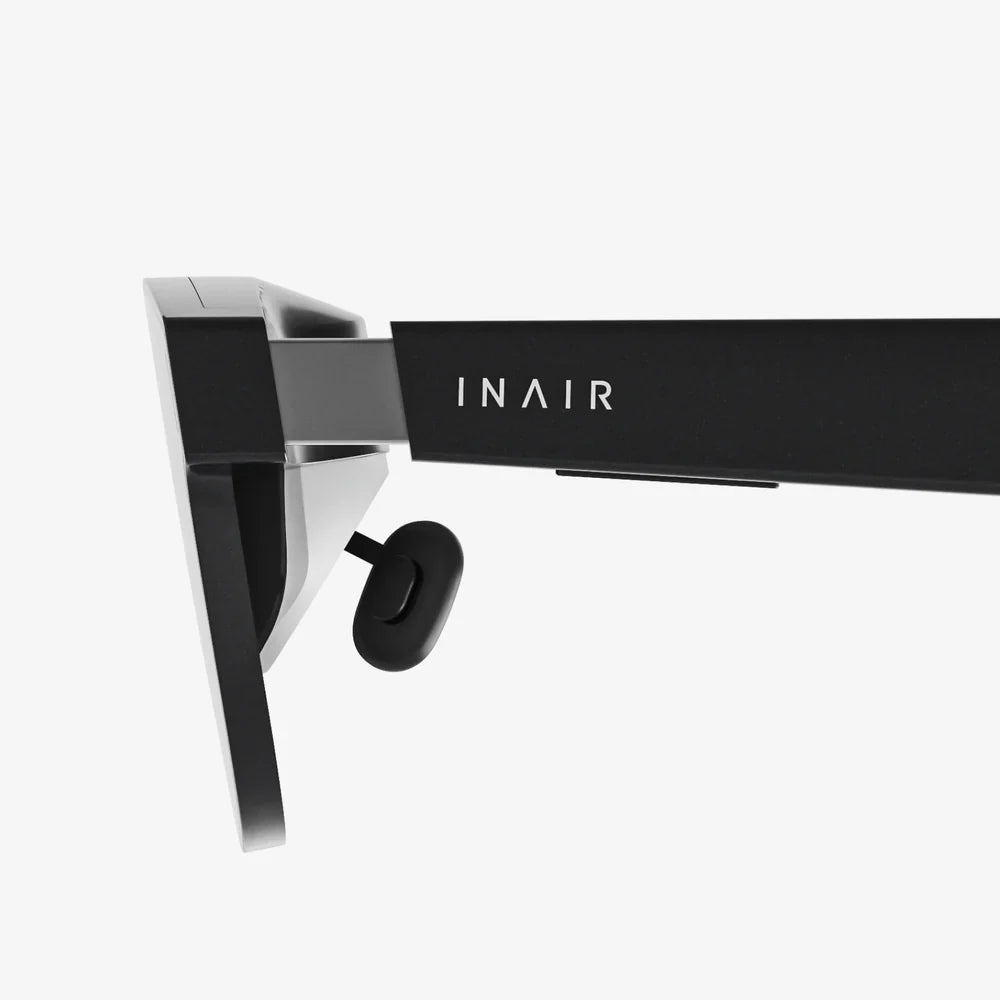
- by wangfred
Holographic AR Glasses: The Invisible Computer Reshaping Reality
- by wangfred
Imagine a world where your entire digital life—the notifications, the maps, the endless stream of information—isn’t confined to a small, glowing rectangle in your hand. Instead, it’s elegantly woven into the fabric of your reality, hovering as crisp, interactive holograms that coexist with the physical world. This is the promise of holographic augmented reality glasses, a technology not merely on the horizon but already beginning to materialize, poised to redefine our relationship with computing, information, and each other. This isn't just an upgrade to your smartphone; it's a fundamental shift toward an invisible, intuitive, and immersive interface with the digital universe.
To understand the revolution, we must first distinguish it from its technological cousins. Virtual Reality (VR) is an escape from reality, transporting users to entirely digital environments. Augmented Reality (AR), as we've known it, overlays simple digital information—like a floating arrow for navigation or a Snapchat filter—onto a camera view of the world, often still mediated through a screen.
Holographic AR glasses represent the next evolutionary leap. They aim to project true, three-dimensional holograms that appear to occupy real space, with realistic depth, occlusion, and persistence. Unlike screen-based AR, the digital content is not just an overlay; it is spatially aware, anchored to specific locations, objects, or people. You could walk around a holographic model of a building, peer behind a digital chart floating in your living room, or see a virtual character sit convincingly on your physical sofa. The goal is a seamless, binocular experience where the boundaries between what is real and what is digital become beautifully blurred.
Creating this illusion of digital objects existing in our world is a feat of engineering that converges several cutting-edge technologies.
At the heart of most advanced AR glasses are waveguides. These are transparent glass or plastic substrates etched with microscopic patterns that guide light from a micro-display on the temple of the glasses into the user's eye. Think of them as incredibly complex and tiny fiber optic cables that pipe the image while allowing ambient light from the real world to pass through. This technology is crucial for creating a sleek, glasses-like form factor, moving away from the bulky headsets of the past.
For holograms to feel real, they must understand the environment. A suite of sensors, including depth-sensing LiDAR scanners, cameras, and inertial measurement units (IMUs), continuously scans the room. This data is processed in real-time by powerful onboard chips to create a constantly updating 3D map of the surroundings. This map allows the system to understand surfaces, recognize objects, and precisely place digital content so it doesn’t drift or clip through physical obstacles. It’s the difference between a sticker pasted on a camera feed and a virtual vase that convincingly rests on your actual table.
The source of the light itself is a marvel. MicroLED displays, lasers, and Liquid Crystal on Silicon (LCoS) panels are used to generate incredibly bright, high-resolution images with a wide color gamut. These miniature projectors must be powerful enough to be visible in bright daylight yet efficient enough to not drain a small battery. The precise manipulation of light waves is what creates the perception of depth and solidity in the holograms.
The potential applications for this technology stretch far beyond novel gaming or flashy marketing. They promise to revolutionize entire industries and redefine daily tasks.
The immediate impact is being felt in the professional sphere. Imagine a surgeon seeing a real-time holographic overlay of a patient’s anatomy during an operation, with vital signs and MRI data pinned directly to their field of view. Architects and engineers can walk clients through full-scale, holographic models of unbuilt structures, making changes on the fly. On a factory floor, a technician wearing glasses could see assembly instructions overlaid directly on the machinery they are repairing, with remote experts able to annotate their view from across the globe. This "see-what-I-see" capability drastically reduces errors, accelerates training, and enhances collaboration.
Holographic AR promises to be the ultimate telepresence tool. A video call could evolve into a holographic projection of a person sitting in your room, making eye contact and gesturing naturally, creating a sense of presence that flat screens cannot match. Social media could transform into a shared spatial experience where friends leave holographic messages and artwork in specific locations for others to discover, creating a new layer of shared history and interaction in physical spaces.
Entertainment will become an active, immersive experience. Instead of watching a film on a television, you could have the action unfold around your furniture. Gaming will break free from the TV screen, allowing you to duel with lightsabers in your hallway or solve spatial puzzles that use your entire home as the game board. Museums could place historical figures and events in the very spaces where they occurred, offering an unparalleled educational experience.
On a more mundane but equally transformative level, these glasses could become the ultimate personal assistant. Navigation arrows would be painted onto the street in front of you. Your daily schedule and notifications could hover discreetly at the edge of your vision. When you look at a restaurant, its reviews and menu might pop up. When you are cooking, a recipe could be projected onto your countertop, guiding your actions step-by-step. The constant friction of looking down at a phone would be eliminated, allowing for a more engaged and efficient interaction with the world.
For all its promise, the path to ubiquitous holographic AR is fraught with significant technical and social hurdles.
The ultimate goal is a device that is indistinguishable from regular eyeglasses: lightweight, stylish, and with all-day battery life. Current prototypes, while impressive, still struggle with balancing processing power, battery size, display brightness, and heat dissipation into a socially acceptable package. Achieving this will require breakthroughs in materials science, battery technology, and chip miniaturization.
A new medium requires a new language. Developers and creators must learn how to design experiences that are useful, intuitive, and magical in three-dimensional space. The "killer app"—the experience that makes the technology indispensable for the average consumer—has yet to be discovered. Building the tools and ecosystems to support this new wave of spatial computing is a monumental task.
Perhaps the most profound challenge is societal. Glasses with always-on cameras and sensors scanning everything and everyone raise legitimate privacy concerns. The concept of a "digital footprint" could become literal, with our movements and interactions constantly logged and analyzed. Establishing clear ethical guidelines, robust data ownership models, and social norms—such as clear visual indicators when recording—will be critical for public acceptance. The specter of a world filled with advertisements we can’t escape is also a dystopian possibility that must be guarded against.
The development of holographic AR glasses is not a single event but a gradual convergence. We will see iterations that are first adopted by professionals in specific fields, then by enthusiasts, and eventually, as the technology becomes smaller, cheaper, and more powerful, by the mass market. The endgame is a device so integrated into our lives that it becomes invisible—not in the sense that we don't see it, but in the sense that we stop noticing it, much like we no longer think of a smartphone as a "phone." It will simply be the way we access information, connect with others, and experience digital content.
This technology has the potential to augment not just our reality, but our humanity. It can expand our memory, enhance our perception, and connect us in deeper ways. But it also demands a thoughtful conversation about the world we want to build. Will we use it to create a utopia of information and connection, or a dystopia of distraction and surveillance? The answer lies not in the technology itself, but in how we choose to design, regulate, and adopt it. The future is not something we enter; it’s something we create. And with holographic AR glasses, we are being handed the tools to paint that future directly onto the canvas of our world.
The tiny screens that dominate our lives are about to shatter, not into pieces, but into a million points of light that will reassemble as a new layer of reality itself. The race to build the definitive pair of holographic AR glasses is more than a tech industry battle; it’s a fundamental reimagining of the human-computer interface, and the winner won’t just capture a market—they will define the next chapter of human experience. The question is no longer if this future will arrive, but how quickly we can prepare for the moment when the digital and physical worlds finally, and irrevocably, become one.