


Imagine a world where digital information doesn't just live on a screen but is painted onto the very fabric of your reality. You point your device at a ancient ruin, and a bustling Roman forum springs to life before your eyes. A mechanic looks at a complex engine, and glowing arrows and text highlight exactly which bolt to turn next. A surgeon sees a patient's vital signs and a 3D model of a tumor superimposed directly onto their field of view during an operation. This is the promise of augmented reality (AR), a technology that is rapidly moving from science fiction to an integral part of our professional and personal lives. But have you ever stopped to wonder, as a digital dinosaur stomps across your living room, just how this technological magic is accomplished? The journey from a blank physical space to an immersive augmented experience is a fascinating symphony of hardware and software, a complex dance of data that happens in milliseconds. It’s a process that involves seeing, understanding, and then enhancing the world around us.
The Core Principle: Blending Real and Virtual
At its most fundamental level, augmented reality works by overlaying computer-generated perceptual information onto the real world. Unlike Virtual Reality (VR), which creates a completely artificial environment, AR uses the existing environment and simply adds new layers of digital information on top of it. The goal is to make the digital additions appear as if they are a coherent part of the physical space, adhering to its laws of physics, perspective, and lighting. This seamless integration is the ultimate challenge and the defining characteristic of a high-quality AR experience. It’s not just about putting a 3D model in your camera feed; it’s about making that model cast a shadow, occlude behind real objects, and look like it truly belongs.
The Technological Triad: Sensors, Processing, and Displays
The entire AR pipeline can be broken down into three critical stages, each reliant on a specific set of technologies. First, the system must perceive the world using a suite of sensors. Next, it must process and comprehend this sensory data to understand the environment and the user's place within it. Finally, it must render and display the digital content in a way that aligns perfectly with the user's perception of reality. A failure in any one of these three stages results in a jarring, unconvincing, or broken experience.
Stage One: Perception - The Art of Seeing the World
Before an AR system can augment anything, it must first gather vast amounts of data about its surroundings. This is the job of its sensors, which act as its eyes. Different AR platforms use different combinations of these sensors, balancing cost, power consumption, and capability.
Cameras: The Primary Data Source
The most obvious sensor is the camera, which captures a 2D video stream of the environment. This visual data is the primary input for most computer vision algorithms. However, a standard RGB camera alone provides only color and light intensity information; it lacks depth perception. This is why more advanced systems incorporate additional sensors to create a richer understanding of the world.
Depth Sensors: Measuring the Third Dimension
To understand the geometry of a space, many AR systems use specialized depth sensors. These work by actively projecting patterns of light (usually infrared light invisible to the human eye) into the environment and measuring how they deform when they hit surfaces. By calculating the time it takes for the light to return or by analyzing the distortion of the pattern, the sensor can construct a detailed depth map—a image where each pixel value represents distance, not color. This depth map is crucial for understanding the shape of objects and the layout of the room, allowing digital objects to be occluded behind real ones and to sit convincingly on surfaces.
Inertial Measurement Units (IMUs): Tracking Movement
An IMU is a micro-electromechanical system that typically includes an accelerometer (measuring linear acceleration), a gyroscope (measuring rotational velocity), and a magnetometer (acting as a digital compass). These components work together at extremely high frequencies to track the device's precise movement and orientation in space. While they drift over time (lose accuracy), they provide critical, low-latency data about quick movements, which is essential for maintaining the stability of virtual objects. If you quickly turn your head while wearing AR glasses, the IMU ensures the digital content doesn't lag behind or jitter, which would instantly break the illusion.
LiDAR and Time-of-Flight Sensors: Advanced Depth Mapping
Light Detection and Ranging (LiDAR) and Time-of-Flight (ToF) sensors are more advanced forms of depth sensing. A LiDAR scanner emits laser pulses and measures the exact time it takes for each pulse to bounce back. By scanning these lasers across a scene, it can build a precise, high-resolution 3D point cloud of the environment. This technology, also used in self-driving cars, allows for incredibly fast and accurate environment mapping, making it possible for AR apps to understand a room's geometry almost instantly without requiring the user to slowly scan the area.
Stage Two: Processing and Comprehension - The Digital Brain
Raw sensor data is useless on its own. The second stage involves processing this torrent of information to answer three fundamental questions: Where am I?, What is around me?, and Where should I put the digital content? This is handled by sophisticated software algorithms and, increasingly, dedicated processing chips.
Simultaneous Localization and Mapping (SLAM)
SLAM is the cornerstone algorithm of most modern AR systems. It's the complex process that allows a device to simultaneously map an unknown environment while tracking its own location within that map in real-time. Here's a simplified breakdown of how SLAM works:
- Feature Detection: The algorithm analyzes the camera feed to identify distinct visual features—corners, edges, or unique patterns on objects. These are called "feature points."
- Tracking and Motion Estimation: As the device moves, the IMU provides a rough estimate of its movement. The SLAM algorithm then tracks how the previously identified feature points move across the camera's field of view. By comparing the movement of dozens or hundreds of these points, it can calculate the device's precise change in position and rotation (its "pose") with high accuracy.
- Map Building: While tracking its own movement, the algorithm is also building a sparse 3D map of the environment by triangulating the positions of the feature points from different camera viewpoints. Depth sensor data is often fused into this process to create a denser, more accurate map.
- Loop Closure: If the device returns to a previously visited area, the algorithm recognizes the familiar feature points (a process called "loop closure"). This allows it to correct any accumulated drift in its positional tracking, ensuring the long-term stability of the AR experience.
This continuous cycle of seeing, moving, mapping, and correcting creates a persistent understanding of the space, which is why a virtual character can stay in one corner of your room even as you walk around it.
Surface Detection and Plane Finding
For digital objects to interact believably with the real world, they need to be placed on surfaces. AR software constantly analyzes the SLAM data and depth maps to identify flat, horizontal, and vertical planes—like the floor, a tabletop, or a wall. Once a plane is detected and confirmed, it becomes an anchor point, a known location where a digital object can be placed and will remain locked in position.
Environmental Understanding and Occlusion
The most advanced AR systems go beyond simple plane detection. They use machine learning models to semantically understand the environment. This means not just detecting a flat surface, but recognizing that it is a "chair," a "couch," or a "wall." This allows for more intelligent interactions. Furthermore, with a detailed enough depth map, the system can handle occlusion—the effect where real-world objects pass in front of digital ones, blocking them from view. This is critical for immersion; a digital toy car should disappear behind a real leg of a table, not float grotesquely in front of it.
Gesture and Hand Tracking
For interaction, many systems incorporate hand and gesture tracking. Using cameras and machine learning, the software identifies the user's hands, maps the skeleton of the fingers, and interprets specific gestures as commands—a pinch to select, a swipe to rotate, or a grab to move. This creates a natural and intuitive interface, freeing the user from a physical controller.
Stage Three: Rendering and Display - Painting the Illusion
Once the device understands the environment and knows where to place the digital content, the final stage is to render it and present it to the user's eyes in perfect alignment with reality. This involves powerful graphics processing and specialized display technology.
Rendering the Graphics
The graphics processing unit (GPU) takes 3D models, textures, and animations and renders them from the exact perspective of the user's viewpoint, which is constantly being provided by the SLAM system. This rendering must happen with extremely low latency (delay)—ideally under 20 milliseconds. Any noticeable lag between the user moving their head and the image updating will cause a disconnect that can lead to discomfort or nausea. The rendering must also account for the environment's lighting, matching the color temperature, direction, and intensity of real light sources to ensure digital objects cast appropriate shadows and have matching highlights.
Display Technologies: How You See the Augmentation
There are two primary ways to deliver the combined real-and-virtual image to the user:
1. Video See-Through (VST)
This is the method used by smartphones, tablets, and some headsets. The user looks at the world through the device's camera feed, which is displayed on a screen. The AR software composites the digital graphics onto this video feed in real-time. The advantage is that the system has complete control over both the real and virtual imagery, making complex effects like occlusion easier to achieve. The disadvantage is that the user is ultimately looking at a 2D screen, which can feel less immersive, and the quality of the passthrough video is limited by the camera's resolution and frame rate.
2. Optical See-Through (OST)
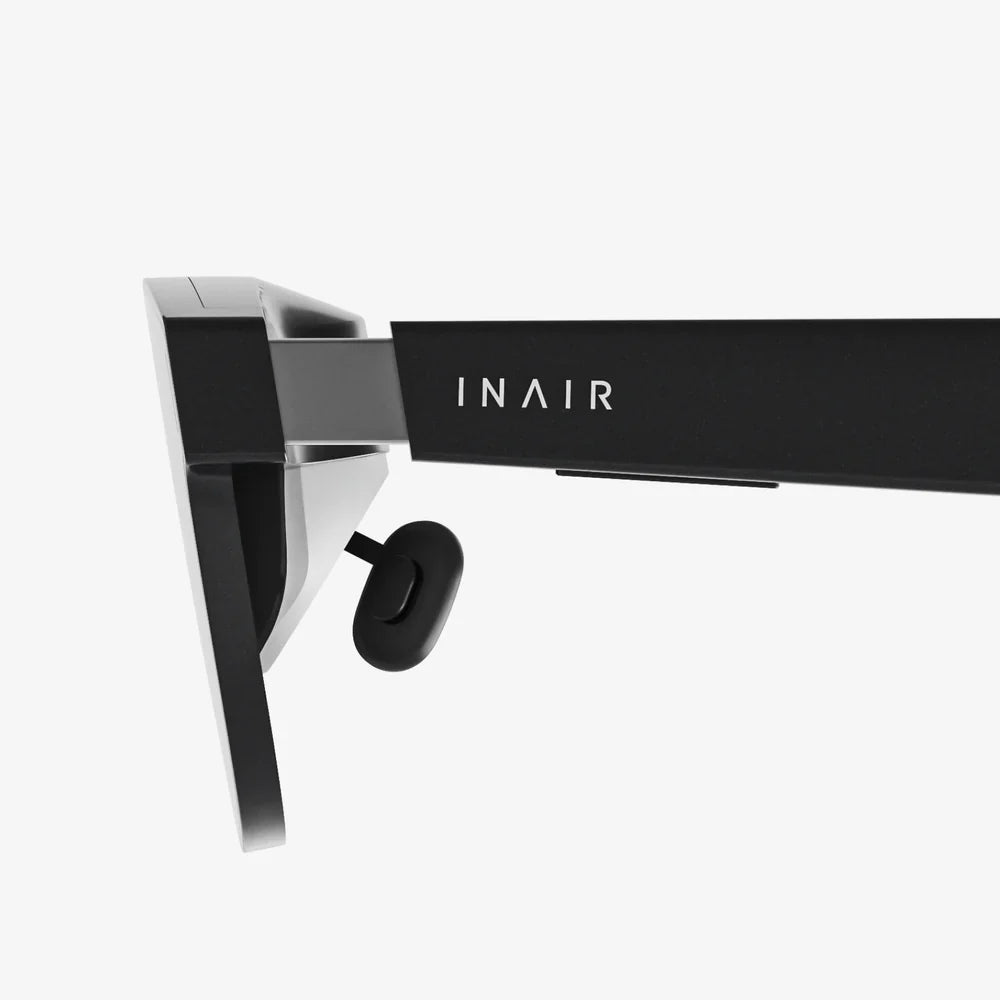
This is the technology used in most AR glasses and smart eyewear. The user looks directly at the real world through transparent lenses. A miniature projector, usually housed in the arm of the glasses, beams the digital imagery onto the inside of the lens, which then reflects it into the user's eye. Technologies like waveguides or holographic optical elements are used to direct this light. The key advantage is that the user sees the real world with their own eyes at its full resolution and without any lag. The challenge is that the digital images must be bright enough to be seen over the background and must be perfectly aligned, which requires extremely precise calibration.
Bringing It All Together: The AR Pipeline in Action
Let's walk through a single frame of an AR experience on a modern device to see this pipeline in action:
- A user points their device at a blank wall.
- The camera captures an image, the depth sensor fires, and the IMU reports a slight tremor in the user's hand.
- In a few milliseconds, the SLAM algorithm processes the new camera frame, identifies feature points on the wall, and updates the device's precise pose. It fuses the depth data to confirm the wall is a flat vertical plane.
- The software recognizes this as a valid surface for placement and activates a virtual art frame asset.
- The GPU renders the art frame from the exact perspective of the camera, matching the virtual lighting to the room's ambient light.
- The compositor layer takes the rendered frame and seamlessly blends it onto the camera feed, ensuring the edges are anti-aliased and it looks natural.
- The final composite image is displayed on the screen for the user, who now sees a beautiful painting hanging on their wall.
- This entire process repeats itself over 60 times per second, creating a fluid, stable, and magical experience.
The Future of How AR Works
The technology is evolving at a breakneck pace. The future of AR lies in improving every stage of this pipeline. Sensors will become smaller, more power-efficient, and more accurate. Processing will be accelerated by dedicated AI chips capable of near-instantaneous environmental understanding. We will move from recognizing planes to understanding entire scenes—knowing that a chair is next to a table in a living room. Displays will become lighter, with wider fields of view and more realistic imagery through advancements like varifocal and light field technology. Ultimately, the goal is to make the technology so seamless and intuitive that the complex symphony of data processing described here becomes completely invisible to the user, leaving behind only the wonder of an enhanced reality.
The magic of seeing a digital creature scamper across your floor is not mere trickery; it is the culmination of decades of research in computer vision, sensor fusion, and graphics rendering. It is a testament to human ingenuity that we can teach machines to see, interpret, and then artistically enhance our world. Understanding how augmented reality works demystifies the experience but, if anything, makes it more impressive. It reveals the incredible technological effort required to make the impossible look effortless. As these layers between the digital and physical continue to dissolve, our reality itself becomes a new canvas, limited only by our imagination and the next generation of algorithms quietly working behind the scenes.
Share:
Augmented Reality Marketplace: The Next Frontier in Digital Commerce and Experience
How Does VR Work With Glasses? A Complete Guide to Immersive Vision