


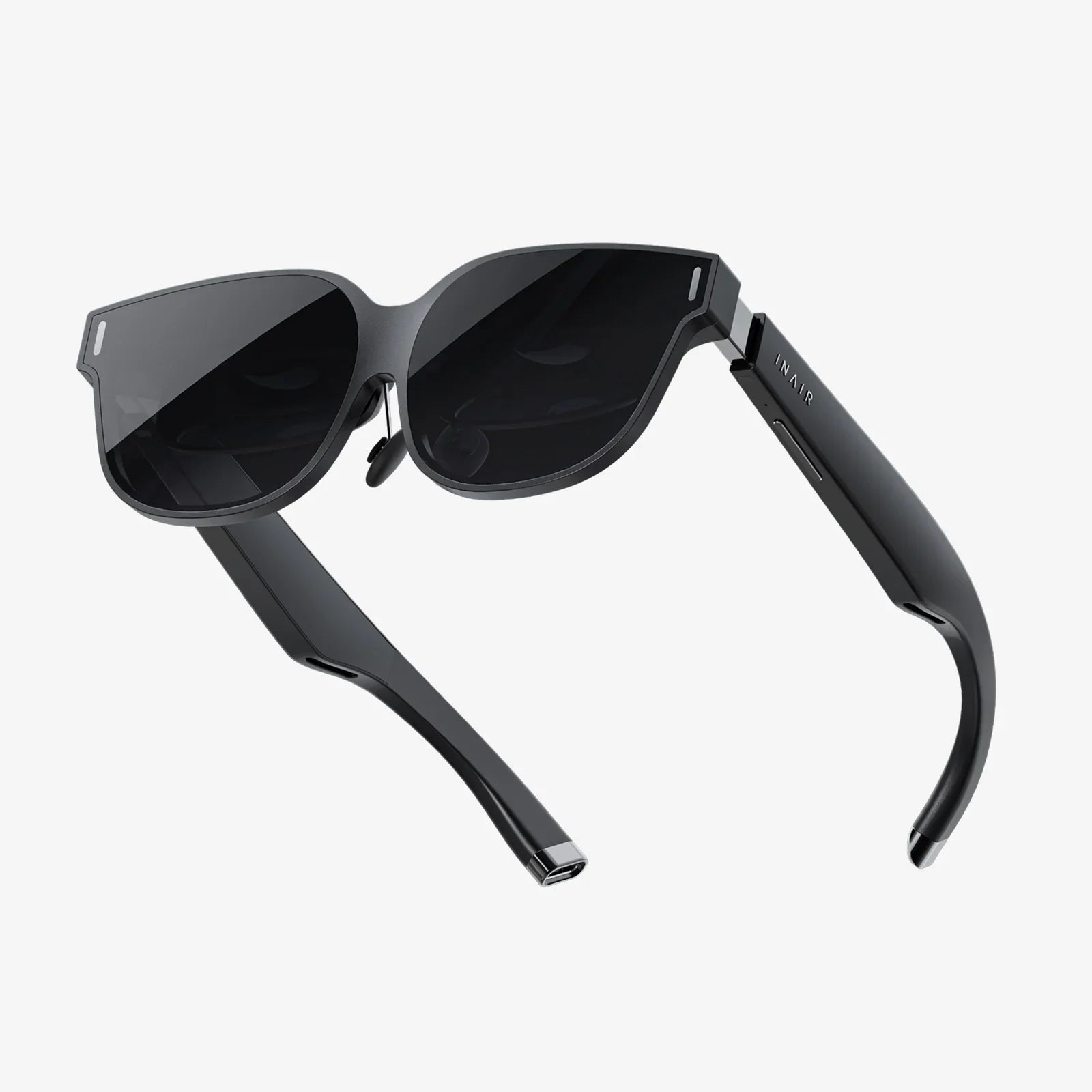
Imagine a world where your digital life doesn’t end at the edge of a screen. Where information, entertainment, and connection are layered seamlessly over your physical reality, accessible with a glance and controlled with a thought. This isn’t a distant science fiction fantasy; it’s the imminent future being unlocked by a new class of wearable technology, epitomized by devices like InAir AR glasses. These aren't just another gadget; they are a portal, promising to fundamentally redefine our relationship with technology by making it intangible, intuitive, and incredibly powerful.
The Evolution of Vision: From Lenses to Digital Canvases
The human desire to enhance vision is ancient. From the polished crystals used by ancient Romans to the sophisticated spectacles of the Middle Ages, and later, contact lenses, we have continually sought to correct and improve the way we see the world. The 20th century introduced a new dimension: information display. Heads-up displays (HUDs) in fighter jets projected crucial flight data onto the cockpit canopy, allowing pilots to keep their "heads up" and focused on the mission. This was the nascent promise of augmented reality—contextual data, presented in real-time, within the user’s field of view.
The journey to consumer-grade AR glasses has been fraught with technological hurdles. Early attempts were often bulky, tethered, and offered a limited field of view, making them impractical for daily use. The core challenge has always been the display technology itself—how to project bright, vibrant, high-resolution digital images that can be clearly seen in a broad range of lighting conditions, all while being housed in a form factor that resembles ordinary eyewear. Furthermore, the problem of input persisted. How does a user interact with a floating interface without a mouse, keyboard, or even a touchscreen?
The development of waveguides, micro-LEDs, and spatial computing has dramatically accelerated progress. Waveguides are essentially transparent glass or plastic plates that use diffraction gratings to pipe light from a micro-projector on the temple of the glasses into the user’s eye. This allows digital images to be overlaid onto the real world without obstructing vision. This technological leap is what makes devices like InAir AR glasses possible, moving the industry from clunky prototypes toward sleek, wearable designs.
Dissolving the Interface: The Core Philosophy of InAir AR Glasses
The name itself, InAir, is a statement of intent. It suggests an interface that exists not on a solid surface, but suspended in the atmosphere around us—weightless, accessible, and non-obtrusive. The defining philosophy behind this approach is to create an invisible computer. The goal is not to command your attention but to assist it, providing information and tools precisely when and where you need them, then fading into the background.
This stands in stark contrast to the current paradigm of screen addiction. Our smartphones, while powerful, are inherently disruptive. To check a notification, get directions, or read a message, we must physically disengage from our environment, looking down at a slab of glass and metal. This constant context-switching fractures our attention and isolates us from the immediate physical world.
InAir AR glasses aim to reverse this dynamic. Instead of you going to the computer, the computer comes to you. Directions appear as a subtle path overlayed on the street ahead. A recipe hovers just above your mixing bowl, allowing you to follow instructions without getting flour on your phone. A notification from a loved one materializes discreetly in the upper corner of your vision without requiring you to stop your conversation. The technology becomes an integrated layer of your perception, not a separate device you interact with.
A Day in the Life: Experiencing the World Through InAir
To understand the transformative potential, consider a day experienced through the lens of this technology.
Morning
Your alarm wakes you, but instead of a blaring sound, the room gradually brightens through smart lights, and your day’s schedule materializes gently on the wall. As you make coffee, you quickly scan the headlines floating in your periphery. The weather forecast for the day is displayed next to your window, showing a clear sky with a suggested light jacket for the evening.
Work & Productivity
During a video conference call, live transcripts and translated subtitles appear below your colleagues, ensuring clear communication. You can pull up documents, charts, or 3D models that are visible only to you, referencing them naturally during the discussion without fumbling between windows on a desktop. For a designer or engineer, complex blueprints can be projected onto a physical prototype, allowing for precise adjustments and annotations in real space.
Navigation & Exploration
Walking through a new city, historical facts and architectural details pop up as you gaze at buildings. Restaurant reviews and ratings are visible as you pass their storefronts. Navigation isn’t a blue dot on a map but a glowing line on the sidewalk, guiding you effortlessly to your destination while leaving you completely aware of your surroundings.
Entertainment & Social Connection
On a long commute, you can watch a movie on a virtual 100-inch screen that only you can see. A friend living across the globe can appear as a photorealistic avatar on your couch, watching the same movie with you as if they were truly there. Gaming transforms the entire world into a playground, with digital characters and objects interacting with your physical environment.
The Technological Symphony: What Makes It Possible
Delivering this seamless experience requires a symphony of advanced technologies working in perfect harmony inside a remarkably small package.
- Advanced Waveguide Optics: The heart of the system. These nano-engineered lenses are what make the sleek form factor possible, bending light to create the illusion that digital images are out in the world.
- Micro-LED Projectors: Tiny, incredibly bright, and energy-efficient light engines that project the digital content into the waveguides. Their low power consumption is critical for all-day battery life.
- Spatial Audio: Speakers built into the temples deliver personalized sound that seems to come from the direction of the digital content, further blending the virtual and real. For privacy, bone conduction can transmit sound without anyone else hearing.
- Computer Vision & AI Co-Processors: A suite of cameras and sensors (including depth sensors and IMUs) constantly scans the environment. A dedicated AI chip processes this data in real-time to understand surfaces, track hand gestures, and map the room, all while protecting user privacy by processing data locally whenever possible.
- Intuitive Input Modalities: Interaction is multimodal. You can use precise hand-tracking to pinch and manipulate virtual objects, voice commands for quick actions, or a simple companion device for tactile feedback. The device learns your preferences, becoming more intuitive over time.
Navigating the Challenges: Privacy, Social Acceptance, and the Path Forward
No transformative technology arrives without its set of challenges and concerns. For augmented reality to become truly mainstream, several significant hurdles must be overcome.
The Privacy Paradigm: A device that sees what you see and hears what you hear raises profound privacy questions. The solution lies in a foundational commitment to privacy-by-design. This means on-device processing for sensitive data (like facial recognition), clear visual indicators when recording, and robust, transparent user controls over what data is collected and how it is used. The ethical development of this technology is not an option; it is a prerequisite for public trust.
The Social Hurdle: Walking down the street talking to an invisible assistant or gesturing at empty air may seem strange—for now. Social norms adapt to technology. The rapid normalization of Bluetooth earpieces and the ubiquitous sight of people looking at their phones are proof. The key to acceptance will be creating devices that are genuinely useful and aesthetically pleasing, moving from geeky to chic. The more the glasses resemble high-fashion eyewear, the faster this transition will occur.
The Digital Divide: As with any advanced technology, there is a risk of creating a new dimension of inequality between those who can afford these tools and those who cannot. Ensuring that the productivity and educational benefits of AR are accessible to as many people as possible will be a crucial societal task.
A New Reality Awaits
The potential applications stretch far beyond consumer convenience. In medicine, surgeons could see vital signs and 3D scans overlayed on a patient during an operation. In manufacturing and field service, technicians could receive guided instructions with arrows and diagrams pointing directly to the components they need to repair. In education, students could dissect a virtual frog or walk through ancient Rome, making learning an immersive, hands-on experience.
We stand at the precipice of a new computing era. The age of the personal computer brought computing to our desks. The mobile revolution put it in our pockets. The next leap, championed by innovations like InAir AR glasses, is to dissolve computing into our environment entirely. It’s a future where technology enhances our humanity instead of competing with it, making us more present, more capable, and more connected to the world around us. The interface of tomorrow isn't on a screen; it's in the air, waiting for you to reach out and interact.
Share:
3D Video Technology: Reshaping Reality and Revolutionizing the Visual Experience
How to Clean Glasses with AR Coating: The Ultimate Guide to Safe, Scratch-Free Care