


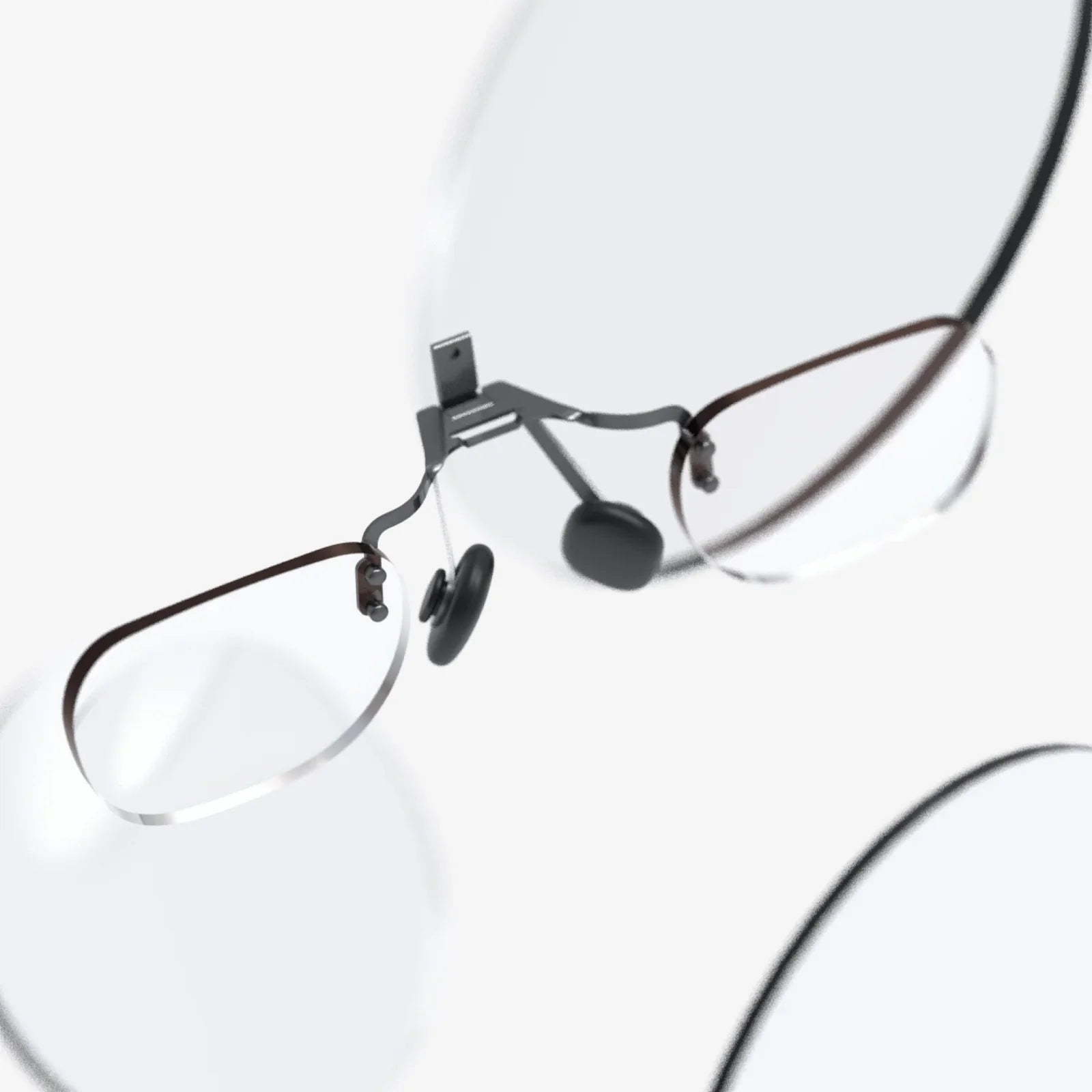
Imagine slipping on a pair of glasses, not to read the morning news, but to step into a breathtaking virtual concert, collaborate with colleagues as if you were in the same room, or learn complex surgery by practicing on a perfect digital replica. This isn't a distant sci-fi fantasy; it's the imminent future being unlocked by a single, transformative innovation: lightweight VR glasses. For years, the promise of virtual and augmented reality has been tethered—both literally and figuratively—to bulky, cumbersome, and often isolating headsets. They were marvels of technology, yet undeniably niche, designed for short, intense bursts of immersion before the strain on your neck and face became too much. But a quiet revolution is underway in laboratories and design studios around the world, one focused on shedding not just grams and ounces, but the very weight of inconvenience that has held VR back. The era of the lightweight VR visor is here, and it’s poised to change everything we thought we knew about digital interaction.
The Engineering Feat: How Did We Get Here?
The journey from the prototype behemoths of yesteryear to the sleek, glasses-like form factors of today is a story of relentless miniaturization and ingenious engineering. Reducing weight and size in VR hardware is a complex puzzle with several interlocking pieces, each a breakthrough in its own right.
The Optical Heart: Pancake Lenses
Perhaps the most significant leap has been in optics. Traditional VR headsets used Fresnel lenses—effective but bulky, requiring a significant distance between the display panel and the user's eyes. This mandatory gap was a primary contributor to the device's overall depth and front-heaviness. The game-changer has been the adoption of pancake lenses. These sophisticated compound lenses use polarization folding to bounce light multiple times within a compact space. This allows the optical path to be dramatically shortened, slashing the required distance between the display and the eye. The result? A visor that can be dozens of millimeters thinner and significantly lighter, moving the center of gravity closer to the face for a fundamentally more balanced and comfortable feel.
Materials Science: The Pursuit of Less
Every single gram counts. Engineers have turned to advanced, lightweight materials to rebuild the headset's very skeleton. Durable magnesium alloys, carbon fiber composites, and high-strength polymers are now standard in premium designs, replacing heavier metals and plastics. Furthermore, the shift away from integrated, bulky audio headsets towards open-ear audio solutions or bone conduction technology further trims weight and allows for greater environmental awareness, a key factor for augmented reality applications.
The Power Dilemma: Processing and Battery Life
A lighter headset is useless if it needs a cable to a powerful computer or dies after thirty minutes. Two parallel paths are solving this. For standalone devices, system-on-a-chip (SoC) processors are becoming incredibly powerful and energy-efficient, capable of delivering high-fidelity experiences without generating excessive heat, which would require heavier cooling systems. Battery technology is also evolving, with higher-density cells offering more juice in smaller packages. The strategic placement of the battery at the rear of the headstrap acts as a counterweight, improving overall balance and comfort, making a device feel lighter than its spec sheet might suggest.
Beyond Comfort: The Ripple Effects of a Lighter Design
The impact of moving to a glasses-like form factor extends far beyond mere comfort. It fundamentally alters the relationship between the user and the technology, unlocking new use cases and dissolving the barriers between the digital and physical worlds.
Social Acceptance and Always-On Readiness
A major hurdle for widespread VR/AR adoption has been social awkwardness. Large headsets are isolating; they block the wearer's eyes and facial expressions, hindering natural interaction with anyone not in the virtual space. Lightweight VR glasses, which resemble large sunglasses or ski goggles, are far less obtrusive. This normalized appearance is critical for use in public spaces, offices, and social gatherings. When the barrier to entry is as low as putting on sunglasses, the technology transitions from a dedicated activity to an always-ready tool. You might wear them on your commute, keep them on at your desk, or slip them on to quickly check a notification or overlay directions onto the street in front of you.
The Democratization of Extended Reality (XR)
Comfort is accessibility. Heavy, nauseating headsets limited VR sessions and excluded individuals with neck or back issues, or those prone to simulator sickness exacerbated by poor fit and weight distribution. Lightweight designs are more inclusive, enabling longer, more productive sessions and opening the door for broader demographics. Elderly individuals could use them for virtual family visits and cognitive therapy. Children could use them for educational field trips without being weighed down. In professional settings, an architect could wear them comfortably for hours to review 3D models, or a factory technician could use them for AR-assisted repairs without the fatigue of a heavy device.
Blurring the Lines: The AR/VR Fusion
The ultimate goal is not just virtual reality, but a seamless blend of the real and the virtual—often called Mixed Reality (MR) or Extended Reality (XR). Lightweight, glasses-like devices are the essential hardware for this fusion. With high-resolution passthrough cameras, these devices can digitally reconstruct your environment in real-time, allowing virtual objects to interact convincingly with your physical space. You could place a virtual television on your real wall, have a digital pet run around your actual living room, or see data visualizations hover over your real-world machinery. This requires a device comfortable enough to wear all day, making the lightweight form factor not just preferable, but absolutely mandatory for the future of spatial computing.
A World Transformed: Applications Reimagined
With the physical constraints lifted, the potential applications for lightweight VR glasses expand exponentially across every facet of society.
The Future of Work is Spatial
The concept of the office will be radically redefined. Instead of a wall of monitors, your virtual workspace could span 360 degrees, limited only by your imagination. Lightweight glasses will allow knowledge workers to toggle between focused, immersive virtual screens and a blended reality mode where digital information is overlaid on their physical desk and colleagues—even those joining remotely as lifelike avatars. For field technicians, complex repair instructions and schematics can be projected directly onto the equipment they are servicing, hands-free and with pinpoint accuracy, reducing errors and training time.
Revolutionizing Education and Training
Education will shift from passive learning to active experience. Instead of reading about ancient Rome, history students can walk through a digitally reconstructed Forum. Medical students can practice intricate procedures on hyper-realistic virtual patients, making mistakes without consequence. This experiential learning, made possible by comfortable, long-duration wear, leads to drastically improved knowledge retention and understanding.
A New Canvas for Social Connection and Entertainment
Social media will evolve from scrolling feeds on a flat screen to sharing experiences in shared virtual spaces. Attending a live concert with friends from across the globe, all represented by expressive avatars, will feel tangibly real. Cinematic storytelling will become experiential, placing you inside the movie. The lightweight, socially acceptable design of these glasses means these experiences won't be solitary events confined to a living room; they could be shared casually, enhancing rather than replacing real-world interaction.
Challenges on the Horizon
The path forward is not without its obstacles. Achieving this minimalist dream requires solving some of the most difficult problems in tech. Battery life remains a constant battle between capacity, size, and the power demands of high-fidelity graphics. Display technology needs to push for higher resolutions in smaller panels with incredible brightness to compensate for the light loss in advanced optics like pancake lenses. Perhaps the most significant challenge is creating intuitive and powerful user interfaces that don't rely on traditional hand controllers—perfecting hand-tracking, eye-tracking, and voice control to make interaction with the digital world as natural as pointing and speaking.
The true magic of lightweight VR glasses lies not in what they remove, but in what they enable. They are the key that unlocks the door from our limited screens into the infinite canvas of spatial computing. By dissolving the physical barrier between us and the digital world, they promise a future where technology enhances our reality without isolating us from it, where learning, working, and connecting are profoundly enriched. The heavy headset was the cocoon; the lightweight glasses are the butterfly—emerging to redefine our perception of what is possible.
Share:
Augmented Reality Job Description: A Deep Dive into the Roles Shaping Our Digital Future
Virtual Reality Glasses UK: A Comprehensive Guide to Immersive Tech