


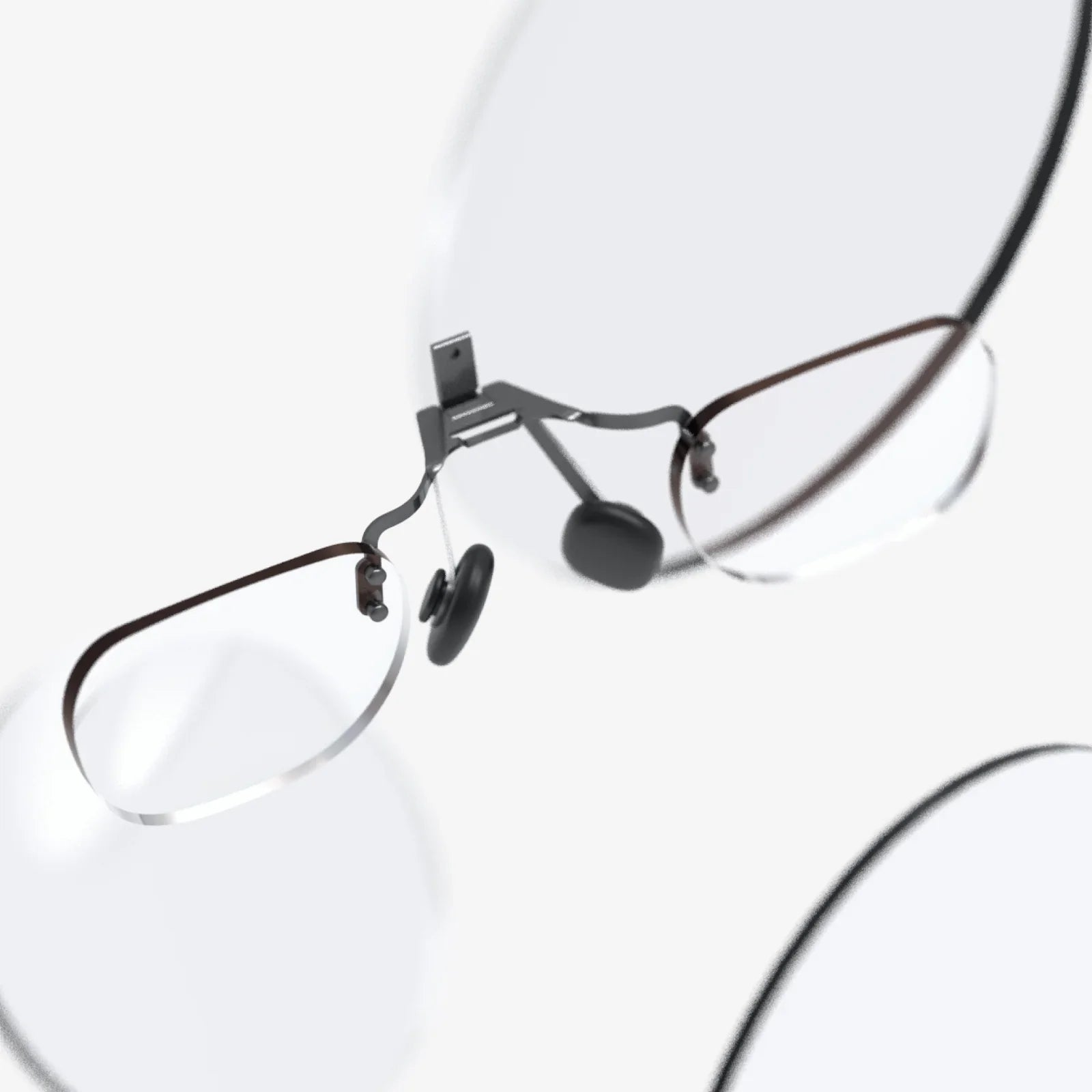
Imagine a world where your digital life doesn’t end at the edge of a screen but is instead painted onto the canvas of your reality, accessible with a simple, almost imperceptible gesture. This is the promise held by a new generation of wearable technology, a promise that devices like Mantis AR glasses are beginning to fulfill, not as a distant sci-fi fantasy, but as an accessible, here-and-now tool. We stand on the precipice of a fundamental shift in human-computer interaction, moving from looking at our devices to looking through them into an augmented world of limitless information and possibility. This isn't just an upgrade; it's a revolution in perception.
The Architectural Leap: How They Create the Illusion
The core magic of any advanced augmented reality glasses lies in their ability to convincingly overlay digital information onto the user's view of the physical world. This feat of optical engineering is far more complex than it appears. Unlike virtual reality, which seeks to replace your vision entirely, AR must seamlessly blend two distinct realities.
At the heart of this system are miniature displays and complex waveguide technology. These are not simple projectors. The process begins with a tiny micro-display, often an advanced LCD or OLED panel, smaller than a fingernail but incredibly dense with pixels. This display generates the raw image that the user will eventually see superimposed on their world.
The true engineering marvel is the waveguide, a transparent piece of glass or plastic etched with microscopic precision. This component acts as a light guide, using principles of diffraction to "pipe" the light from the micro-display into the user's eye. It bends and shapes the light, allowing the digital image to appear focused at a comfortable distance in the real world. The result is a bright, stable, and surprisingly high-resolution image that feels as though it exists in the space around you, not on a screen mere centimeters from your face. This sophisticated optical stack is what allows the device to maintain a sleek, glasses-like form factor, avoiding the bulky, helmet-like designs of early AR and VR attempts.
Beyond the Optics: The Silent Symphony of Sensors and Processing
For the augmented layer to feel truly anchored to reality, it cannot simply float arbitrarily in space. It must interact with it. This requires a sophisticated array of sensors working in concert, a silent symphony of data collection and interpretation. This suite typically includes:
- High-Resolution Cameras: These act as the digital eyes, constantly scanning the environment. They are used for simultaneous localization and mapping (SLAM), building a real-time 3D model of the room, understanding the geometry of surfaces, and identifying objects.
- Inertial Measurement Units (IMUs): Comprising gyroscopes, accelerometers, and magnetometers, these sensors track the precise movement and rotation of the user's head with incredible speed and accuracy. This ensures that digital objects remain locked in place even as you turn and move your head, preventing drift and nausea.
- Depth Sensors: Some systems employ dedicated time-of-flight or structured light sensors to accurately gauge the distance to objects, creating a detailed depth map of the environment. This allows digital content to realistically occlude behind real-world objects and interact with surfaces.
All this sensor data is processed in real-time by a powerful onboard processor. This chip is the brain of the operation, fusing the visual, inertial, and depth data to understand the world in six degrees of freedom (6DoF)—knowing its position in space along the X, Y, and Z axes and its orientation in pitch, roll, and yaw. This spatial understanding is the bedrock upon which convincing and interactive AR experiences are built.
A New Paradigm for Human-Computer Interaction
The most profound impact of this technology may not be the graphics themselves, but how we interact with them. The traditional paradigms of the mouse, keyboard, and touchscreen are dissolving, replaced by more intuitive and natural forms of input.
Gesture control is a primary interface. Using the outward-facing cameras, the system can track the user's hands with high fidelity, interpreting pinches, swipes, and grabs as commands. This allows for direct manipulation of digital objects, pulling, rotating, and placing them as if they were physically present. It’s a powerful and instinctive way to interact that reduces the cognitive load of learning abstract control schemes.
Voice assistants, powered by natural language processing, provide another hands-free layer of control. Users can summon information, launch applications, or control media with simple voice commands, making the technology accessible and efficient for a wide range of tasks.
Perhaps the most futuristic interface is gaze tracking. By using inward-facing infrared cameras to monitor the user's pupils, the system can determine exactly where on the AR interface the user is looking. This enables "look to select" functionality, where simply gazing at a button can activate it, or dynamic focus, where the depth of digital elements can adjust based on where your eyes are focused in the real world. This creates an unprecedented level of seamlessness between user intent and system action.
Transforming Everyday Life: From Productivity to Play
The applications for this technology stretch as far as the imagination, poised to revolutionize nearly every facet of our daily routines.
The Augmented Workspace
For the professional, the potential is staggering. Imagine architects walking clients through a full-scale 3D model of a building before a single brick is laid. Engineers could have complex schematics and repair manuals overlaid directly onto the machinery they are fixing, with step-by-step instructions highlighting specific components. Remote collaboration becomes truly spatial, with colleagues appearing as holograms in your room, able to point to and manipulate shared 3D models as if they were physically present. This dissolves the barriers of distance and creates a shared spatial understanding that video calls cannot replicate.
Reimagining Navigation and Contextual Information
Navigation moves beyond a flat map on a phone screen. Giant floating arrows can guide you through a complex airport terminal, street names and business ratings can appear over their real-world locations, and public transit schedules can pop up as you glance at a bus stop. The world itself becomes labeled and interactive. Travel becomes richer as historical facts and architectural details materialize before your eyes as you look at a monument, and language barriers crumble as real-time translation of street signs and menus is projected onto them.
The Future of Entertainment and Social Connection
Entertainment becomes an immersive, shared experience. Instead of gathering around a television, a group could watch a movie on a virtual giant screen placed on their living room wall, or play a board game that comes to life on their coffee table. Gaming escapes the confines of the console and invades the real world, turning your home into a dungeon-crawling adventure or your local park into an alien landscape to be explored.
Socially, the implications are profound. Sharing experiences moves from curated photos on a social media feed to shared AR experiences in a common physical space. Friends could leave virtual notes and drawings for each other in specific locations, creating a layer of inside jokes and memories tied to the physical world.
Navigating the Inevitable Challenges
This bright future is not without its significant challenges and ethical considerations. The most immediate hurdle is the social one. Wearing technology on your face in public spaces raises questions of etiquette, privacy, and distraction. The concept of "digital eye contact"—whether it's disconcerting to talk to someone who is wearing glasses that record or display information—is a new social frontier that will need to be navigated.
Privacy concerns are paramount. A device that is always looking at the world through a camera is a powerful surveillance tool. Robust and transparent data handling policies, on-device processing where possible, and clear user controls over what is recorded and stored are non-negotiable prerequisites for widespread public adoption. The potential for unauthorized recording in private spaces and the creation of persistent facial recognition networks are dystopian pitfalls that must be avoided through careful regulation and ethical design.
Finally, there is the challenge of the digital divide. As with any transformative technology, there is a risk that it could exacerbate existing inequalities. Ensuring that the benefits of augmented reality are accessible and not just a luxury for the affluent will be crucial for its healthy integration into society.
The Road Ahead: From Niche to Normal
The current generation of devices represents a critical stepping stone. They are proving the concept, refining the technology, and building the foundational developer community that will create the killer applications to drive mass adoption. The path forward will be defined by continuous innovation in several key areas: battery life, processing power, field of view, and connectivity.
Future iterations will become lighter, more powerful, and last longer on a single charge. The field of view—the window into the augmented world—will expand to fill more of the user's natural vision, increasing immersion. Most importantly, they will become more contextually aware and intelligent, moving from simple display terminals to proactive assistants that anticipate needs and surface relevant information at the perfect moment without being asked.
We are moving towards a future where this technology will be as ubiquitous and unremarkable as the smartphone is today. The goal is not to live inside a digital world, but to enrich our experience of the physical one. It’s about enhancing human capability, not replacing it; about providing information and utility that empowers us to be more productive, more creative, and more connected to the world and people around us.
The true power of this technology lies not in the complexity of its waveguide or the speed of its processor, but in its potential to become an invisible bridge between our minds and the vast digital universe, allowing us to access it all without ever looking down. The next great platform for human experience is being built right before our eyes, and it’s a vision of the world made infinitely more interesting, informative, and magical.
Share:
Virtual Reality Collaboration News: The Dawn of a New Digital Workspace
Best Streamer Wireless Headphones: The Ultimate Guide for Crystal-Clear Audio