


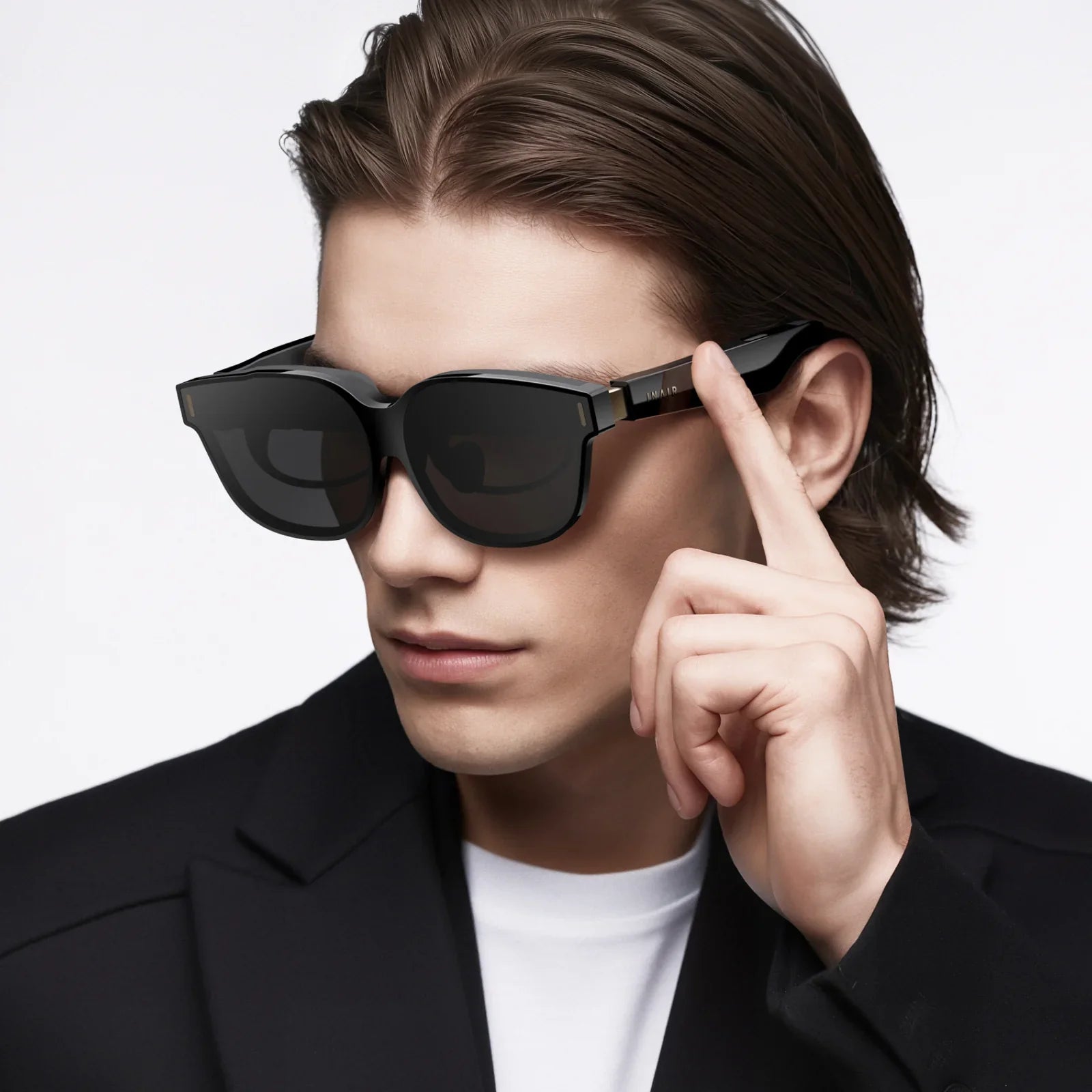
Imagine a world where the line between the digital and the physical isn't just blurred—it's erased. Where information, interaction, and imagination are woven directly into the fabric of your perception, accessible not through a screen you look at, but as a layer of reality you look through. This is the profound promise held within the concept to merge virtual reality goggles, a technological leap that moves beyond immersion into the realm of integration, forever altering our relationship with reality itself.
The Evolutionary Journey: From Clunky Headsets to Merged Reality
The path to this merged future began with bulky, expensive prototypes that offered a tantalizing, if pixelated, glimpse into other worlds. Early iterations were isolating, corded to powerful machines, and focused primarily on gaming and niche industrial applications. The user was a spectator in a digital sphere, fully aware they were wearing a device on their face.
The next wave introduced greater fidelity, inside-out tracking, and untethered freedom. Yet, the fundamental paradigm remained: putting on a headset to enter VR and taking it off to return to the real world. The goal was total immersion, a complete replacement of one's surroundings. However, a new vision was simultaneously taking shape—Augmented Reality (AR), which sought to overlay digital information onto the physical environment through transparent lenses. For years, VR and AR were seen as parallel, competing paths.
The true breakthrough, the paradigm we are now approaching, is the synthesis of these two fields. The next generation of devices aims to merge virtual reality goggles into a single, unified platform. This isn't just a VR headset with a passthrough camera; it's a fundamental reimagining of the hardware and software to dynamically blend realities. Using advanced sensors, LiDAR, and real-time environment mapping, these devices understand the world as you do. They can render convincing virtual objects that appear to obey the laws of physics, occlude correctly behind your real sofa, and interact with your physical space. The headset becomes a portal for mixed reality (MR), capable of shifting seamlessly along the spectrum from full virtual immersion to subtle digital augmentation, all based on the user's intent.
The Core Technologies Powering the Merge
This seamless merger is not powered by a single invention but by a confluence of several cutting-edge technologies working in concert.
Photorealistic Passthrough and Environmental Understanding
The key to a believable merge is high-fidelity passthrough. Early video passthrough was laggy, low-resolution, and distorted, constantly reminding the user of the artificial layer. The next generation uses high-resolution cameras, often in stereo, to capture the real world with minimal latency and dynamic range that matches human vision. More importantly, on-board processors use Simultaneous Localization and Mapping (SLAM) algorithms to create a persistent, 3D mesh of the user's environment in real-time. This digital twin allows virtual objects to have a spatial understanding, enabling them to collide with real surfaces, rest on real tables, and be hidden by real walls.
Varifocal Displays and Eye-Tracking
A major hurdle in VR/AR comfort is the Vergence-Accommodation Conflict (VAC). In the real world, our eyes converge and their lenses accommodate (focus) in tandem when looking at objects at different distances. Traditional headsets have a fixed focal plane, forcing our eyes to focus on a screen inches away while trying to converge on a virtual object that appears feet away. This disconnect causes eye strain and headaches.
Advanced systems now integrate eye-tracking and varifocal displays. The eye-tracker precisely measures where the user is looking and at what depth. The display then physically or optically adjusts its focal plane to match that depth, dynamically shifting focus just as our natural lenses do. This not only eliminates discomfort but also creates a powerful and intuitive interface—selection by gaze—and enables foveated rendering.
Foveated Rendering: Doing More with Less
The human eye only sees a small central area (the fovea) in high detail; our peripheral vision is much lower resolution. Foveated rendering, powered by precise eye-tracking, mimics this. It renders the exact point of gaze in ultra-high resolution while intelligently reducing the rendering quality in the periphery. This massive reduction in computational load allows for stunning visual fidelity without requiring impossibly powerful and energy-intensive hardware, making high-end merged reality feasible on mobile processors.
Haptic Feedback and Embodied Interaction
True merger isn't just visual; it's tactile. The feeling of pressing a virtual button or the resistance of pulling a virtual lever is crucial for presence. Advanced controllers are giving way to haptic gloves that provide nuanced feedback, simulating texture, weight, and impact. Further on the horizon are technologies like ultrasonic arrays that can project tactile sensations directly onto the user's skin, freeing them from wearable controllers entirely and allowing for natural hand interaction with digital objects.
Beyond Entertainment: The Transformative Applications
While gaming will remain a killer app, the implications of merged reality extend far beyond, poised to revolutionize nearly every professional and personal domain.
Revolutionizing Design and Architecture
Architects and industrial designers can step inside their 1:1 scale models before a single brick is laid or a part is machined. They can walk through a building, assessing sightlines and ergonomics, or assemble a complex engine prototype, identifying design flaws that would be invisible on a 2D screen. This ability to prototype in real space saves immense time and resources.
The Future of Remote Work and Collaboration
The concept of a "virtual office" will evolve from a grid of video calls to a shared, persistent virtual workspace. Colleagues from across the globe can merge into the same room, interacting with 3D data models, brainstorming on a virtual whiteboard that feels physical, or training on a piece of equipment together as if they were side-by-side. This spatial collaboration adds a layer of human context and intuition currently lost in remote work.
Education and Training Reimagined
Students can take a field trip to ancient Rome, witnessing history unfold around them. Medical students can practice complex surgical procedures on hyper-realistic virtual patients, making mistakes without consequence. Mechanics can see interactive repair instructions overlaid directly onto the engine they are working on. This experiential learning is far more engaging and effective than textbooks or videos.
Enhancing Daily Life and Accessibility
Imagine navigation arrows painted directly onto the street, a translator that overlays subtitles onto a person speaking a foreign language in real-time, or a system that highlights your lost keys on the coffee table. For individuals with visual or auditory impairments, merged reality can act as a powerful sensory aid, highlighting obstacles, amplifying sounds, or providing captions for the world.
The Societal and Ethical Crossroads
Such a powerful technology does not arrive without significant questions and potential pitfalls. The merger of realities forces us to confront profound ethical dilemmas.
The Data Privacy Imperative
These devices are, by their nature, the most intimate data-gathering tools ever conceived. They have continuous, high-resolution audio and video feeds of your home, your workplace, and your life. They map the precise layout of your private spaces and track your biometric responses—where you look, how you react. The potential for misuse of this data by corporations or governments is staggering. Robust, transparent, and user-centric data privacy frameworks are not an add-on; they are a prerequisite for public trust and adoption.
The Reality Divide
There is a genuine risk of creating a new socioeconomic schism—a "Reality Divide." If this technology becomes essential for work, education, and social connection, what happens to those who cannot afford it? Will we see a world where the affluent layer their reality with helpful information and enhanced experiences, while others are left with an un-augmented existence? Ensuring equitable access will be a critical challenge.
Identity, Agency, and the Nature of Experience
When reality becomes customizable and filterable, what happens to our shared sense of objective truth? If two people in the same room can be experiencing entirely different perceptual layers, does a common reality still exist? Furthermore, the potential for addiction and escapism is profound. If a user can design a world that is always comfortable, stimulating, and affirming, the motivation to engage with the often-messy physical world may diminish, impacting mental health and social cohesion.
Looking Ahead: The Invisible Interface
The ultimate endpoint of this technology is not a goggle at all, but its eventual disappearance. The goal is an interface that is truly invisible—perhaps contact lenses or even direct neural interfaces—that provides seamless access to the digital layer of our world without any intermediary hardware. The journey to merge virtual reality goggles is the critical intermediate step, teaching us how to design for this new paradigm, understand the human factors, and build the computational foundations for a world where the digital and physical are one.
The headset that truly mergers realities will not be a product you use; it will be a lens through which you experience life. It will redefine creativity, collapse distance, and expand human potential in ways we are only beginning to imagine. The device is coming. The question is not if we will wear it, but how we will choose to see through it.
Share:
Virtual Reality and Remote Work: The Dawn of the Immersive Digital Office
Virtual Reality Uses in Daily Life: Beyond Gaming and Into Our Homes