


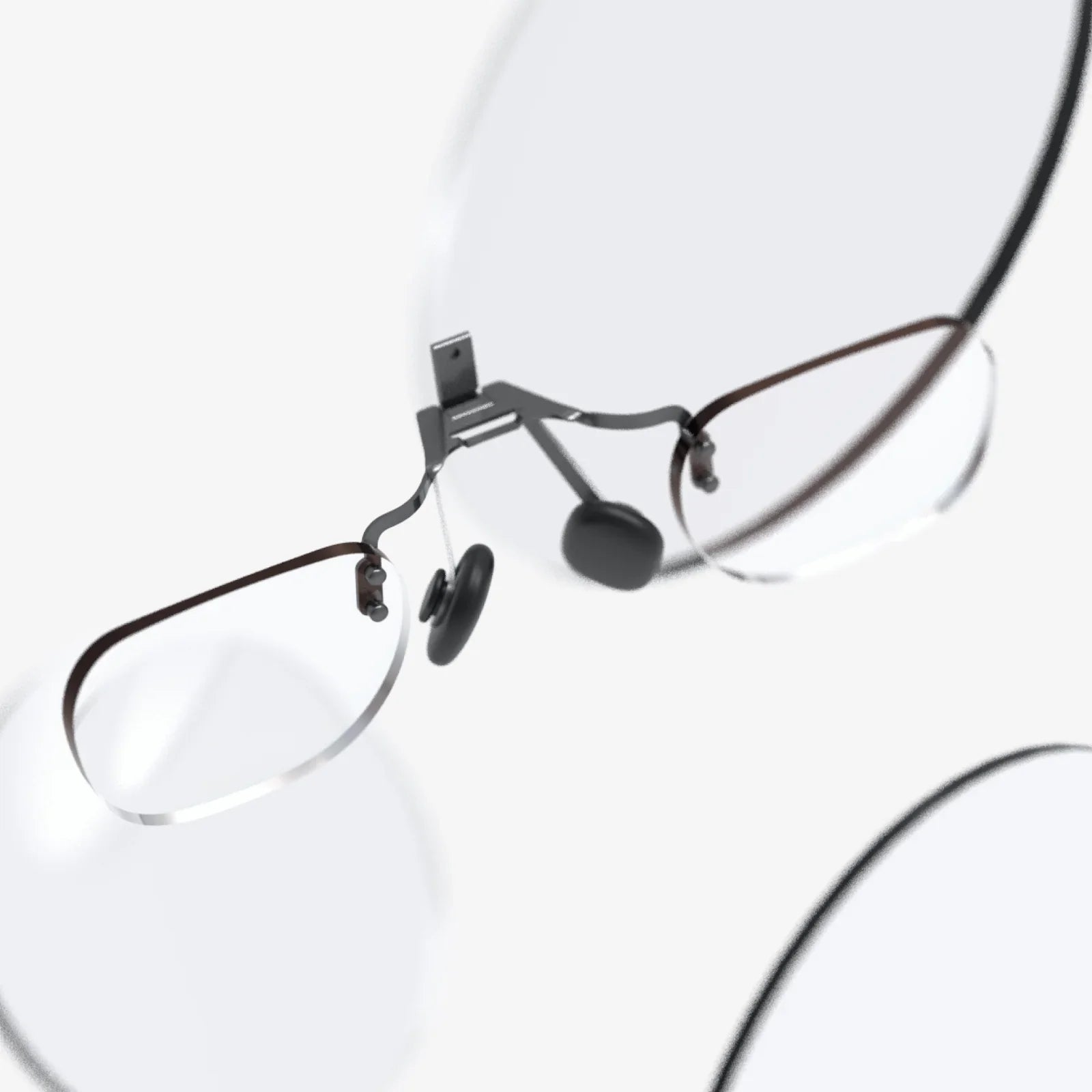
Imagine a computer that fits in your pocket yet projects a screen the size of a building, an office that materializes on any empty desk, and a digital world that seamlessly overlays and enhances your physical reality. This isn't a scene from a science fiction film; it is the imminent future being forged today by the powerful convergence of a mini PC with AR glasses. This combination represents more than just a technological iteration; it is a fundamental paradigm shift, promising to untether us from traditional screens, dissolve the boundaries between physical and digital spaces, and redefine the very essence of personal computing. The era of static, location-bound computing is ending, and the age of spatial, contextual, and immersive interaction is dawning.
The Architectural Core: Understanding the Symbiosis
To appreciate the revolution, one must first understand the distinct yet complementary roles of the two components. This isn't merely a peripheral attached to a computer; it's a symbiotic relationship where the whole is vastly greater than the sum of its parts.
The Mini PC: The Unseen Powerhouse
The mini PC is the brains of the operation. These compact devices, often no larger than a hardcover book, have undergone a meteoric rise in computational power. Leveraging ultra-efficient architectures, they now pack performance that rivals or even surpasses traditional desktop towers. They are equipped with powerful multi-core processors, dedicated graphics processing units (GPUs) capable of rendering complex 3D environments in real-time, ample high-speed memory, and a suite of connectivity options.
Their role is to execute all the intensive computational tasks: running the operating system, applications, and complex algorithms for spatial mapping and rendering. By housing this power in a separate unit, it solves one of the most significant hurdles facing standalone AR glasses: heat dissipation and battery life. A mini PC can be powered for hours without the thermal and energy constraints of a device perched on a user's face, ensuring sustained high performance.
The AR Glasses: The Window to a New Reality
The AR glasses are the sensory interface. They are not merely displays but sophisticated optical computers in their own right. Modern models feature:
- Waveguide Optics: Advanced transparent lenses that project digital images directly into the user's eyes while allowing them to see the real world clearly.
- High-Resolution Micro-Displays: Tiny screens, often using technologies like MicroLED or OLED, that provide crisp, bright, and vibrant imagery.
- Spatial Sensors: An array of cameras, depth sensors, and inertial measurement units (IMUs) that continuously scan the environment. This enables inside-out tracking, meaning the glasses understand their position and orientation in space without external markers.
- Audio Solutions: Integrated spatial audio speakers that deliver sound directly to the ears, often with beamforming technology for privacy, making the experience immersive without isolating the user from their surroundings.
The glasses' primary job is to capture the world, send that data to the mini PC for processing, and then present the augmented reality overlay back to the user with imperceptible latency.
The Vital Connection
The link between these two units is critical. While some early systems use a physical cable for zero-latency, lossless data transfer, the industry is rapidly moving towards robust, high-bandwidth wireless protocols. This wireless tether is the final piece of the puzzle, granting the user complete freedom of movement and cementing the truly untethered nature of the experience.
A World Transformed: Use Cases and Applications
The theoretical potential of this technology becomes staggering when applied to real-world scenarios. It promises to transform every major sector.
The Ultimate Productivity Station
For the professional and remote worker, this combination is a game-changer. Instead of being chained to a desk with a limited number of physical monitors, a user can don their glasses and instantaneously summon multiple virtual screens of any size, arranged anywhere in their field of view. You could have a word processor open on your virtual wall, a video conference call floating to your left, and a web browser to your right—all while sitting on your patio or in a coffee shop. This is the definitive end of the multi-monitor setup, replaced by an infinite, portable workspace.
Revolutionizing Design and Engineering
For architects, engineers, and designers, the ability to visualize 3D models at scale and in context is invaluable. An architect could walk a client through a full-scale, holographic rendering of a building design on the actual empty plot of land. A mechanic could see a transparent, annotated overlay of a complex engine, with repair instructions and part numbers hovering next to each component. This contextual, hands-free information overlay drastically reduces errors, improves understanding, and accelerates complex tasks.
The Future of Entertainment and Social Connection
Entertainment ceases to be a confined experience on a rectangular screen. Imagine watching a movie with a virtual 100-inch screen projected on your living room wall, or playing a game where the characters and environments burst out into your physical space. Socially, this technology could enable truly holographic video calls, where life-sized representations of friends and family can sit on your couch as if they were physically present, bridging geographical gaps with unprecedented presence.
Navigating the Frontier: Challenges and Considerations
Despite the immense promise, the path to ubiquitous adoption is not without its obstacles. These challenges are significant but not insurmountable.
- Form Factor and Comfort: AR glasses must become as lightweight, comfortable, and socially acceptable as a standard pair of eyeglasses. Current technology is advancing rapidly, with a strong focus on slimmer profiles and more fashionable designs.
- Battery Life and Power Management: While the mini PC handles the heavy lifting, the glasses themselves still require power for displays and sensors. Optimizing this for all-day use is a key engineering focus.
- User Interface (UI) and User Experience (UX): Interacting with a floating, spatial interface requires entirely new paradigms beyond the mouse and keyboard. Gesture control, voice commands, and advanced eye-tracking are being developed as the primary input methods, but perfecting an intuitive and fatigue-free system is an ongoing process.
- Software Ecosystem: For any computing platform to thrive, it needs a robust library of applications. Developers must be empowered to create native spatial computing apps that fully leverage the capabilities of AR, moving beyond mere screen mirroring.
- Privacy and Security: Devices with always-on cameras and sensors that map our personal spaces raise legitimate privacy concerns. Clear guidelines, robust data encryption, and user-controlled permissions will be non-negotiable for public trust.
The Road Ahead: From Niche to Normal
The journey of the mini PC with AR glasses is following a familiar trajectory in the history of computing. It begins as a specialized tool for enthusiasts and professionals in fields like engineering and medicine. As the technology matures—becoming more powerful, affordable, and comfortable—it will gradually permeate the consumer market.
We are currently in this early adopter phase. The foundations are being laid, the developer tools are being distributed, and the first generation of compelling hardware is arriving. The next five to ten years will see exponential growth in this space, driven by continuous improvements in processing power, display technology, and battery efficiency.
This evolution will not happen in isolation. It will be accelerated by parallel advancements in artificial intelligence, which will provide the contextual awareness and predictive capabilities to make AR interfaces truly intelligent. It will also be bolstered by the expansion of 5G and future 6G networks, which will provide the high-speed, low-latency connectivity required for cloud-based processing and seamless experiences anywhere.
The destination is a world where digital information is no longer confined to slabs of glass we carry in our pockets or place on our desks. Instead, it will be an integrated layer of our reality, accessible instantly, contextually relevant, and limited only by our imagination. The combination of a powerful, portable mini PC and sophisticated, comfortable AR glasses is the key that will unlock this door, finally merging the boundless potential of the digital realm with the rich, tactile experience of the physical world. The devices on our desks are destined to disappear, only to reappear all around us, transforming every blank space into a potential portal and every task into an opportunity for augmented brilliance.
This isn't just an upgrade to your computer; it's an upgrade to your reality, offering a glimpse into a world where your digital life is no longer something you look at, but something you live within, seamlessly blending the lines between what is real and what is possible.
Share:
Future Breakthroughs in Technology: The Next Decade of Radical Innovation
Best AR Glasses for Training: The Ultimate Guide to a Smarter Workout