


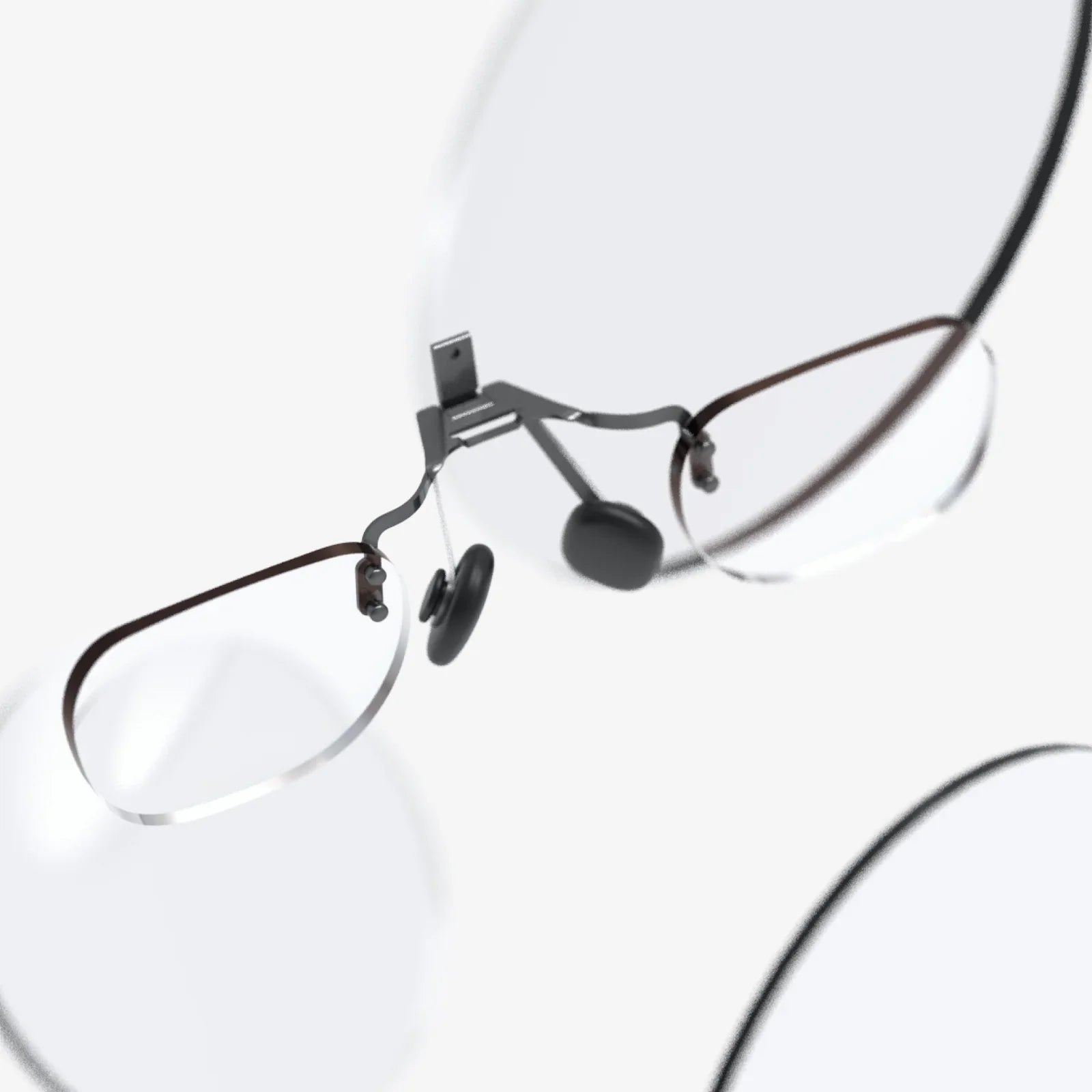
Imagine a world where information doesn't live on a screen in your hand, but floats seamlessly in your field of vision, accessible with a glance and controllable with a whisper. This is the promise of mobile glasses, a technological leap that is quietly moving from science fiction to a tangible, imminent reality. This isn't just another gadget; it's a fundamental shift in our relationship with computing, promising to untether us from our devices and weave digital intelligence directly into the fabric of our daily lives. The era of staring down at a slab of glass and metal is nearing its end, and the age of looking up and engaging with the world, enhanced and empowered, is about to begin.
Beyond the Hype: Defining the True Nature of Mobile Glasses
The term "mobile glasses" might conjure images of specific products, but it is far broader. It represents a category of wearable technology that integrates computational power, display systems, sensors, and connectivity into a form factor resembling traditional eyewear. Their primary function is to act as a personal, heads-up display, projecting information onto lenses or into the user's line of sight, thereby creating an augmented or mixed reality experience.
It is crucial to distinguish this technology from its predecessors. These are not simple video viewers or displays for a single function. True mobile glasses are a platform—a general-purpose computer for your face. They are characterized by several core capabilities:
- Untethered Operation: They possess their own processing unit, battery, and wireless connectivity (5G, Wi-Fi), operating independently without being physically wired to a phone or computer.
- Spatial Awareness: Equipped with a suite of sensors—cameras, LiDAR, accelerometers, gyroscopes, and microphones—they understand their environment and the user's position within it.
- Contextual Intelligence: By processing environmental data in real-time, they can deliver relevant information precisely when and where it is needed.
- Natural Interaction: Control is moving beyond touchscreens to voice commands, gesture recognition, and even subtle eye movements, creating a more intuitive and hands-free interface.
The Architectural Marvel: How Mobile Glasses Work
The magic of mobile glasses lies in the sophisticated symphony of components working in unison. At their heart is a System-on-a-Chip (SoC), a miniature computer processor that handles all computational tasks, from running the operating system to processing complex visual data. This is powered by a compact yet high-density battery, a significant engineering challenge given the spatial and weight constraints.
The most critical and complex component is the optical system. Unlike a projector shining on a wall, this system must paint an image directly onto the human retina or create the illusion of a stable, high-resolution screen floating in space. Several technologies are competing for dominance:
- Waveguide Displays: This is a leading method where light is projected from the side of the glasses into a thin, transparent piece of glass or plastic. This waveguide uses diffraction gratings to "bend" the light, channeling it toward the eye. The result is a bright, clear image overlaid on the real world, all within a relatively slim lens design.
- MicroLED Projection: Extremely small, bright, and efficient MicroLEDs project light onto a specially coated lens that reflects it back to the eye. This can offer exceptional contrast and color fidelity.
- Holographic Optics: An emerging technology that uses laser light to create interference patterns, generating full-color, three-dimensional images that appear to occupy real space, offering a more natural and depth-accurate experience.
Surrounding this display are the sensors. Cameras capture the world for object recognition and spatial mapping. Inertial Measurement Units (IMUs) track head orientation and movement. Depth sensors map the geometry of a room. Microphones listen for voice commands and filter out ambient noise. All this data is fused together to create a real-time, understanding digital model of the user's environment.
A Lens on Life: Transformative Applications Across Industries
The potential applications for mobile glasses extend far beyond novelty or consumer entertainment. They are poised to become indispensable tools across numerous professional and personal domains.
Revolutionizing the Workplace
In industrial and field service settings, mobile glasses are a game-changer. A technician repairing a complex machine can see schematics and animated instructions overlaid directly on the equipment itself, with their hands free to work. A surgeon could see vital signs, ultrasound data, or surgical guides without ever looking away from the patient. An architect walking through a construction site could see the digital building model aligned perfectly with the physical structure, identifying potential clashes before they become costly errors.
Redefining Social Connection and Communication
Imagine a video call where the participants appear as life-like holograms sitting across the table from you, able to share 3D models and data you can both examine from different angles. Mobile glasses can translate foreign language signs and conversations in real-time, not as text on a screen, but as subtitles seamlessly integrated into your vision, breaking down language barriers instantly. For those with visual or hearing impairments, they could highlight obstacles, amplify sounds, or provide real-time captioning of the world around them.
The Ultimate Personal Assistant
In daily life, they become the ultimate contextual assistant. Walking through a city, historical facts about a building could pop up as you look at it. Navigating a new airport, arrows could be painted on the floor guiding you to your gate. Shopping for groceries, you could see product reviews, price comparisons, and allergy information simply by looking at an item on the shelf. Your schedule, messages, and notifications would appear without you ever needing to reach for your pocket, allowing you to stay connected without being disconnected from your surroundings.
Navigating the Obstacle Course: The Challenges to Mainstream Adoption
Despite the exciting potential, the path to ubiquitous mobile glasses is fraught with significant hurdles that engineers, designers, and society must overcome.
The Form Factor Conundrum
The ultimate challenge is making the technology disappear. Current prototypes often face a trade-off between capability and aesthetics. To be widely adopted, mobile glasses must be lightweight, comfortable for all-day wear, and, crucially, socially acceptable. They need to look like fashionable eyewear, not clunky, robotic headgear. This requires miniaturizing powerful components, managing heat dissipation, and developing new battery technologies—all without compromising on performance.
The Privacy Paradox
This is perhaps the most significant societal challenge. Glasses with always-on cameras and microphones understandably raise profound privacy concerns. The potential for surreptitious recording is a serious issue. Solving this will require a multi-faceted approach: clear hardware indicators like recording lights that cannot be disabled, robust software permissions that give users complete control over data collection, and perhaps most importantly, establishing strong social norms and legal frameworks around their use in public and private spaces.
The Digital Divide and Accessibility
As with any transformative technology, there is a risk of exacerbating existing inequalities. The high cost of early adoption could create a new digital divide between those who can afford this enhanced reality and those who cannot. Furthermore, the technology must be designed for inclusivity, ensuring it is accessible to people with different visual acuities, hearing abilities, and physical capabilities. Prescription lenses must be easily integrated, and interfaces must be adaptable to diverse needs.
The Road Ahead: From Niche to Normal
The adoption of mobile glasses will not be an overnight phenomenon. It will likely follow a gradual trajectory, similar to the adoption of smartphones. Initially, they will find their strongest foothold in enterprise and specialized industrial applications, where their value in improving efficiency, safety, and accuracy is clear and easily quantifiable. This initial market will fund further research and development, driving down costs and improving the technology.
From there, adoption will trickle down to prosumers and early adopters in the consumer space. As the technology becomes more refined, affordable, and stylish, it will gradually reach a mass market. This transition will be accompanied by the development of a robust ecosystem of applications and services, a killer app that demonstrates their indispensable value to the average person, and a cultural shift in how we perceive always-available digital information.
We are standing at the precipice of the next major computing platform. The journey from the personal computer to the smartphone was about putting a computer in everyone's pocket. The journey to mobile glasses is about finally setting that computer free, allowing us to look up from our screens and re-engage with the world, only now a world made richer, smarter, and more connected by the intelligent lens through which we see it. The future is not in your hand; it's on your face.
The world is about to get a major upgrade, and it will be delivered through a pair of lenses. The next time you reach for your phone to check a message, look up a fact, or find your way, picture doing all of that without breaking your stride or your gaze. The potential to enhance human capability, bridge understanding, and unlock new forms of creativity is immense, waiting just beyond the horizon of our current reality. Get ready to see the world, and your place within it, in a whole new light.
Share:
What Heads Up Display Is and How It's Revolutionizing Your View of the World
AR Brillen 2025: The Dawn of a Seamless Augmented Reality Future