


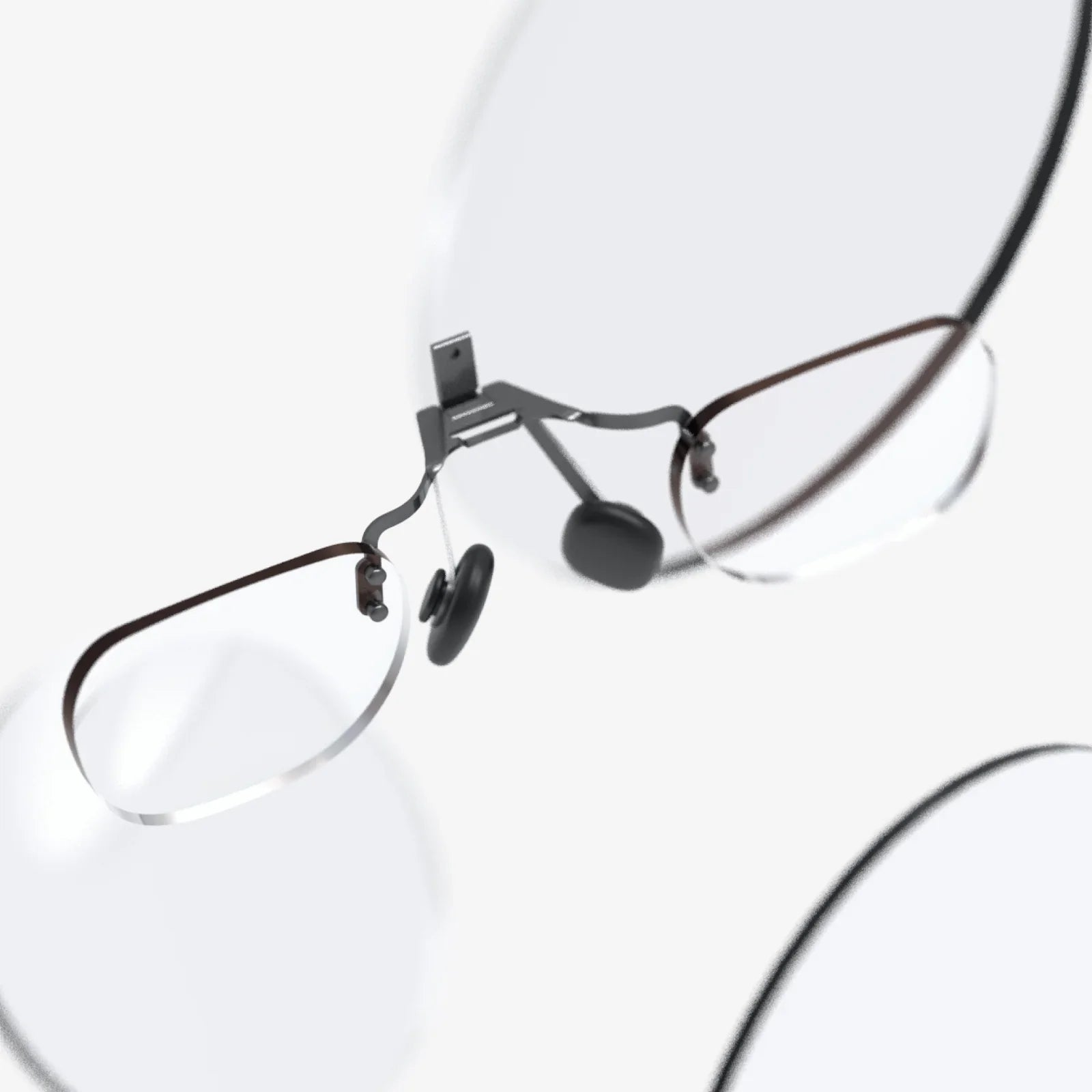
Imagine a world where the digital and the physical are no longer separate realms but a single, seamless tapestry of experience. Where information doesn’t live on a screen in your hand but is woven into the very fabric of your environment, accessible with a glance, a gesture, or a whispered command. This is the promise of augmented reality, a promise that, by 2025, is being delivered upon by the most advanced AR glasses the world has ever seen. These are not the clunky, limited prototypes of yesterday; they are sophisticated, powerful, and intuitive windows into a new layer of reality, and they are poised to change everything.
The Architectural Leap: Hardware Redefined
The fundamental barrier to mass adoption of AR has always been the hardware. The dream of all-day, comfortable glasses that project vivid, believable holograms into the real world required a series of technological breakthroughs. By 2025, these breakthroughs have converged to create a form factor that is both socially acceptable and computationally formidable.
Photonic Light Engines and Waveguides
At the heart of any AR experience is the display system—the mechanism that paints digital light onto your retina. The most advanced AR glasses of 2025 have moved beyond traditional optics, embracing novel photonic light engines. These systems use microscopic structures to manipulate light with incredible efficiency, projecting full-color, high-brightness imagery that is visible even in direct sunlight. This is coupled with next-generation waveguide technology. These are the transparent lenses that guide light from the projectors to your eye. The latest iterations are thinner, clearer, and offer a vastly expanded field of view, eliminating the distracting "/binoculars effect" and creating a digital canvas that feels expansive and immersive.
The Invisible Computer: Distributed Processing and 5G/6G
No one wants a supercomputer heating up their temple. The processing paradigm has shifted. While the glasses themselves house a sophisticated System-on-a-Chip (SoC) for real-time sensor fusion and basic tasks, the heavy computational lifting—complex AI inference, high-fidelity 3D rendering—is handled via seamless, low-latency streaming to a companion device or, more commonly, the cloud. The proliferation of 5G Advanced and early 6G networks provides the high-bandwidth, ultra-reliable connection necessary for this distributed model. The glasses become a terminal for a vast, remote supercomputer, ensuring they remain lightweight, cool, and energy-efficient for all-day use.
Perceiving the World: The Sensor Suite
To understand and augment the world, the glasses must first see it with unparalleled clarity. The sensor array on 2025's leading devices is comprehensive. High-resolution RGB cameras capture the environment in vivid detail, while depth sensors—using advanced LiDAR and new solid-state time-of-flight sensors—map the world in real-time with millimeter accuracy. Eye-tracking cameras, operating at over 300Hz, not only enable intuitive gaze-based interfaces but also allow for foveated rendering, where computational resources are focused precisely where the user is looking, drastically optimizing power consumption. Inward-facing sensors monitor cognitive load and focus, allowing the device to adapt its information flow to the user's state.
The Cognitive Core: The AI Co-Pilot
Hardware is the skeleton, but artificial intelligence is the brain and nervous system of these advanced glasses. The AI integrated into these platforms is not a simple voice assistant; it is a persistent, contextual, and proactive co-pilot.
Contextual Understanding and Personalization
Using data from its sensor suite, the onboard AI constructs a deep, dynamic understanding of your context. It knows not just where you are, but what you’re looking at, who you’re talking to, and what task you’re likely trying to perform. If you glance at a complex piece of machinery, it can overlay maintenance instructions. If you’re in a meeting, it can provide real-time transcription and highlight relevant documents. It learns your preferences, habits, and goals, curating a hyper-personalized stream of information that is relevant, timely, and dismissible with a blink.
On-Device Intelligence and Privacy
A key concern has always been privacy. Having a camera and microphone always on your face is a significant hurdle. The solution in 2025 is a strong emphasis on on-device AI processing. Sensitive data—conversations, visual feeds, location—is processed locally on a dedicated Neural Processing Unit (NPU) within the glasses. Only anonymized, necessary queries are sent to the cloud. This architecture ensures that your personal experiences and surroundings remain yours alone, building the trust required for these devices to become true personal companions.
The Spatial Web: A New OS for Reality
The operating system of these glasses is not a mere adaptation of a mobile OS. It is a spatially aware platform designed from the ground up to orchestrate digital content within the physical world. This is the foundation of the much-hyped "spatial web."
Persistent Digital Twins and Anchors
Digital objects and information can be pinned to specific locations in the real world with persistent accuracy. A virtual sculpture can live in a town square, a navigational sign can hover over a restaurant's entrance, and a complex data visualization can remain fixed to a conference room wall. These "digital twins" of objects and places are maintained in the cloud, allowing every user to see and interact with the same consistent digital layer overlaid on reality. This creates a shared, collaborative canvas for humanity.
Universal Gesture and Gaze Control
Interaction is liberated from the touchscreen. A refined lexicon of subtle hand gestures, recognized by the onboard cameras, allows users to grab, resize, and manipulate holograms. Gaze selection becomes the primary pointing mechanism, making interactions feel effortless and magical. Voice remains a key input, but it is now deeply integrated with gesture and gaze, creating a multimodal interface that feels more human and less like commanding a machine.
Transforming Industries: The Killer Apps of 2025
The true measure of this technology is its impact. The most advanced AR glasses of 2025 are not seeking a single "killer app"; they are enabling a multitude of transformative applications across every sector.
Enterprise and Industrial Design
This remains the most mature market. Surgeons overlay real-time patient data and guidance directly onto their field of view during operations. Field engineers receive remote expert assistance, with annotations appearing directly on the machinery they are repairing. Architects and designers walk clients through full-scale, interactive holograms of unbuilt structures, making changes in real-time with a wave of their hand. The productivity gains are measured in double-digit percentages.
The Social and Creative Revolution
Social media evolves from a feed on a phone to a shared experience in space. Friends can leave virtual messages and artwork on physical landmarks for others to discover. Live events are enhanced with volumetric captures of performers appearing in the middle of a user's living room. Creators are no longer limited to a rectangular frame; they can design 3D experiences, games, and stories that exist in the user's world, ushering in a new renaissance of spatial art and entertainment.
Navigation and Accessibility
Turn-by-turn navigation is replaced by a path of light painted onto the sidewalk before you. For individuals with visual impairments, the glasses can highlight obstacles, recognize faces and read text aloud, granting a new level of independence. Language barriers dissolve as real-time translation is overlaid onto street signs and conversations, creating a truly connected global village.
Challenges on the Horizon
Despite the progress, challenges remain. Battery technology, while improved, still requires innovative solutions like swappable cells or integration with clothing. The "digital divide" is a real concern, as access to this powerful technology could create new societal gaps. Furthermore, establishing ethical norms and regulations for a world where recording and overlaying digital content is effortless is a complex, ongoing societal conversation that must keep pace with the technology itself.
The most advanced AR glasses of 2025 are more than just a product; they are a portal. They represent the culmination of decades of research in optics, material science, and artificial intelligence, finally converging into a device that feels less like technology and more like an extension of human capability. They promise to augment not just our reality, but our intellect, our creativity, and our connection to each other. The boundary between the human and the machine is blurring, and on the other side lies a future limited only by our imagination.
Share:
Ultra Wide Screen 4K: The Definitive Guide to Immersive Visual Fidelity
AI Assistant Comparison: A Deep Dive into Capabilities, Security, and the Future