


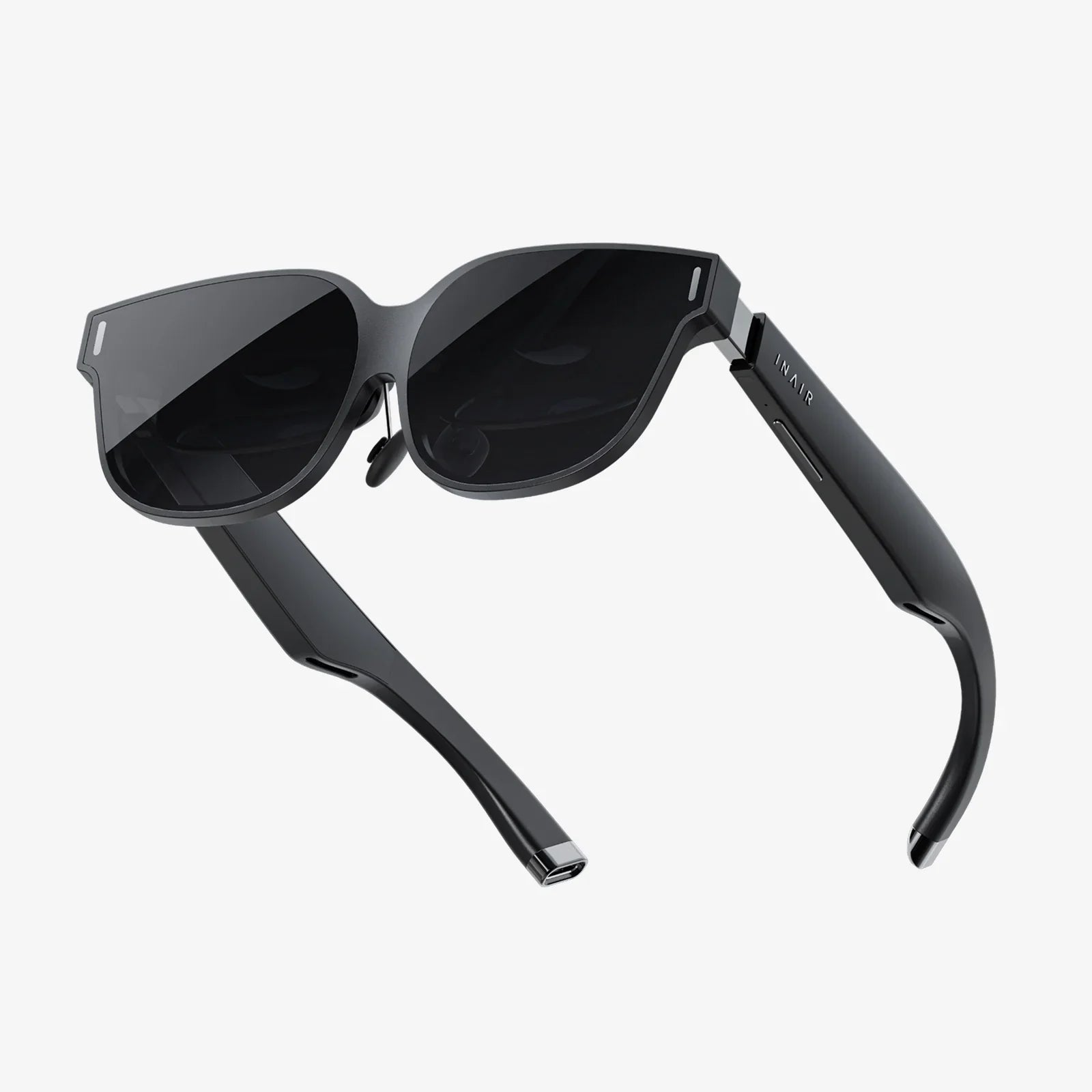
Imagine a world where the boundary between your digital life and physical reality doesn't just blur—it vanishes. A future where information, entertainment, and social connection are painted directly onto the fabric of the world around you, not through a clunky screen you hold in your hand, but through a pair of elegant, almost ordinary-looking glasses. This isn't science fiction; it's the imminent promise of the most mysterious and transformative tech development of our time: next-generation augmented reality glasses. The race to perfect this technology is shrouded in secrecy, conducted in hidden R&D labs, and protected by a veil of patents and prototypes. The ultimate goal is deceptively simple yet breathtakingly complex: to create a seamless, intuitive, and powerful interface that becomes an invisible extension of our own perception.
The Veil of Secrecy: Why So Much Mystery?
Unlike the very public and iterative process of smartphone evolution, the development of advanced AR glasses is occurring under a cloak of intense secrecy. This isn't without reason. The challenges are not merely incremental; they are fundamental, spanning the fields of physics, material science, optics, and human-computer interaction. Companies and research consortiums are investing billions, not just to be first to market, but to solve a series of profound technological puzzles. Leaked patents and rare, controlled demos offer glimpses, but the full picture remains a carefully guarded mystery. This secrecy fuels both immense hype and deep skepticism, as the world waits to see if the reality can ever live up to the revolutionary promise.
The core of the mystery lies in the extreme miniaturization required. Packing the computational power of a modern smartphone, a high-resolution transparent display system, a suite of advanced sensors, and all-day battery life into a form factor that is socially acceptable and comfortable to wear is a Herculean task. It requires reinventing nearly every component from the ground up, moving beyond established manufacturing techniques into the realm of nanotechnology and novel materials.
Deconstructing the Magic: The Core Technologies Under the Hood
To understand the mystery, we must dissect the components that make this technology so formidable. While specific implementations are proprietary, the general architectural principles are what separate this new wave of AR glasses from earlier, more primitive attempts.
The Display: Painting Light onto the Real World
This is perhaps the most significant technical hurdle. The display cannot be a simple screen; it must be a system that can project vibrant, high-resolution digital images that appear to coexist with physical objects at various depths. Early technologies like birdbath optics are giving way to more advanced and mysterious solutions.
- Waveguide Optics: This is a leading contender. Think of it as a method of piping light. Light from a micro-LED projector is "injected" into a thin, transparent piece of glass or plastic (the waveguide). Using a complex pattern of microscopic gratings, this light is then bounced and manipulated through the glass before being finally directed out towards the user's eye. The result is a digital image that appears to float in the world beyond the lens. The precise engineering of these nano-scale gratings is a black art, a key differentiator that companies are fiercely competing to master.
- Holographic Optics: Even more futuristic are approaches based on holography. Rather than simply reflecting light, these systems use holographic film to reconstruct light fields, creating digital objects with genuine depth cues that match the way human eyes naturally focus. This technology promises to solve the vergence-accommodation conflict—the eye strain caused when your eyes focus on a screen fixed at one distance while trying to look at a virtual object that appears to be at another.
Spatial Mapping and Perception: The Digital Nervous System
For digital content to feel truly anchored in the real world, the glasses must understand the environment with incredible precision. This is achieved through a sophisticated array of sensors that act as a digital nervous system.
- LiDAR (Light Detection and Ranging): This sensor fires out invisible laser beams and measures the time it takes for them to bounce back, creating a precise, real-time 3D map of the surroundings. It understands the shape of your room, the distance to your coffee cup, and the location of every wall and doorframe.
- Cameras and Simultaneous Localization and Mapping (SLAM): Multiple cameras work in concert to track the user's position in space while simultaneously building and updating the map of the environment. This is what allows a virtual character to sit convincingly on your real sofa and stay there as you walk around it.
- Inertial Measurement Units (IMUs): These accelerometers and gyroscopes track the precise movement and orientation of your head, ensuring the digital world stays locked in place even during rapid motions.
Battery and Processing: The Hidden Engine
All this magic requires immense computational power and energy. The mystery here is one of distribution. Will the glasses themselves house a revolutionary new class of ultra-low-power chips specifically designed for AR workloads? Or will they act as a sophisticated display and sensor terminal, offloading the heavy number-crunching to a powerful companion device in your pocket or, eventually, to the cloud with imperceptible latency via 5G/6G networks? The answer likely lies in a hybrid approach, but achieving this efficiently and elegantly remains a core challenge.
Beyond the Hardware: The Software That Weaves the Illusion
The hardware is only half the story. The true magic will be woven by the software and algorithms that power the experience. This is the soul within the machine.
- AI-Powered Contextual Awareness: The glasses won't just see the world; they will need to understand it. Advanced AI and machine learning models will analyze the sensor data in real-time to identify objects, people, text, and scenes. This allows for context-aware interactions. Look at a restaurant, and its menu and reviews pop up. Look at a foreign language sign, and it instantly translates. Hold up a broken engine part, and an interactive repair manual overlays instructions onto it.
- Intuitive and Private Interaction:
How do you interact with an interface that has no buttons? The quest is to develop control systems that feel natural and, crucially, preserve privacy. Voice commands are one method, but speaking to your glasses in public isn't always desirable. This is where even more mysterious interaction models come into play.
- Subvocalization Recognition: Emerging technology can detect the tiny neuromuscular signals generated when you form words in your head without speaking them aloud. A microphone array could pick up these signals, allowing for silent, private communication with your AI assistant.
- Micro-Gestures and EMG: Sensors could detect minute finger movements or gestures performed near the temple or in a pocket, interpreting them as commands. Electromyography (EMG) bands could read the electrical signals from your forearm muscles as you tap your fingers, turning your hand into an invisible input device.
- Eye-Tracking: Built-in infrared sensors can track your gaze with extreme accuracy. This allows for UI navigation simply by looking at different elements, and it enables foveated rendering—a technique where the display focuses its highest resolution only on the spot where your eyes are directly looking, saving immense processing power.
The Societal Chasm: Promise, Peril, and the Privacy Paradox
The potential benefits of this technology are staggering. It could revolutionize fields from medicine, where a surgeon sees vital stats and 3D scans overlaid on a patient, to engineering, where a technician sees wiring diagrams superimposed on machinery. It could redefine navigation, education, and remote collaboration.
However, this power comes with a profound and unsettling dark side. The very feature that makes AR glasses magical—their always-on, first-person view of your life—also makes them the ultimate surveillance tool. The privacy implications are perhaps the most troubling aspect of this mysterious tech.
- The End of Anonymous Public Life? If these devices become widespread and are equipped with always-on cameras and facial recognition, the concept of anonymity in a public space could vanish. Anyone you pass on the street could, in theory, instantly pull up your name, social media profile, and personal data.
- Data Harvesting on an Unprecedented Scale: The amount of data generated—what you look at, for how long, your physiological responses, the layout of your home, the products you use—would be exponentially more intimate and valuable than anything collected by today's smartphones. Who owns this data? How is it stored, secured, and used?
- Reality Hijacking and Digital Vandalism: The shared understanding of our physical environment could be fractured. Malicious actors could "deface" real-world locations with offensive virtual graffiti or misinformation tags that only certain users can see, creating alternate, conflicting realities in the same physical space.
Navigating this chasm will be the great societal challenge of this technology. It will require entirely new frameworks for digital ethics, privacy laws, and social norms that we are only beginning to contemplate.
The Invisible Future: Blending In Until They Disappear
The final and most mysterious evolution of this technology is its trajectory towards invisibility. The first generation will be a remarkable achievement, but subsequent generations will focus on erasing their own presence.
- Form Factor: The goal is to look like a standard, even fashionable, pair of eyeglasses or sunglasses. The technology will retreat into the frame, becoming unnoticeable to anyone else.
- Interaction: Control will move away from obvious gestures and voice commands to seamless, silent, and thought-driven intention recognition, making the user interface feel like a natural extension of the mind.
- Presence: The ultimate success of this technology will be measured by its ability to fade into the background of our lives. It won't be a device we "use"; it will be a layer of our perception we simply "have," as natural and unobtrusive as a pair of prescription lenses. The technology itself will become a mystery, not because it is hidden in labs, but because it is so perfectly integrated into our everyday experience that we cease to notice it at all.
The journey to perfect this mysterious technology is far from over. The path is littered with daunting engineering challenges, unanswered ethical questions, and the immense task of convincing the world to adopt a new way of seeing. Yet, the potential is too great to ignore. We are standing on the precipice of a new sensory paradigm, peering through a looking glass into a world where the digital and physical are one. The true mystery isn't just how they will work, but how they will change us, our society, and our very definition of reality. The glasses are coming, and they promise to reveal a world we've only ever been able to imagine.
Share:
VR and AR Glasses Comparison: A Deep Dive into the Virtual and Augmented Realms
Dimensions for AR Glasses: The Critical Balance Between Form, Function, and the Future