


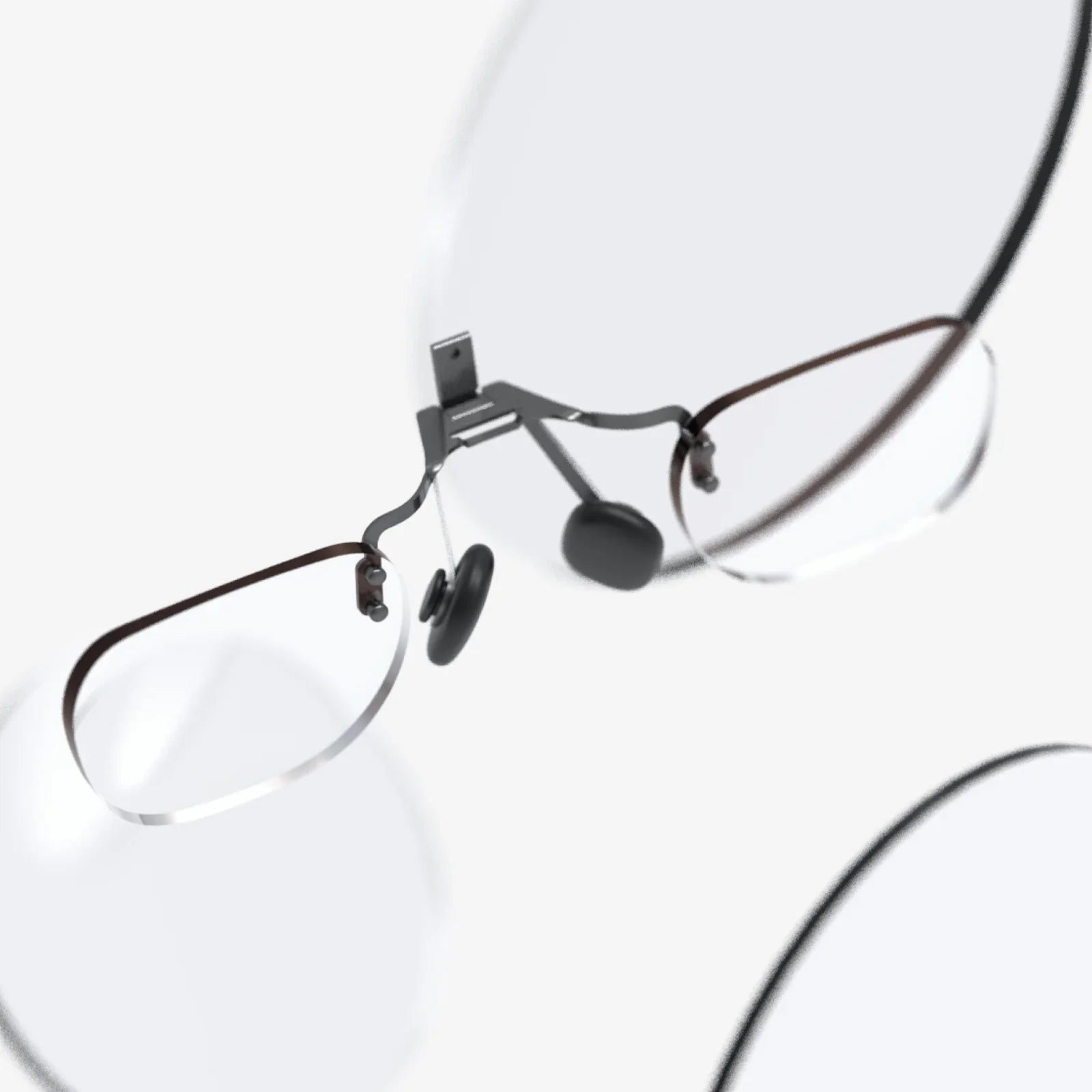
Imagine a world where digital information doesn't live on a screen in front of you, but is seamlessly woven into the very fabric of your reality. Where a surgeon can see a patient's vital signs overlaid on their body during a procedure, where an engineer can collaborate with a holographic model of a jet engine, and where your morning workout is guided by a virtual coach in your living room. This is not a distant science fiction fantasy; it is the imminent future being unlocked by a new class of wearable technology: Pro XR glasses. These are not mere consumer gadgets for gaming and entertainment; they are sophisticated professional tools poised to redefine the boundaries of computing, communication, and human capability. The revolution is here, and it’s being viewed through a new lens.
Beyond the Hype: Defining the Professional Extended Reality Spectrum
To understand the significance of Pro XR glasses, we must first move beyond broad marketing terms. "XR" or Extended Reality is an umbrella term encompassing a spectrum of immersive technologies.
- Virtual Reality (VR): Fully immersive, computer-generated environments that completely obscure the real world. Pro VR headsets are typically used for simulation training, advanced design visualization, and therapy.
- Augmented Reality (AR): Digital content overlayed onto the user's real-world environment. This can range from simple data annotations to complex, interactive 3D models.
- Mixed Reality (MR): A more advanced form of AR where digital objects are not just overlaid but can interact with and be occluded by the physical world. A virtual ball can bounce off a real table, for instance.
Pro XR glasses primarily focus on the AR and MR segments of the spectrum. Their defining characteristic is their intended use: they are engineered for enterprise, industrial, medical, and creative professionals where reliability, precision, and functionality trump consumer-friendly price points and aesthetics. They are tools for solving complex problems, enhancing productivity, and enabling entirely new workflows.
The Anatomy of Cutting-Edge Technology
The magic of Pro XR glasses is a symphony of advanced hardware components working in perfect harmony. Unlike their consumer-oriented cousins, professional-grade devices pack a formidable technological punch.
Advanced Optical Systems: See-Through Displays
The heart of any XR glass is its display technology. How do you project a bright, high-resolution digital image onto a transparent lens without blocking the user's view of the real world? Pro models typically employ one of two cutting-edge solutions:
- Waveguide Technology: This is the most common method in sleek, glasses-like form factors. Light from a micro-display is coupled into a thin glass or plastic substrate, where it "guides" the light through total internal reflection before ejecting it towards the user's eye. This allows for a compact design but can present challenges with field of view and brightness.
- Birdbath Optics: This system uses a combination of a beamsplitter and a curved mirror (like a birdbath) to fold the light from a micro-OLED display into the user's eye. This often allows for richer colors and higher contrast but can result in a slightly bulkier design.
The pursuit is a combination of a wide field of view (FOV), high resolution, and vibrant color accuracy, all within a comfortable, wearable form factor.
Spatial Mapping and Perception: The Digital Nervous System
For digital content to convincingly interact with the real world, the glasses must understand the environment in minute detail. This is achieved through a sophisticated array of sensors that act as a digital nervous system.
- Cameras: High-resolution RGB cameras for video see-through and capturing the environment.
- Depth Sensors: Time-of-Flight (ToF) sensors or structured light projectors actively map the world in 3D, measuring the distance to every surface to create a precise depth map.
- Inertial Measurement Units (IMUs): Accelerometers, gyroscopes, and magnetometers track the precise movement and rotation of the user's head with six degrees of freedom (6DoF).
- LiDAR (Light Detection and Ranging): Particularly on modern systems, LiDAR scanners fire out grids of invisible laser dots to measure distances and create a detailed 3D mesh of the surroundings with incredible speed and accuracy.
This sensor fusion data is processed by onboard chipsets using simultaneous localization and mapping (SLAM) algorithms to create a persistent, digital twin of the physical space. This allows virtual objects to stay locked in place, even as the user moves around.
Computational Power and Connectivity
Processing the immense amount of sensor data and rendering complex 3D graphics requires serious computational muscle. Some Pro XR glasses are tethered to a powerful external computer or a wearable processing pack, providing desktop-level performance for the most demanding tasks. Others are moving towards standalone operation, leveraging customized chipsets that balance immense processing power with thermal and power efficiency. Connectivity is also key, with support for Wi-Fi 6/6E and often 5G for high-speed, low-latency data transfer, essential for cloud processing and remote collaboration scenarios.
Transforming Industries: The Professional Use Cases
The true value of Pro XR glasses is revealed not in their specifications, but in their transformative application across the global economy.
Design, Engineering, and Manufacturing
This is one of the most mature and impactful use cases. Engineers and designers are using Pro XR glasses to visualize 3D CAD models at 1:1 scale, long before a physical prototype is ever built. They can walk around a virtual car engine, inspect the interior layout of a new building, or assemble complex machinery using animated holographic instructions overlaid directly onto the workbench. This drastically reduces prototyping costs, accelerates time-to-market, and minimizes errors on the production line.
Healthcare and Medicine
In medicine, Pro XR glasses are literally saving lives and improving outcomes. Surgeons can use them to access critical patient information, such as MRI or CT scan data, directly in their field of view during an operation without breaking sterility. Medical students can practice procedures on detailed anatomical holograms. Furthermore, they are being used for remote guidance, allowing a specialist surgeon to see what a local doctor sees and provide real-time visual annotations and instructions from thousands of miles away.
Field Service and Maintenance
Imagine a technician arriving to repair a complex, unfamiliar piece of equipment. Instead of fumbling with paper manuals or a tablet, they don a pair of Pro XR glasses. The system recognizes the machine via computer vision and instantly overlays animated repair instructions, highlights specific components, and displays schematics. A remote expert can see the technician's view and draw arrows and circles directly into their environment to guide them. This slashes repair times, improves first-time fix rates, and empowers less experienced technicians to perform complex tasks.
Remote Collaboration and Telepresence
Pro XR glasses are erasing geographical barriers. Using photorealistic avatars or simple volumetric captures, colleagues from around the world can meet in a shared virtual space or appear as holograms in each other's physical office. They can collaboratively interact with the same 3D model, review architectural plans on a virtual table, or train on a piece of equipment together. This "holoportation" technology creates a sense of shared presence that video conferencing can never match, fostering a new era of connected and efficient teamwork.
Navigating the Challenges: The Road to Ubiquity
Despite the immense promise, the path to widespread adoption of Pro XR glasses is not without its obstacles.
The Form Factor Conundrum
The ultimate goal is a device that offers the visual fidelity and performance of a high-end system in a form factor as lightweight, comfortable, and socially acceptable as a pair of everyday sunglasses. We are not there yet. While progress is rapid, balancing computational power, battery life, thermal output, and optical performance in a small package remains a significant engineering challenge. Battery technology, in particular, is a key bottleneck, with many current systems offering only a few hours of intensive use.
The Software Ecosystem and Interoperability
Hardware is nothing without software. The development of robust, enterprise-grade applications is critical. This includes not only vertical-specific apps but also core platform services like secure cloud storage, identity management, and device management. Furthermore, interoperability is a major concern. For XR to reach its full potential, digital assets and experiences need to be able to move seamlessly across different devices and platforms, a challenge the industry is still grappling with through efforts like the OpenXR standard.
Privacy, Security, and the Ethical Lens
Devices equipped with always-on cameras and microphones that map our every movement raise profound questions about privacy and data security. In a professional setting, who has access to the video feed from an employee's glasses? How is sensitive environmental data, like the layout of a secure facility, protected? Enterprises require end-to-end encryption and robust data governance policies. Ethically, the constant overlay of digital information onto reality also prompts questions about attention, distraction, and our relationship with the physical world.
The Future Through an Augmented Lens
The trajectory is clear. Pro XR glasses will become lighter, more powerful, and more integrated into our professional lives. We can anticipate advancements like:
- Retina-level resolution displays that make digital objects indistinguishable from reality.
- Haptic feedback systems that allow users to "feel" holograms.
- AI-powered contextual awareness that anticipates user needs and serves up the right information at the right time.
- Neural interfaces that move beyond hand gestures to control interfaces with subtle intention.
This evolution will lead us towards the concept of the spatial computer, where the world around us becomes the interface, and our physical and digital tools merge into one continuous, intelligent workspace.
The age of staring down at a slab of glass and metal is drawing to a close. Pro XR glasses are the gateway to a more intuitive, immersive, and powerful way of working, learning, and creating. They promise to augment not just our reality, but our very intelligence, giving us superhuman abilities to see, understand, and manipulate the world around us. The question is no longer if this future will arrive, but how quickly we can adapt to its incredible potential. The next platform for human achievement is being built right before our eyes—and soon, we’ll all be wearing it.
Share:
Gaming Glasses Screen: The Ultimate Shield for the Modern Gamer
Holography Augmented Reality: The Future of Visual Computing is Here