


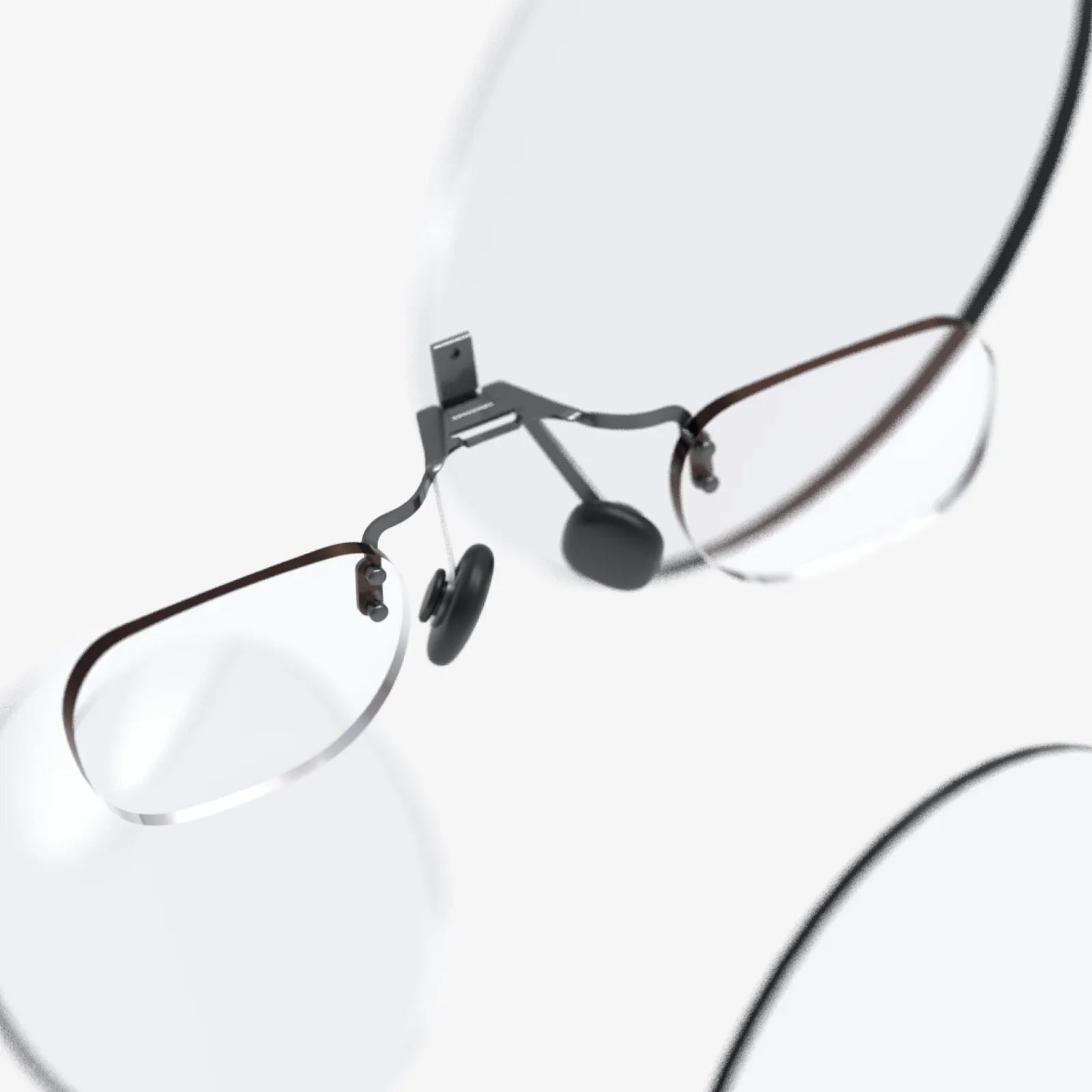
Imagine a world where digital information doesn't confine you to a screen but instead, flows seamlessly into your immediate reality, enhancing everything you see and do. This is no longer the stuff of science fiction. The arrival of simple augmented reality glasses with LEDs is quietly revolutionizing how we interact with technology, making the once-distant dream of pervasive, helpful AR an accessible reality for millions. This isn't about bulky, expensive headsets; it's about subtle, stylish, and surprisingly powerful wearables that are beginning to weave the digital and physical worlds together in ways we are only starting to understand.
The Dawn of Accessible Augmented Reality
For years, the concept of augmented reality was synonymous with complex, high-powered visors often associated with industrial applications or high-end gaming. These devices, while powerful, were frequently cumbersome, cost-prohibitive, and isolated the user in a conspicuously technological experience. They were tools for specialists, not accessories for everyday life. The market longed for an entry point—a gateway device that could introduce the core concepts of AR without overwhelming the user or their wallet.
This is precisely the gap that simple augmented reality glasses with LEDs are filling. By strategically reducing complexity and focusing on core, impactful functionalities, these devices are achieving something profound: democratization. They are stripping away the non-essential to deliver a pure, intuitive augmented experience. The defining feature, often a ring or array of light-emitting diodes, serves as a versatile and low-power tool for notification, navigation, and interaction, providing a constant, yet unobtrusive, link to the digital realm.
Deconstructing the Simplicity: How LED-Based AR Works
At their heart, these devices operate on an elegantly simple premise. Instead of projecting high-resolution, complex 3D models into your field of view—a process that requires significant processing power and battery life—they utilize patterns of light to convey information. This might sound limited, but its effectiveness is rooted in intuitive design and user experience.
The LED Interface: The LEDs are not just for show; they are the primary output medium. A sequence of colored lights blinking in a specific pattern can signal an incoming call from a specific contact. A gently pulsing guide light in the periphery of the lens can direct you to your next turn while walking, keeping your eyes on the world instead of a phone screen. A scrolling ticker of light can translate snippets of text or display vital metrics from a connected smart device.
Sensors and Connectivity: Despite their simple output, these glasses are packed with sophisticated but miniaturized technology. Accelerometers, gyroscopes, and magnetometers work in tandem to understand your head's position and orientation relative to the world. They are consistently connected to a smartphone via low-energy wireless protocols, leveraging its processing power, internet connection, and app ecosystem. This symbiosis allows the glasses to remain lightweight and efficient while still being smart and context-aware.
The Philosophy of Minimal Information: This approach champions the idea of "glanceable" information. It’s about delivering the right data at the right time without requiring deep focus or pulling you out of your current activity. This minimalistic philosophy reduces cognitive load, making the technology feel less intrusive and more like a natural extension of your own senses.
Beyond Novelty: Practical Applications in Daily Life
The true value of any technology is measured by its utility. Simple AR glasses are finding their footing not in fantastical applications, but in genuinely useful everyday scenarios that enhance convenience, safety, and connectivity.
Navigation Reimagined: Imagine walking through an unfamiliar city. Instead of holding up your phone and following a blue dot on a map, a soft light pulses gently on your left peripheral vision, indicating your next turn is approaching. You look up, engaged with your surroundings, noticing the architecture and the people, not a glass rectangle. The directions are integrated into your world, making navigation more intuitive and far safer for pedestrians.
A New Paradigm for Notifications: Our phones are a constant source of distraction. Every buzz and beep pulls our attention away from conversations, work, or moments of peace. With simple AR glasses, notifications become ambient. A specific color glow for a message from family, another for an urgent work email. You can instantly gauge the importance of an alert without ever reaching for your pocket. This allows for a more present life, where you control technology, not the other way around.
Fitness and Health Companion: For runners, cyclists, and gym-goers, these glasses are a game-changer. Key metrics—heart rate, pace, distance, time—can be projected subtly within the lens or communicated via light patterns. This allows athletes to stay in the zone, maintaining focus on their form and their environment without breaking stride to check a watch or a phone strapped to their arm.
The Social and Ethical Dimension of Subtle Tech
One of the biggest hurdles for previous AR and VR headsets was their social awkwardness. They were barriers to natural human interaction, literally placing a screen between people. The simplicity and discreet nature of LED-based AR glasses present a fascinating shift.
Their form factor is often comparable to standard eyeglasses or sleek sunglasses. The LED output is typically only visible to the wearer or is subtle enough not to be distracting to others. This makes them socially acceptable to wear during a conversation, at a coffee shop, or in a meeting. They augment the user's experience without isolating them from the people around them. This is a critical step forward for wearable technology, moving it from an isolating device to a integrating one.
However, this subtlety also raises important questions. How do we negotiate privacy in a world where people can be recording or looking up information about their surroundings without it being obvious? The ethical design and transparent use of this technology will be paramount. Features like clear recording indicators (e.g., a prominent LED that activates during video capture) are essential to maintaining social trust and ensuring these devices are used responsibly.
The Future is Bright: Where Do We Go From Here?
The current iteration of simple augmented reality glasses with LEDs is just the beginning. They are the foundational stepping stone, acclimating the public to the idea of perpetual, ambient computing. As battery technology, micro-displays, and sensor fusion continue to advance, we can expect this category to evolve rapidly.
We will see hybrid devices that combine simple LED notifications with slightly more complex, but still limited, text and icon overlays. Integration with voice assistants will become more seamless, allowing for hands-free control of smart home devices and information retrieval. The ultimate goal remains a pair of glasses that can elegantly handle both detailed data projection and simple light-based cues, adapting intelligently to the context of the user's needs.
This evolution will be driven by a continued focus on user-centric design. The winners in this space will not be the devices with the most features, but the ones that understand human behavior the best. The technology that feels the most natural, the most helpful, and the least intrusive will be the one that truly succeeds in weaving itself into the fabric of our daily lives.
The gentle glow of an LED on a pair of stylish frames is more than just a notification; it's a beacon signaling a fundamental shift in our relationship with computers. We are moving away from a world where we go to a device to get information and towards a world where information comes to us, contextually and gracefully. This is the quiet revolution of simple augmented reality glasses—they are not shouting about the future; they are subtly, brilliantly, illuminating it right before our eyes.
Share:
AR Technology: Bridging the Digital and Physical Worlds for a Revolutionary Future
AR Technology: Bridging the Digital and Physical Worlds for a Revolutionary Future