


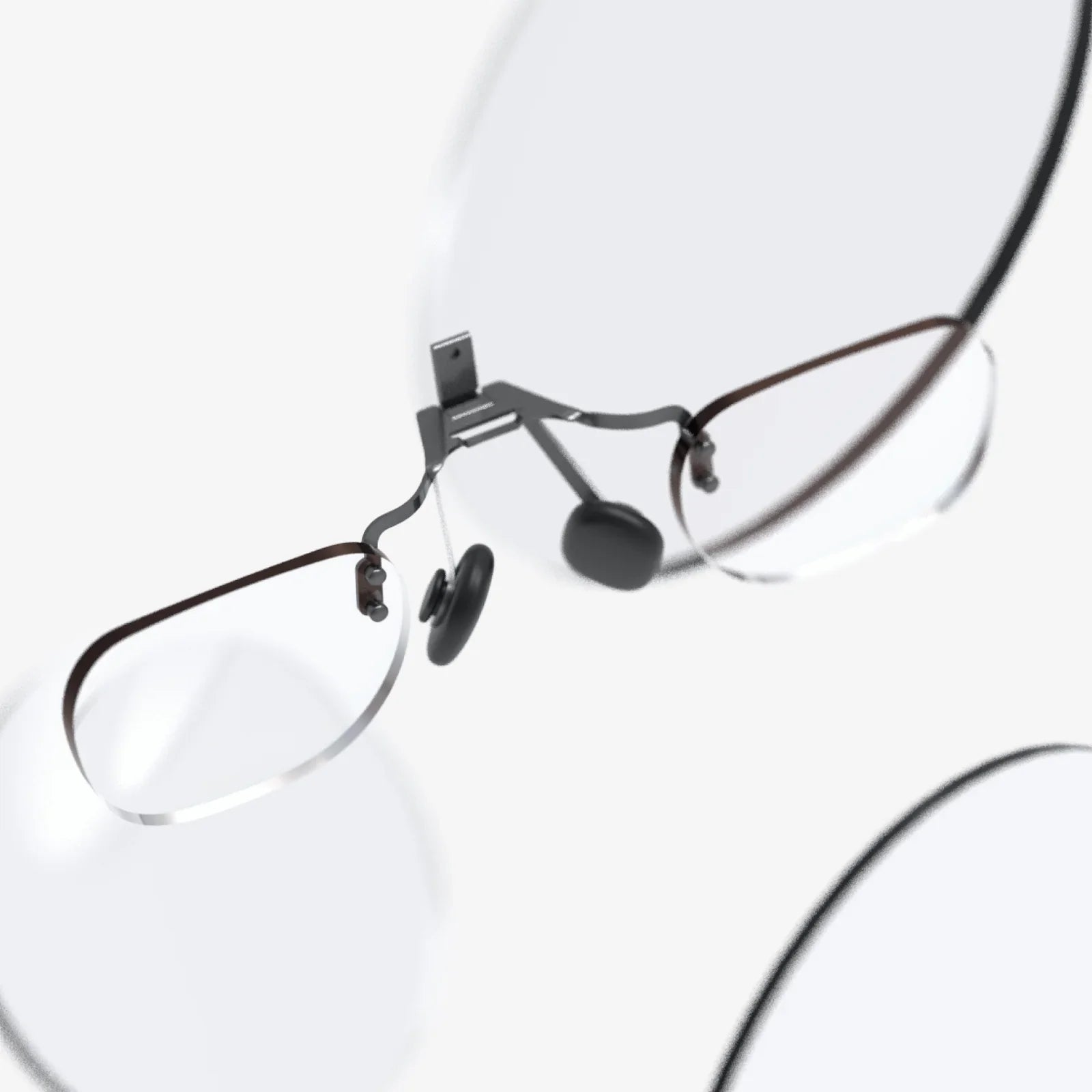
Imagine a world where information doesn't live on a screen in your hand, but floats seamlessly in your field of vision. Where directions are painted onto the street before you, where a foreign language is instantly translated and overlaid onto a menu, and where the face of a colleague you met once is gently recognized, their name and project discreetly displayed for you. This isn't science fiction; it's the imminent reality promised by smart specs, a technological evolution set to redefine our very perception of reality and our interaction with the digital realm. This wearable technology represents more than just a gadget; it signifies a fundamental shift in computing, moving from something we carry to something we wear, integrating technology into the very fabric of our daily lives and sensory experiences.
From Sci-Fi to Reality: The Long Road to Wearable Vision
The concept of augmented reality (AR) eyewear has been a staple of futuristic imaginings for decades. From the Terminator's chilling heads-up display to the whimsical world of *Back to the Future Part II*, the idea of visually enhanced reality has captivated audiences. The journey from fantasy to tangible product, however, has been fraught with technical and social hurdles. Early iterations were often bulky, expensive, and limited in functionality, struggling with short battery life, poor display quality, and significant heat generation. They were, for the most part, prototypes for developers and tech enthusiasts, not consumer-ready products. The fundamental challenge has always been the miniaturization of incredibly powerful components—processors, batteries, sensors, and high-resolution displays—into a form factor that is socially acceptable, comfortable to wear for extended periods, and aesthetically pleasing. Overcoming these barriers required breakthroughs in materials science, micro-electronics, optics, and power management, a convergence of engineering disciplines that is only now reaching a point of maturity necessary for widespread adoption.
Beyond the Hype: Core Technologies Powering Smart Specs
So, what exactly makes a pair of glasses "smart"? It's a sophisticated fusion of hardware and software working in concert to augment the user's experience.
The Magic of Waveguides and Micro-LEDs
At the heart of the visual experience is the display technology. Unlike virtual reality (VR) headsets that completely block your view, smart specs use transparent displays to project digital images onto the real world. This is most commonly achieved through optical waveguides—thin, transparent pieces of glass or plastic that use principles of diffraction or reflection to channel light from a micro-projector at the temple into the user's eye. This creates the illusion that text, images, and 3D objects are floating in space at a comfortable viewing distance. Coupled with this are incredibly small, bright, and efficient Micro-LED displays that provide the light source, offering high resolution and color fidelity while consuming minimal power.
The Sensory Suite: Cameras, LiDAR, and Inertial Measurement
To understand and interact with the environment, smart specs are equipped with a sophisticated array of sensors. High-resolution cameras capture the world in front of the user, feeding visual data to onboard processors for object recognition, text scanning, and gesture tracking. Depth sensors, like miniature LiDAR (Light Detection and Ranging) scanners, map the surrounding space in 3D, understanding the distance and dimensions of objects. This allows digital content to be realistically occluded by real-world objects—a virtual dinosaur could appear to walk behind your sofa. An Inertial Measurement Unit (IMU), containing accelerometers and gyroscopes, tracks the precise movement and orientation of the user's head, ensuring the digital overlay remains stable and locked in place within the physical world, preventing drift and nausea.
On-Device Intelligence and Spatial Audio
Processing all this sensor data in real-time requires significant computational power. Advanced chipsets, often with dedicated neural processing units (NPUs) for machine learning tasks, handle complex algorithms for spatial mapping, scene understanding, and voice recognition. This allows for actions like translating text instantly or identifying products without a constant, lag-inducing connection to the cloud. Furthermore, audio is a critical component. Spatial audio speakers built into the frames deliver sound directly to the user's ears without blocking ambient noise, allowing for private listening of music, calls, or notifications while remaining aware of their surroundings. Some prototypes even use bone conduction technology for audio transmission.
Transforming Industries: The Professional Power of Augmented Vision
While consumer applications generate excitement, the most immediate and profound impact of smart specs is likely to be in enterprise and specialized fields, where the hands-free access to information provides a clear return on investment and enhances safety and efficiency.
Revolutionizing Manufacturing and Field Service
In complex manufacturing and assembly lines, technicians can have digital schematics, instruction manuals, or safety checklists overlaid directly onto the machinery they are working on. A remote expert can see what the on-site worker sees and annotate their field of view with arrows and notes to guide them through a repair, drastically reducing downtime and errors. This "see-what-I-see" capability is transformative for training and collaboration across vast distances.
Advancing Healthcare and Surgery
Surgeons could have vital patient statistics, ultrasound images, or 3D anatomical models visualized during a procedure without ever looking away from the operating field. Medical students could learn anatomy by exploring detailed, life-sized holograms of the human body. For general practitioners, instantly accessing a patient's records during a consultation simply by looking at them could streamline workflows and improve care.
Empowering Logistics and Warehousing
In massive distribution centers, warehouse workers equipped with smart specs could be guided along the most efficient pick path by digital arrows on the floor, with the exact item and quantity needed highlighted on the shelf. This eliminates the need to constantly refer to a handheld scanner, freeing up hands for lifting and moving packages, and significantly accelerating order fulfillment.
The Social Lens: Navigating the World of Always-On Wearables
The integration of cameras and sensors into a device worn on the face inevitably raises complex and critical questions about privacy, social etiquette, and security. The prospect of a society where people can record video, take photos, or identify strangers discreetly and constantly is a legitimate concern. The term "glasshole" emerged from early testing phases, highlighting the social anxiety and rudeness associated with someone whose attention is divided by a screen on their face or who might be recording without consent. Manufacturers will need to build clear and intuitive social signals—like a visible light indicating recording is active—and robust privacy controls that give users ownership over their data. Furthermore, the potential for always-on facial recognition raises dystopian fears of a world without anonymity. A robust public dialogue and thoughtful, preemptive regulations will be essential to ensure this technology develops in a way that respects individual rights and fosters social trust rather than eroding it.
The Horizon and Beyond: What the Future Holds
The current generation of smart specs is merely the beginning. Future iterations will become lighter, more powerful, and more socially normalized, perhaps eventually evolving from a distinct device to a feature integrated into standard prescription eyewear. Advancements in battery technology, such as solid-state batteries, could enable all-day use. Breakthroughs in AI will enable more contextual and intuitive interactions, with the device anticipating your needs based on what you're looking at and what you're doing. The long-term vision is the concept of the "metaverse"—a persistent layer of digital information and experience draped over the physical world, accessible not through a phone or a headset, but through a lightweight pair of glasses. This spatial web could fundamentally change how we socialize, learn, work, and play.
The true success of smart specs won't be measured by their technical specifications alone, but by their ability to become invisible—to fade into the background of our lives while enhancing our capabilities. They promise a future where technology doesn't demand our attention but empowers our perception, making us more knowledgeable, connected, and efficient without isolating us from the world right in front of our eyes. The journey to a seamlessly augmented world is just beginning, and the view from here looks truly extraordinary.
Share:
Meaning of Seamless Workflow: The Unseen Engine of Modern Productivity
Meaning of Seamless Workflow: The Unseen Engine of Modern Productivity