


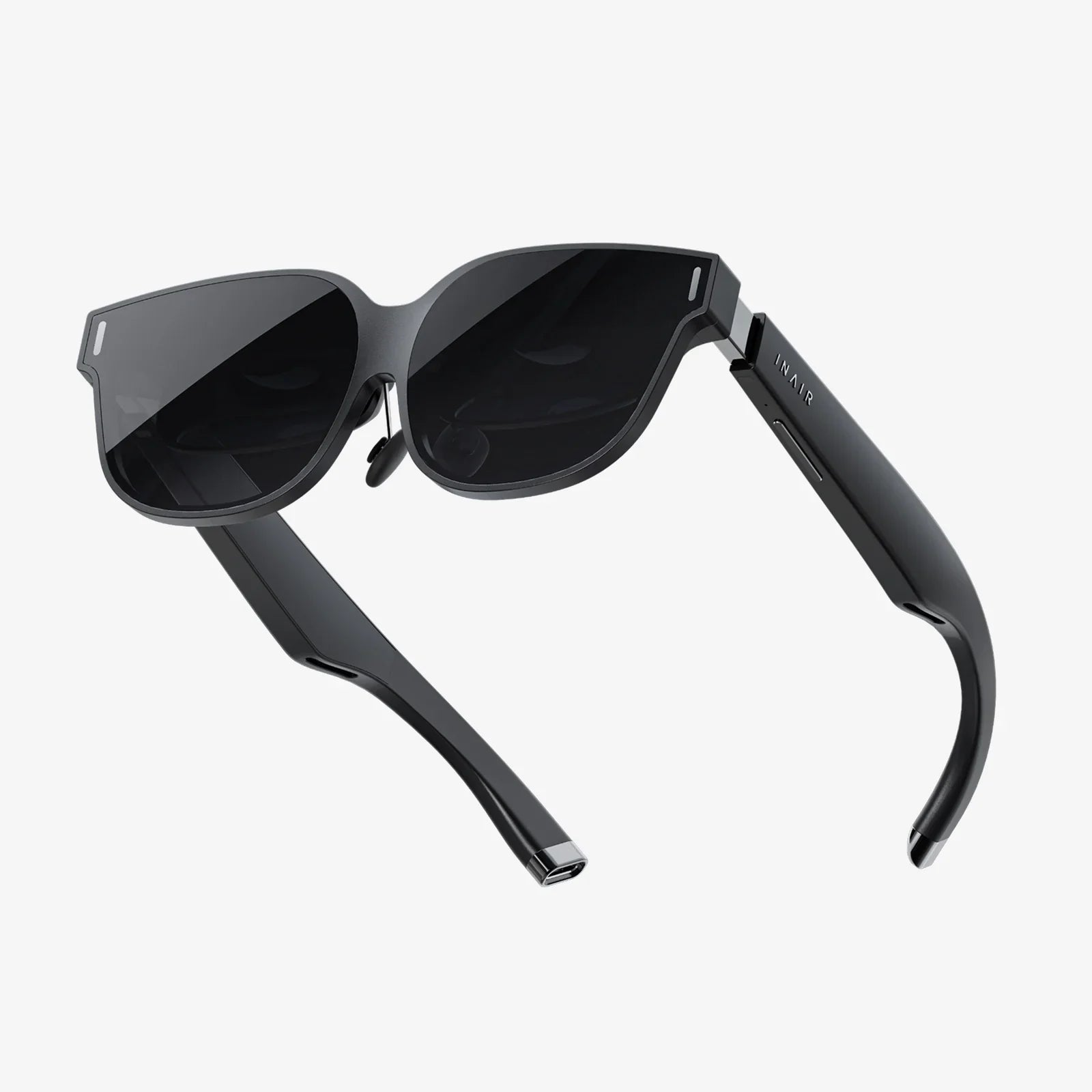
Imagine a world where digital information doesn't just live on a screen in your hand or on your desk, but is seamlessly woven into the very fabric of your reality. Directions float on the road ahead, the name of a distant constellation appears as you gaze at the night sky, and a virtual colleague sits across from you at your kitchen table. This is the promise of augmented reality, and it’s a promise being delivered today by the latest generation of top AR glasses. This isn't science fiction; it's the next great computing platform, and it's already reshaping how we work, play, and connect.
The Core Technology: How AR Glasses Create Magic
At their heart, top AR glasses are a sophisticated fusion of hardware and software designed to overlay digital content onto the user's view of the physical world. Unlike virtual reality, which creates a fully immersive digital environment, AR enhances reality by adding a layer of useful, interactive data.
Display Systems: Projecting the Future
The most critical component of any AR glasses is its display technology. This is the mechanism that paints the digital images onto your field of vision. The top contenders in this space utilize several advanced methods:
- Waveguide Optics: This is the most common technology in high-end, sleek devices. It uses a tiny projector to shoot light into a transparent, wafer-thin piece of glass or plastic (the waveguide). This light bounces through the waveguide via total internal reflection until it's directed into the user's eye. This allows for a compact form factor and a clear, albeit sometimes limited, field of view.
- Birdbath Optics: This system uses a beamsplitter (the "birdbath") to reflect the image from a micro-display located above or to the side of the lens into the user's eye. This often allows for brighter colors and a wider field of view but can result in a slightly bulkier design.
- MicroLED with Laser Beam Scanning: An emerging and highly promising technology, it uses microscopic LEDs to generate incredibly bright and efficient images. When combined with laser beam scanning, it can project images directly onto the retina, promising unparalleled brightness and efficiency in a tiny package.
Spatial Mapping and Tracking: The Digital Nervous System
For digital objects to feel like they are truly part of your world, the glasses must understand the environment with incredible precision. This is achieved through a suite of sensors that act as a digital nervous system.
- Cameras: Multiple monochrome and RGB cameras continuously scan the surroundings.
- Depth Sensors: Time-of-flight (ToF) sensors or structured light projectors measure the distance to surfaces, creating a 3D map of the room.
- Inertial Measurement Units (IMUs): These accelerometers and gyroscopes track the precise movement and orientation of the user's head.
- LiDAR Scanners: Particularly in advanced models, LiDAR (Light Detection and Ranging) fires out laser pulses to measure distances and create a highly detailed point cloud map of the environment, crucial for object occlusion and precise placement.
This sensor data is processed in real-time by powerful onboard chipsets, fusing the information to understand surfaces, edges, and objects. This allows a virtual character to hide behind your real sofa, or a digital model of a engine to sit perfectly still on your physical desk.
Processing Power and Connectivity
All this data requires serious computational muscle. Top-tier AR glasses often feature dedicated processors for computer vision and machine learning tasks, working in tandem with the main CPU. They also maintain robust connectivity via Wi-Fi and Bluetooth, and increasingly, 5G, to offload intensive processing to the cloud or connect to other devices like smartphones and controllers.
Beyond Novelty: The Real-World Applications of AR Today
The value of top AR glasses is not in the technology itself, but in the profound problems they solve across countless industries.
Enterprise and Industrial Revolution
This is where AR has found its strongest foothold. Enterprises are adopting AR glasses to increase efficiency, reduce errors, and enhance safety.
- Remote Expert Guidance: A field technician repairing a complex piece of machinery can stream their first-person view to an expert thousands of miles away. The expert can then draw arrows, circles, and instructions directly into the technician's field of view, guiding them through the repair step-by-step. This slashes travel costs and downtime.
- Assembly and Manufacturing: Digital work instructions can be overlaid directly onto an assembly line. Workers see exactly which part goes where, with torque specifications and quality check prompts, drastically reducing errors and training time for complex tasks.
- Design and Prototyping: Architects and engineers can place full-scale 3D models of their designs into a physical space, allowing them to walk around, inspect, and modify prototypes before a single physical resource is spent.
- Logistics and Warehousing: Warehouse workers are guided by digital navigation to the exact shelf location of an item. The system can also display item details and quantity, supercharging picking and packing efficiency.
Healthcare: A New Vision for Medicine
The medical field is leveraging AR for both training and practice.
- Surgical Planning and Assistance: Surgeons can overlay 3D scans from CT or MRI directly onto a patient's body, providing an X-ray vision-like view of anatomy, tumors, or blood vessels during procedures, improving precision and outcomes.
- Medical Training: Students can interact with detailed, life-size holographic models of the human body, practicing procedures without risk.
- Patient Education: Doctors can visually show patients a 3D model of their condition, making complex medical issues easier to understand.
The Future of Everyday Life
While enterprise leads, consumer applications are rapidly evolving.
- Navigation: Imagine walking through a new city with turn-by-turn directions and points of interest painted onto the streets themselves, eliminating the need to constantly look down at a phone.
- Information Overlay: Look at a restaurant and instantly see its reviews and menu. Look at a monument and see its history unfold. This concept of "contextual computing" provides information exactly when and where you need it.
- Social Connection and Telepresence:
Remote interaction becomes visceral. Instead of a flat video call, you could share a virtual space with photorealistic avatars of friends, family, or colleagues, feeling as if you are truly together.
Defining the Elite: What Separates Top AR Glasses from the Rest
Not all AR glasses are created equal. The devices that truly belong in the "top" category excel in several key areas.
Visual Fidelity: The Window to a New World
This encompasses resolution, brightness, field of view (FOV), and contrast. The digital images must be high-resolution to be readable and not pixelated. They must be incredibly bright to be visible in daylight conditions. A wide field of view is crucial for immersion—narrow FOV feels like looking through a postage stamp. Top devices are constantly pushing the boundaries on all these fronts to make the digital layer indistinguishable from reality in quality.
Comfort and Form Factor: All-Day Wearability
Technology that isn't comfortable is technology that gets left in a drawer. The best AR glasses are lightweight, well-balanced, and feature ergonomic designs that can be worn for an entire workday without causing fatigue. They are moving away from the bulky, heads-up display look towards a form factor that resembles premium eyewear.
Battery Life: Untethered Freedom
True mobility requires all-day battery life. The elite devices either achieve this through highly efficient components and large batteries, or through clever systems like a swappable battery pack that clips onto clothing, allowing for hot-swapping without powering down.
Spatial Understanding and Persistence
Beyond just mapping a room, top devices understand it semantically—they can identify a table, a wall, a chair. Furthermore, they offer persistence, meaning if you place a digital sticky note on your physical refrigerator, it will still be there exactly where you left it when you put the glasses back on days later. This creates a stable, reliable digital layer over your world.
Developer Ecosystem and Software
Hardware is nothing without software. The top platforms are backed by robust software development kits (SDKs) and thriving communities of developers creating applications that unlock the device's potential. A closed system with no apps is a useless piece of hardware.
Gazing into the Crystal Ball: The Future of AR Wearables
The current generation of top AR glasses is impressive, but it is merely a stepping stone. The future holds even more transformative possibilities.
The Path to True Consumer Adoption
The holy grail is a pair of AR glasses that look identical to regular fashion eyewear, with all the compute, battery, and projection technology hidden within the slim frame. Advances in nanophotonics, battery chemistry, and chip miniaturization are relentlessly driving the industry toward this goal. When the technology becomes invisible, its adoption will become universal.
The AI Revolution: Your Contextual Companion
The true power of AR will be unlocked by artificial intelligence. Instead of just displaying pre-programmed information, future AR glasses, powered by a contextual AI, will anticipate your needs. It will see what you see, hear what you hear, and proactively offer the most useful information or tool for that exact moment, becoming an intelligent companion that enhances your cognitive abilities.
The Spatial Web and Digital Twins
AR glasses will be the primary interface for the spatial web—a version of the internet mapped onto the real world. Every location and object could have a digital counterpart. Furthermore, entire factories, cities, or systems could have a "digital twin" that can be visualized, analyzed, and interacted with in AR, enabling unprecedented levels of planning and control.
Ethical Considerations and the Future of Privacy
This always-on, camera-and-sensor-packed technology raises significant questions about privacy, data security, and societal norms. The industry must proactively address these concerns with transparent policies, user control, and ethical design to ensure this powerful technology benefits humanity without creating a dystopian future of constant surveillance.
The journey into an augmented world is already underway, led by the incredible innovation embedded in today's top AR glasses. They are more than just a gadget; they are a new lens through which we will perceive, interact with, and ultimately improve our reality. The boundary between the physical and digital is dissolving, and the most exciting applications are yet to be imagined. The future isn't just something we will watch on a screen—it's something we will step into and shape with our own eyes.
Share:
Casque VR: The Ultimate Guide to Virtual Reality Headsets and the Future of Immersion
What Does HUD Mean? The Ultimate Guide to Head-Up Displays