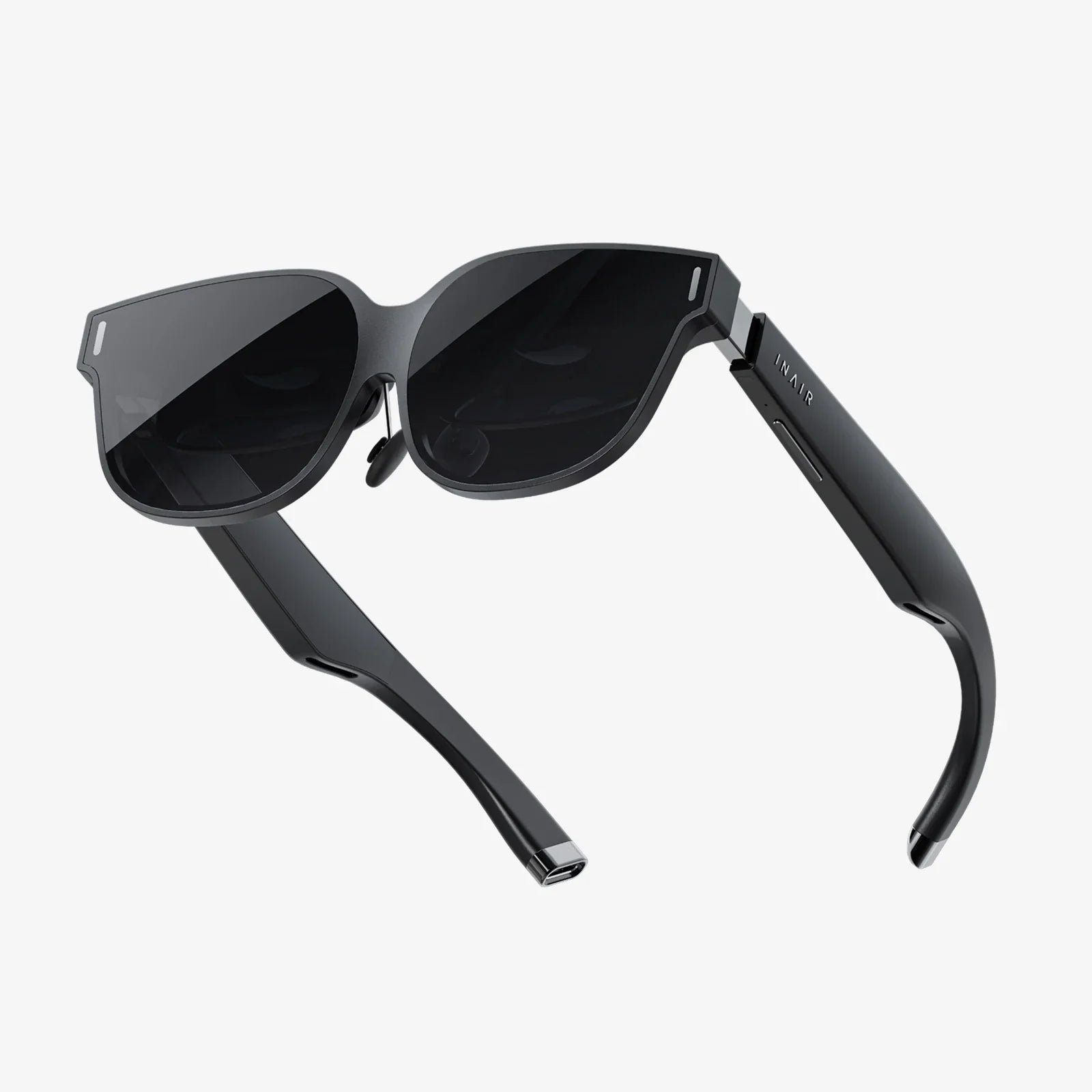
Imagine a cinema-sized screen materializing in thin air, a pristine office materializing on a café table, or a high-stakes gaming environment unfolding in the quiet of your living room—all without a single physical monitor. This is no longer the stuff of science fiction; it's the tangible, awe-inspiring reality offered by virtual display glasses for PC. This nascent technology is poised to shatter the physical constraints of traditional displays, offering a glimpse into a future where our digital worlds are boundless, personal, and seamlessly integrated into our physical reality. The era of being tethered to a desk is ending, and the age of immersive, on-the-go computing is dawning.
The Core Technology: How Do They Create a Screen From Nothing?
At first glance, virtual display glasses might seem like simple video viewers, but the engineering inside is remarkably sophisticated. They function as a personal, head-mounted projector system. Here’s a breakdown of the core components and principles that make the magic happen:
Optical Systems: Pancake Lenses and Micro-OLED Displays
The heart of the experience lies in the optical stack. Unlike the bulky optics of early VR headsets, modern virtual display glasses utilize advanced pancake lenses. These are compact, multi-element lenses that use polarization folding to create a long focal path in a very short physical space. This is why newer models can be so much sleeker and lighter. Behind these lenses are ultra-high-resolution Micro-OLED displays. These self-emissive panels offer exceptional pixel density, contrast, and color accuracy, crucial for rendering sharp text and vibrant imagery that feels real.
The Connection: Untethering Your Experience
Connectivity is key to the PC experience. Most glasses offer multiple pathways:
-
Wired (USB-C Alt Mode/DP): The most common and reliable method. A single USB-C cable carrying DisplayPort Alternate Mode delivers power, video, and data. This ensures zero latency and a crystal-clear, uncompressed signal, perfect for productivity and gaming.
-
Wireless (Wi-Fi 6/6E & dedicated adapters): For ultimate freedom, wireless options are emerging. These often use a high-speed proprietary protocol or leverage Wi-Fi 6's low latency to stream the PC's display to the glasses. While offering unparalleled mobility, wireless can introduce minimal latency and potential compression artifacts, though the technology is improving rapidly.
Tracking and Immersion: Degrees of Freedom (DoF)
Virtual display glasses exist on a spectrum of immersion. Basic models may offer 3-Degrees of Freedom (3DoF), tracking rotational movement (pitch, yaw, roll) to keep the screen locked in your field of view as you move your head. This is sufficient for most desktop computing tasks. More advanced models incorporate 6-Degrees of Freedom (6DoF), which adds positional tracking (forward/back, up/down, left/right). This allows you to physically lean in to see details or place multiple virtual screens around your environment, creating a truly spatial computing experience.
A Universe of Applications: Far Beyond Just Movies
While consuming media is a killer app, the utility of virtual display glasses extends far into professional and personal realms.
The Ultimate Productivity Machine
For knowledge workers, this technology is transformative. Imagine replacing a multi-thousand-dollar multi-monitor setup with a single pair of glasses.
-
Portable Office: Your entire workspace—email, documents, communication apps, coding IDE—travels with you. Work from a library, a hotel room, or your backyard with a massive, private screen.
-
Focus Mode: By digitally blacking out your surroundings, these glasses can create a profound state of deep work, eliminating visual distractions and boosting concentration.
-
Multi-Tasking Reimagined: Instead of being limited by physical desk space, you can array countless windows, apps, and browsers around you in a 360-degree virtual sphere.
Next-Level Gaming and Entertainment
Gamers are early adopters for a reason. Virtual display glasses offer a uniquely immersive experience.
-
Big Screen Immersion Anywhere: Play your favorite PC games or stream movies on a perceived screen size of over 100 inches, with theater-quality blacks and contrast, from anywhere.
-
AR-Enhanced Gameplay: Some glasses allow for passthrough AR, enabling developers to create games that blend virtual elements with your real-world environment.
-
Private Sessions: Enjoy loud, explosive games or late-night movie marathons without disturbing others, as audio can be routed through the built-in speakers or your own headphones.
Accessibility and Specialized Use Cases
The benefits extend to specialized fields and accessibility needs. Architects and engineers can visualize 3D models at scale. Researchers can examine complex data visualizations in a spacious virtual environment. For individuals with physical limitations or specific ergonomic needs, the ability to position a perfect screen anywhere in their field of view can be life-changing.
Weighing the Virtual Against the Physical: Considerations and Challenges
As with any emerging technology, there are trade-offs to consider before diving in.
The Human Factor: Comfort and Eyestrain
Comfort is paramount for a device worn on the head. Weight distribution, padding, and overall fit vary significantly between models. Furthermore, vergence-accommodation conflict is a known challenge in VR/AR optics. Your eyes converge to focus on a virtual screen at a certain distance, but must accommodate (flex their lenses) as if focusing on the physical display panel just centimeters away. For most users in short bursts, this isn't an issue, but prolonged use can cause eyestrain for some. Newer optical technologies are actively working to solve this.
The Fidelity Gap: Resolution and the Screen-Door Effect
While Micro-OLED is a huge leap forward, we haven't reached perfection. The quest for "retina" quality in AR/VR is ongoing. Users with exceptionally sharp vision might still perceive a faint "screen-door effect" or find that text sharpness doesn't quite match a premium 4K physical monitor, especially at the peripheries of the virtual screen. However, for the majority, the current resolution is more than adequate.
Isolation vs. Awareness
Immersion is a double-edged sword. While blocking out distractions is great for focus, it can also isolate you from your environment. This can be a safety concern (e.g., not seeing someone approach) or a social hindrance. Many glasses now feature high-quality color video passthrough cameras, allowing you to switch between an immersed state and an augmented reality view of your surroundings with a tap or a voice command, blending the digital and physical worlds safely.
The Future is Transparent: Where is This Technology Headed?
We are in the very early chapters of this story. The trajectory for virtual display glasses is incredibly exciting.
-
Sleeker Form Factors: The goal is to move from "glasses" to something indistinguishable from standard eyewear. Advances in holographic optics and laser beam scanning will make this a reality.
-
True Contextual Awareness: Future devices will use on-device AI to understand your environment at a deeper level, allowing virtual screens to interact with physical objects—docking to a wall, wrapping around a corner, or resizing automatically based on context.
-
The Evolving Input Paradigm: The mouse and keyboard won't disappear, but they will be joined by more intuitive inputs like voice control, hand tracking, and eventually, neural interfaces, making interaction with your virtual workspace more seamless than ever.
-
The Convergence of AR and VR: The line between fully virtual displays and augmented reality overlays will blur into a single spectrum of mixed reality, controlled by the user.
The journey towards a world where digital information is overlaid seamlessly onto our physical reality is accelerating at a breathtaking pace. Virtual display glasses for PC are not merely a novel accessory; they are the foundational stepping stone, the practical application that is introducing millions to the principles of spatial computing today. They are democratizing access to immense digital canvases, freeing us from the tyranny of the desk, and redefining what it means to be productive, creative, and entertained. This is more than an upgrade to your monitor; it's the first, thrilling step into a future where your entire world is your canvas.