


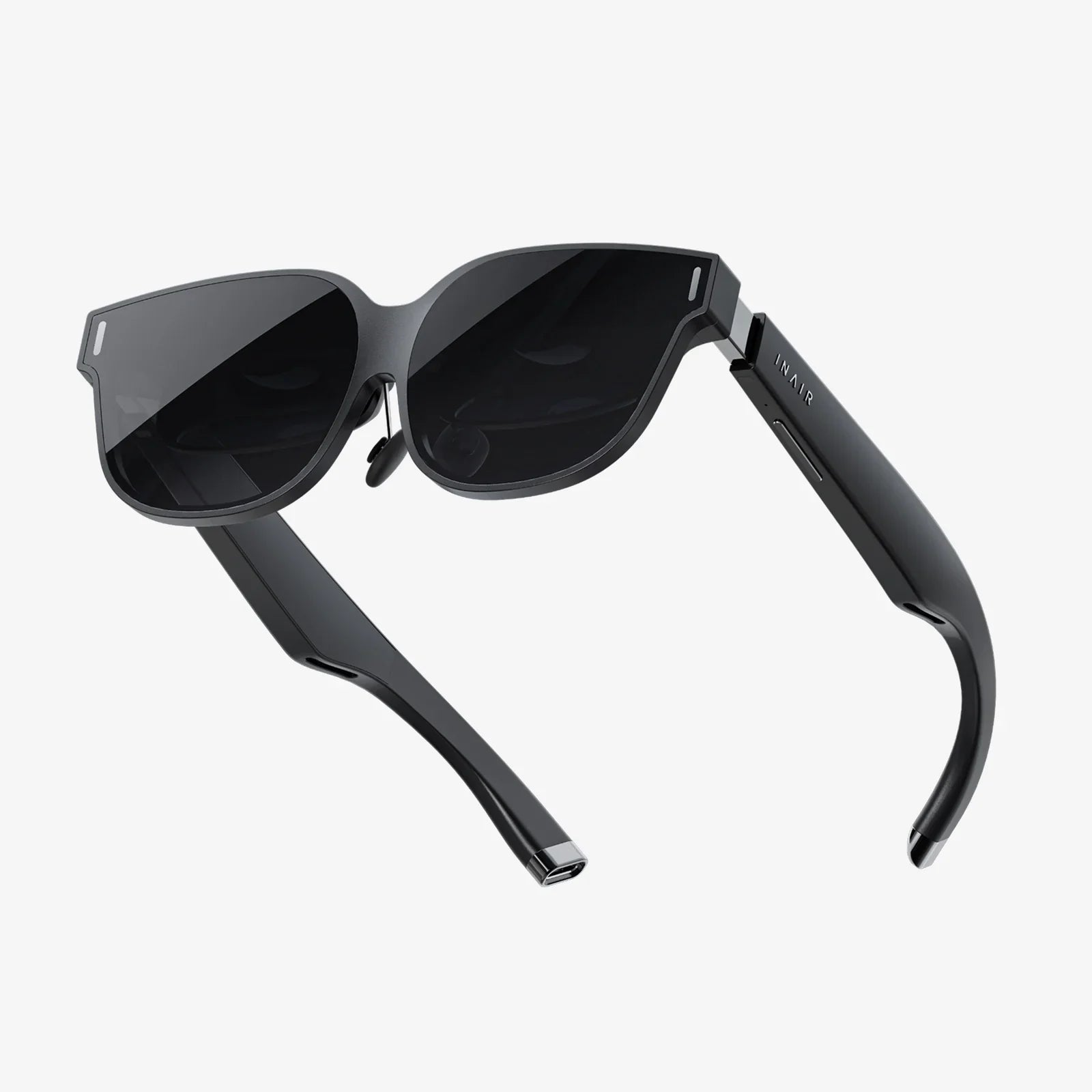
Imagine slipping on a pair of sleek, unassuming glasses and instantly being transported from your mundane desk into a boundless digital universe. Your multi-monitor workstation materializes around you, a sprawling city of information. A blockbuster film doesn't just play on a screen; it unfolds on the moon's surface, with you in the front row. This is no longer the stuff of science fiction. This is the tangible, awe-inspiring reality offered by virtual glasses for PC, a technology poised to revolutionize how we interact with the digital world.
Beyond the Screen: Defining the Virtual Glasses Ecosystem
The term "virtual glasses" is a broad church, encompassing several distinct but related technologies. Understanding these categories is the first step to appreciating their potential.
Virtual Reality (VR) Headsets: Total Digital Immersion
VR headsets are the most immersive option. They completely occlude your view of the physical world, replacing it with a computer-generated environment. When connected to a powerful personal computer, these devices become portals to incredibly detailed and complex worlds. They track your head movements with extreme precision, and often your hand controllers as well, allowing you to look, move, and interact within the virtual space as if you were truly there. The primary application for PC-tethered VR has been gaming, offering unparalleled levels of immersion in virtual adventures, flight simulators, and racing games. However, their use has expanded dramatically into professional sectors like architecture, medicine, and design, where visualizing 3D models at scale is invaluable.
Augmented Reality (AR) Glasses: Blending Realities
Augmented Reality glasses take a different approach. Instead of replacing your reality, they enhance it. Using transparent lenses or clever waveguides, they overlay digital information—windows, holograms, data streams—onto your view of the real world. You can see your physical desk, your keyboard, and your coffee mug, but floating beside them might be a web browser, a messaging app, or a schematic for a project you're working on. This makes them exceptionally well-suited for productivity. The goal is to provide contextual computing, where digital tools are integrated seamlessly into your physical workflow, rather than being confined to a separate rectangular screen.
Mixed Reality (MR): The Best of Both Worlds
Mixed Reality is often seen as the pinnacle of this spectrum. MR headsets, typically powered by a PC, combine high-fidelity VR immersion with advanced AR capabilities. They use outward-facing cameras to digitally reconstruct your physical environment and then anchor virtual objects within it. This allows for truly magical interactions: you could have a virtual television mounted on your real wall, or examine a photorealistic 3D model of an engine block sitting on your actual desk, able to walk around it and peer inside. The virtual objects understand and interact with the physical space, enabling a cohesive blend of both worlds.
The Engine Room: Why a Powerful PC is Non-Negotiable
While standalone headsets exist, the most compelling and high-fidelity experiences are unlocked by tethering to a personal computer. The PC acts as the engine room, performing the immense computational heavy lifting required for immersive computing.
- Graphics Processing Power (GPU): Rendering high-resolution stereoscopic visuals at a buttery-smooth 90 frames per second or higher is an extraordinarily demanding task. It requires a potent graphics card to avoid latency and the dreaded "judder" that can break immersion and cause discomfort. The GPU is responsible for painting two distinct images (one for each eye), applying complex lighting and shading effects, and maintaining a consistent frame rate.
- Central Processing Unit (CPU): The CPU is the conductor of the orchestra. It manages the core application logic, physics simulations, audio processing, and the constant stream of data from the headset's sensors—tracking position, rotation, and controller movements thousands of times a second. A powerful CPU ensures everything runs in harmony without bottlenecks.
- Memory and Storage (RAM & SSD): Vast amounts of high-speed RAM are essential for loading the complex textures and assets of virtual environments. Similarly, a fast solid-state drive drastically reduces loading times, allowing for seamless transitions between worlds and preventing immersion-breaking pauses.
This symbiotic relationship between headset and PC is what enables the breathtaking realism and complexity that defines high-end virtual experiences.
A Universe of Applications: More Than Just Games
While gaming is the most famous use case, the potential applications for PC-connected virtual glasses stretch far beyond entertainment, infiltrating and enhancing numerous aspects of professional and personal life.
Revolutionizing Productivity and Remote Work
The concept of the office is being fundamentally reshaped. Virtual glasses allow for the creation of the ultimate virtual workspace. Instead of being limited by physical monitor size and quantity, users can spawn infinite, customizable screens in a virtual environment. A financial analyst could have live data feeds, charts, and news tickers arrayed around them. A software developer could have multiple code editors, documentation, and a testing terminal all visible at once. This is a paradigm shift from window management to space management.
Furthermore, remote collaboration is transformed. Teams scattered across the globe can meet in a shared virtual boardroom, interacting with 3D models, brainstorming on virtual whiteboards, and feeling a sense of co-presence that flat video calls simply cannot provide. An architect in London can walk a client in Tokyo through a building design at 1:1 scale before a single brick is laid.
The Future of Entertainment and Social Connection
Entertainment becomes an active experience rather than a passive one. Imagine watching a film in a virtual cinema with friends who live in different countries, feeling like you're all sitting together. Or attending a live concert from the best seat in the house, right from your living room. Narrative experiences can become interactive, where you are no longer a viewer but a participant within the story.
Social platforms within virtual spaces are burgeoning. They allow people to interact using personalized avatars, playing games, attending virtual events, or simply hanging out in stunning digital environments. This fosters a powerful sense of connection and shared experience that transcends geographical limitations.
Professional Training and Simulation
Industries are leveraging this technology for high-stakes training without high-stakes risks. Surgeons can practice complex procedures on virtual patients. Aircraft mechanics can learn to repair engines using interactive holographic guides overlaid on real machinery. Emergency responders can simulate disaster scenarios to hone their skills. The ability to train in a safe, repeatable, and cost-effective virtual environment is a game-changer for many fields.
Navigating the Current Landscape: Considerations and Challenges
As with any transformative technology, there are hurdles to overcome and factors to consider before diving in.
- Comfort and Form Factor: Early headsets were often bulky and cumbersome. The industry is making rapid strides toward lighter, more comfortable, and more aesthetically pleasing designs that can be worn for extended periods without fatigue.
- Visual Fidelity and the "Screen Door Effect": While resolution has improved dramatically, some users may still perceive a faint grid-like pattern (the screen door effect) or limitations in the field of view. These issues continue to be the focus of intense research and development.
- Accessibility and Cost: The barrier to entry can be high. It requires a significant investment not only in the glasses themselves but also in a high-end PC capable of running them. This currently places the technology out of reach for some consumers.
- Bodily Awareness and Motion Sickness: A disconnect between what your eyes see and what your body feels can induce motion sickness in some individuals. Developers are employing clever software techniques to mitigate this, and user acclimatization is also a key factor.
Gazing into the Future: What Comes Next?
The trajectory of virtual glasses technology is incredibly exciting. We are moving toward devices that are indistinguishable from regular eyeglasses, with photorealistic visuals, perfect eye-tracking, and intuitive neural interfaces. The line between the digital and the physical will continue to blur until it disappears entirely.
We can anticipate a future where context-aware computing is the norm. Your glasses will recognize people you meet and discreetly display their name and last conversation topic. They will translate foreign street signs in real time. They will offer step-by-step instructions for assembling furniture, projected directly onto the pieces in front of you. The PC will remain the silent powerhouse behind it all, but the interface will be natural, seamless, and woven into the fabric of our daily perception.
The door to your personal holodeck is already open. Virtual glasses for PC are not just a new peripheral; they are the beginning of a fundamental shift in human-computer interaction. They promise a future where our digital potential is limited only by our imagination, offering a glimpse into a world where anything we can conceive, we can experience firsthand. The question is no longer if you will use this technology, but how soon you will step through and see what's on the other side.
Share:
When Was Augmented Reality Invented? The Surprising History of Digital Overlays
When Was Augmented Reality Invented? The Surprising History of Digital Overlays