


- by wangfred
VR Glasses Lenses: The Optical Heart of Virtual Reality
- by wangfred
You slip on the headset, and suddenly, you're there. The real world melts away, replaced by a breathtaking digital landscape that feels tangibly real. But have you ever stopped to wonder what makes this magical transportation possible? While processors and screens get most of the glory, the true unsung heroes, the very gateway to these virtual worlds, are the meticulously crafted pieces of glass or plastic mere centimeters from your eyes. The quality of your entire experience hinges on this critical component. This is the story of VR glasses lenses, the optical heart of virtual reality.
To the uninitiated, the lenses in a head-mounted display might seem like a simple, almost trivial part of the assembly. This couldn't be further from the truth. Their primary job is deceptively complex: to take the focused image from the small screens housed inside the headset and transform it into a wide, immersive field of view that your eyes can comfortably perceive.
Without these specialized optics, you would simply be holding a smartphone screen uncomfortably close to your face, seeing a blurry, pixelated mess. The lenses act as an interpreter between the digital display and the human visual system. They perform several vital functions simultaneously:
In essence, the lenses are the final, and most important, link in the visual chain. A state-of-the-art display paired with a mediocre lens will always result in a mediocre experience. The lens defines the clarity, comfort, and overall visual fidelity of the virtual world.
Not all VR lenses are created equal. Over the years, several different optical designs have emerged, each with its own set of advantages, trade-offs, and engineering challenges. The choice of lens technology is a fundamental decision that shapes the entire design of a headset.
These are a common starting point in optical design. Unlike simple spherical lenses, which have a constant curvature that can introduce distortions like spherical aberration, aspheric lenses feature a more complex, gradually changing curvature. This design allows engineers to better correct for optical errors, potentially creating a clearer image with fewer distortions, especially towards the edges of the lens. They can often be made flatter and lighter than their Fresnel counterparts, which can contribute to a more compact headset design. However, perfecting them for a wide field of view remains a significant challenge, often requiring sophisticated and expensive manufacturing processes.
If you've used a modern headset, you've almost certainly looked through a Fresnel lens. This design, pioneered for lighthouses, is a masterpiece of optical efficiency. A standard lens is thick and heavy because the glass must be curved to refract light. A Fresnel lens achieves the same refraction but by using a series of concentric ridges or grooves etched into a much thinner, lighter substrate.
The advantage is immense: a drastic reduction in weight and thickness, which is absolutely critical for a device meant to be worn on your head. However, this clever design comes with notable compromises. The concentric grooves can create a phenomenon known as god rays or glare—unwanted scattering of light that appears as faint streaks or circles, especially in high-contrast scenes. Additionally, the image quality can sometimes be softer away from the very center of the lens, a challenge known as maintaining edge-to-edge clarity.
This is the new frontier in VR/AR optics, representing a significant leap forward. Pancake lenses operate on a completely different principle called folded optics. Instead of a single refraction path, light from the display passes through a polarizing filter, reflects off a curved semi-reflective surface, passes through another polarizer, and finally reaches your eye. This "folding" of the light path allows the lenses to be incredibly thin—hence the name "pancake."
The benefits are transformative. Headsets utilizing this technology can be dramatically slimmer and lighter, moving away from the front-heavy design of the past. They also often provide superior edge-to-edge clarity and significantly reduce the god rays associated with Fresnel lenses. The trade-off? Light loss. Each time the light is reflected or polarized, some intensity is sacrificed. This means displays must be significantly brighter to compensate, which can impact power consumption and thermal design.
The quest for the perfect lens continues, driving research into even more advanced technologies. Liquid Crystal Lenses are a form of adaptive optics where an electric field can change the orientation of liquid crystals, effectively altering the lens's focal power dynamically. This could one day eliminate the need for mechanical IPD adjustment and even correct for a user's personal prescription.
Furthermore, companies and researchers are exploring metalenses—ultra-thin surfaces covered with microscopic nanostructures that can manipulate light in precise ways. While still largely in the lab, this technology promises completely flat, lightweight lenses that could control chromatic and spherical aberration with unprecedented precision, potentially rendering all current bulky designs obsolete.
Evaluating a VR lens goes beyond simply naming its type. Engineers and enthusiasts alike focus on several key metrics that directly impact user experience.
These challenges are interconnected. Widening the FOV can exacerbate distortion and reduce edge clarity. Making lenses lighter can introduce visual artifacts. The entire field of VR optics is a constant exercise in managing these trade-offs to find the optimal balance for human visual perception.
The best lens in the world is useless if it's uncomfortable to use or doesn't align with the user's physiology. This brings the discussion to the practicalities of wearables.
Proper fit is paramount. The lenses must be positioned at the correct distance from the eyes (the eye relief) and must align perfectly with the user's IPD. Modern headsets increasingly feature mechanical IPD sliders, which are a critical feature for achieving a clear and comfortable image and preventing headaches or nausea.
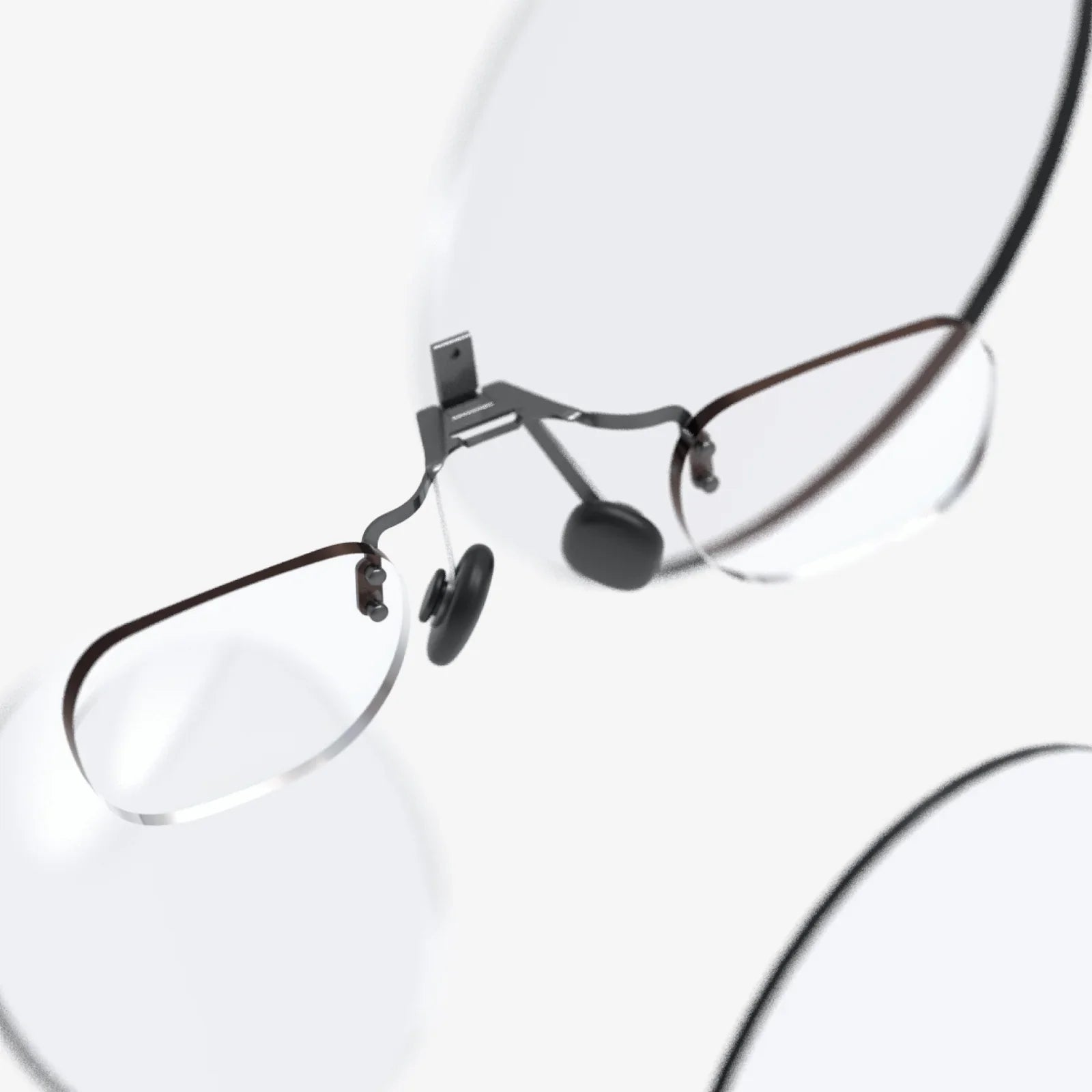
For the millions of users who wear corrective eyewear, the experience can be fraught. Trying to squeeze glasses inside a headset is often uncomfortable, can scratch both the prescription lenses and the VR lenses, and pushes the eyes further from the optical sweet spot, degrading the experience. The solutions are prescription lens inserts—custom magnetic adapters that slot inside the headset, providing a tailored correction that sits perfectly in the optical path. For those without severe prescriptions, some headsets offer built-in diopter adjustment wheels, allowing users to dial in minor focus corrections without needing inserts or glasses.
Finally, maintenance is simple but crucial. The lenses are delicate and prone to scratching. They should only be cleaned with a soft, dry microfiber cloth. Using harsh chemicals, rough paper towels, or excessive pressure can permanently damage their carefully calibrated surfaces.
The evolution of VR glasses lenses is accelerating, moving beyond mere correction towards enhancement and innovation. We are on the cusp of a new era where the optics will enable experiences that are currently unimaginable.
The holy grail for many is varifocal technology. Current headsets have a fixed focal plane, meaning your eyes converge (angle inward) to perceive depth, but their focus (accommodation) remains fixed at a specific distance, often around 2 meters. This conflict between vergence and accommodation is a major source of visual fatigue. Varifocal systems dynamically adjust the focal distance of the lenses in real-time based on where you are looking, matching the virtual distance of the object. This will finally resolve this conflict, unlocking unprecedented levels of visual comfort and realism, especially for close-up objects.
Furthermore, the line between VR and AR is blurring, and lenses are at the forefront. Advanced waveguide combiners and other optical systems are being developed to seamlessly blend digital content with the real world. These technologies will require lenses that are not just viewports into a virtual world, but intelligent windows that can selectively block, add, or manipulate light from our environment.
Finally, the drive for miniaturization will continue. Pancake lenses are just the beginning. Technologies like metalenses and holographic optics point to a future where high-performance, high-field-of-view optics are as thin as a piece of paper, paving the way for headsets that resemble everyday eyeglasses rather than bulky helmets.
Imagine a world where your portal to digital realms is no heavier than a pair of sunglasses, where the text is pin-sharp from edge to edge, where your eyes feel as relaxed as they do looking at a distant horizon, and where virtual objects blend with your physical space with perfect optical fidelity. This is the future being built today, not in the processors, but in the intricate, beautiful, and brilliantly complex world of VR glasses lenses. The next time you step into another reality, take a moment to appreciate the marvel of engineering right before your eyes.