


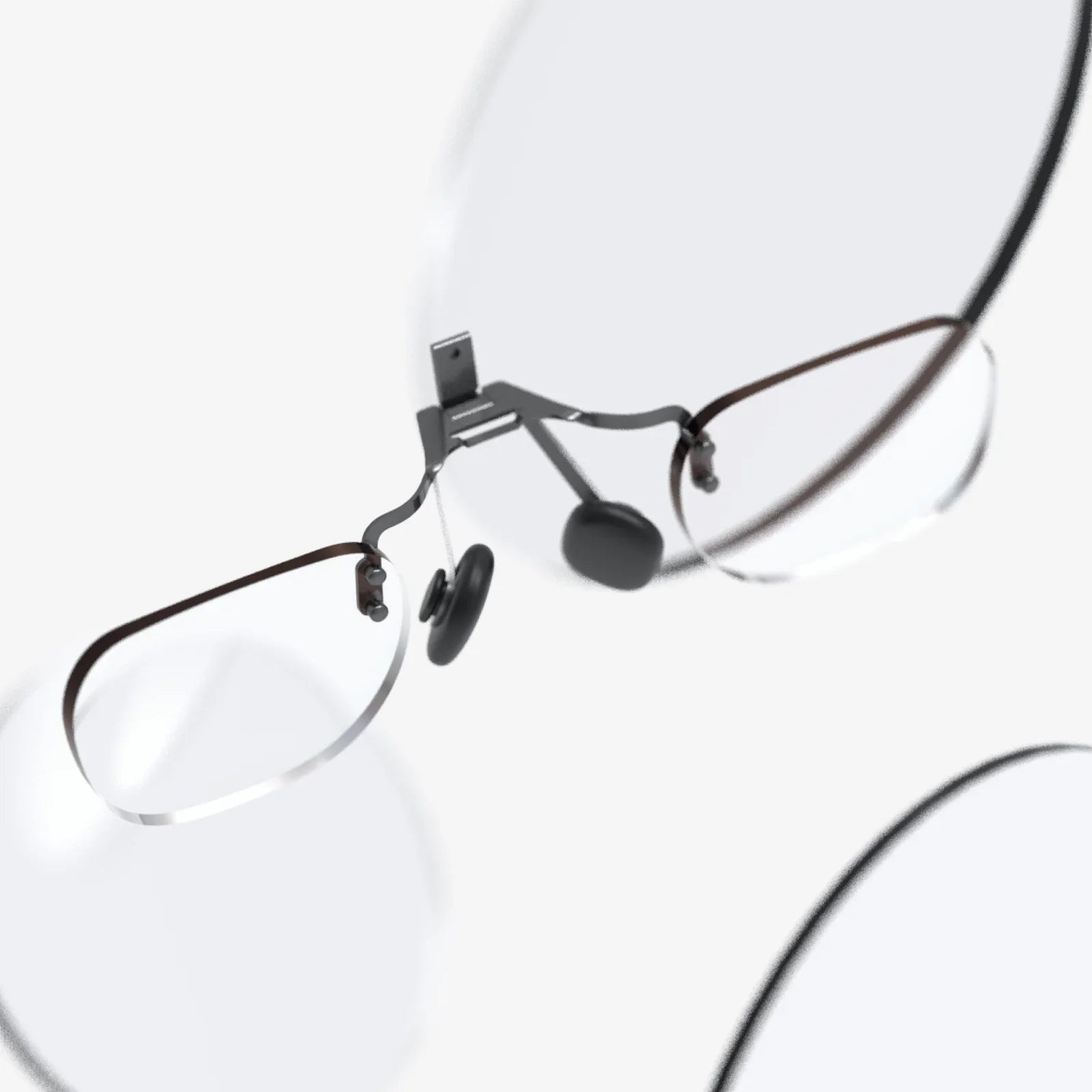
Imagine slipping on a pair of sleek, futuristic glasses and suddenly finding yourself standing on the surface of Mars, conducting a complex surgical procedure from your living room, or facing down a dragon in a mythical castle. This is no longer the stuff of science fiction; it is the tangible, breathtaking reality made possible by the sophisticated synergy of VR goggles and controllers. These two components form the fundamental gateway, the essential hardware duo that has unlocked entirely new dimensions of human experience, creativity, and connection. The journey from clunky prototypes to today's immersive systems is a story of relentless innovation, and it’s a story that is still being written, with each iteration bringing us closer to seamless digital immersion.
The Evolution of the Digital Window: From Prototype to Portal
The concept of virtual reality is decades old, but its practical application was long hindered by technological limitations. Early VR goggles were monstrously heavy, offered painfully low-resolution displays that induced nausea, and were tethered to computing power that filled entire rooms. They were tools for multi-million-dollar laboratories and military simulations, far removed from the consumer market. The controllers, if they existed at all, were often simple joysticks or data gloves that provided little tactile feedback or intuitive connection to the virtual world.
The turning point came with a convergence of advancements: the miniaturization of high-density displays, the development of precise internal and external tracking systems, and the exponential growth in mobile processing power. Modern VR goggles are marvels of engineering. They are equipped with high-resolution OLED or LCD screens, often with refresh rates exceeding 90Hz to ensure smooth motion and minimize the disorientation of latency. Sophisticated sensor arrays—including gyroscopes, accelerometers, and magnetometers—work in concert with external base stations or inward-facing cameras to perform inside-out or outside-in tracking. This complex dance of technology allows the system to map the physical space around you and track the precise orientation and position of your head with astonishing accuracy, making the virtual world stable and responsive.
More Than a Screen: The Technology Inside Modern VR Goggles
To understand the magic, one must look inside the headset. The core components work in a seamless feedback loop to create the illusion of presence.
- Lenses and Displays: The screens are positioned very close to the eyes, and specialized lenses focus and reshape the picture for each eye, creating a stereoscopic 3D effect with a wide field of view. This binocular vision is crucial for depth perception within the virtual environment.
- Positional Tracking: This is the heart of immersion. Systems using external sensors (like Lighthouse base stations) place infrared dots around a room, which are read by sensors on the headset. Inside-out tracking, now more common, uses cameras on the headset itself to observe the real world, identifying unique features to triangulate its position without external hardware.
- Audio: Spatial audio is a critical, often overlooked, component. Built-in or attached headphones deliver 3D sound that changes dynamically as you turn your head, making a noise behind you in the virtual world sound like it is actually behind you. This auditory cue is incredibly powerful for selling the illusion of being somewhere else.
- Haptics: Some advanced headsets are beginning to incorporate haptic feedback systems directly into the headstrap, providing subtle vibrations that can simulate everything from a gust of wind to the impact of a virtual punch.
The Extension of Self: The Revolution of VR Controllers
If VR goggles are your eyes and ears in the digital realm, then controllers are your hands. Their evolution has been just as dramatic and arguably more important for interaction. The shift from traditional gamepads to motion-tracked controllers with haptic feedback was a quantum leap. These devices are no longer simple input tools; they are virtual appendages.
Modern VR controllers are packed with their own sophisticated technology. They feature the same constellation of sensors as the headset for precise positional and rotational tracking. They are covered in capacitive touch sensors that can detect the presence and approximate position of your individual fingers, allowing for nuanced gestures like pointing, waving, or making a fist. But the true magic lies in their haptic feedback systems. Using precise linear resonant actuators (LRAs), these controllers can generate a vast range of tactile sensations—from the sharp buzz of a virtual object collision to the gentle, rhythmic pulse of a heartbeat or the rough texture of dragging a sword along a stone wall.
This combination of precise tracking and nuanced haptics enables a phenomenon known as embodiment. When you look down in VR and see two virtual hands that mirror your every movement with perfect fidelity, and you feel a convincing *thump* in your palm when you touch a virtual table, your brain begins to accept those digital hands as your own. This psychological leap is the foundation for true presence and is what separates VR from any other form of media.
A Universe of Applications: Beyond Gaming
While gaming remains the most visible and popular application for VR goggles and controllers, their potential stretches far beyond entertainment. They are becoming indispensable tools across numerous professional fields.
- Education and Training: Medical students can practice complex surgical procedures on virtual patients without risk. Mechanics can train on the intricate systems of a jet engine before ever touching a real one. History students can take a walking tour of ancient Rome. VR provides a safe, scalable, and deeply engaging platform for experiential learning.
- Healthcare and Therapy: Therapists are using VR to treat PTSD by carefully and controllably exposing patients to triggering scenarios. It's used for physical rehabilitation, turning painful exercises into engaging games. VR is also a powerful tool for managing pain and anxiety, transporting patients undergoing difficult procedures to calming, peaceful environments.
- Design and Architecture: Architects and interior designers can walk clients through unbuilt structures at a 1:1 scale. Car designers can sit inside a virtual model of a new vehicle long before a physical prototype is made. This allows for iterative design and stakeholder buy-in in a way blueprints and renders never could.
- Remote Collaboration: VR offers the promise of the ultimate "work from anywhere" meeting. Teams distributed across the globe can meet in a shared virtual space, interacting with 3D models, whiteboards, and each other's avatars as if they were in the same room, a significant step up from flat video calls.
Challenges and Considerations on the Road to Ubiquity
Despite the incredible progress, the path to mainstream adoption for VR is not without its obstacles. A primary concern is accessibility, with cost still being a significant barrier for high-end systems that require a powerful computer. There is also the issue of user comfort; VR-induced motion sickness, or cybersickness, still affects a portion of the population, though advancements in higher refresh rates and better tracking continue to mitigate this. The form factor of the goggles, while shrinking, still needs to become as lightweight and socially acceptable as a pair of sunglasses to achieve true all-day usability.
Furthermore, the industry faces important questions around data privacy, social interaction norms in virtual spaces, and the potential for addiction. As the technology becomes more immersive and realistic, establishing ethical guidelines and safeguards becomes paramount.
The Next Frontier: Glimpsing the Future of Immersion
The trajectory of VR hardware points toward a future of even deeper and more seamless immersion. Several key technologies are poised to redefine the experience. Eye-tracking, already appearing in some headsets, will allow for foveated rendering—where the system focuses processing power only on where the user is directly looking, drastically improving performance and visual fidelity. It will also enable more natural social interactions, as avatars' eyes can move and focus realistically.
Varifocal displays, which can dynamically adjust their focus based on the depth of the virtual object you're looking at, promise to solve the vergence-accommodation conflict, a major source of eye strain and a break in immersion. The ultimate goal is a shift from handheld controllers to full hand-tracking, allowing users to manipulate the virtual world with their bare hands, and eventually to brain-computer interfaces (BCIs) that could translate neural signals directly into digital actions.
We are rapidly moving towards a future where the line between the physical and the digital will become increasingly blurred. The humble beginnings of VR goggles and controllers have ignited a revolution in human-computer interaction, one that is reshaping how we work, learn, heal, and play. They are not just peripherals; they are the first true prototypes of a new sense, a new way of being. The portal is open, and its potential is limited only by our imagination.
Stepping through the portal defined by VR goggles and controllers is to willingly suspend disbelief and embrace a new layer of reality. It’s an invitation to sculpt with digital clay, to walk on distant planets, to master skills in hyper-realistic simulations, and to connect with others in shared spaces that defy geography. This isn't just about better graphics or new ways to play; it's about fundamentally expanding the canvas of human experience. The hardware is the key, and as it continues to evolve toward invisibility, the focus will shift entirely to the experiences themselves—to the worlds we will build and the stories we will live, all at the tips of our fingers and the turn of our heads. The next great adventure isn't on a map; it's waiting just behind the lenses of a headset.
Share:
Personal Safety Wearable News: The Revolution in Proactive Protection
Best Smart Glasses for Work 2025: The Ultimate Guide to Augmented Productivity