


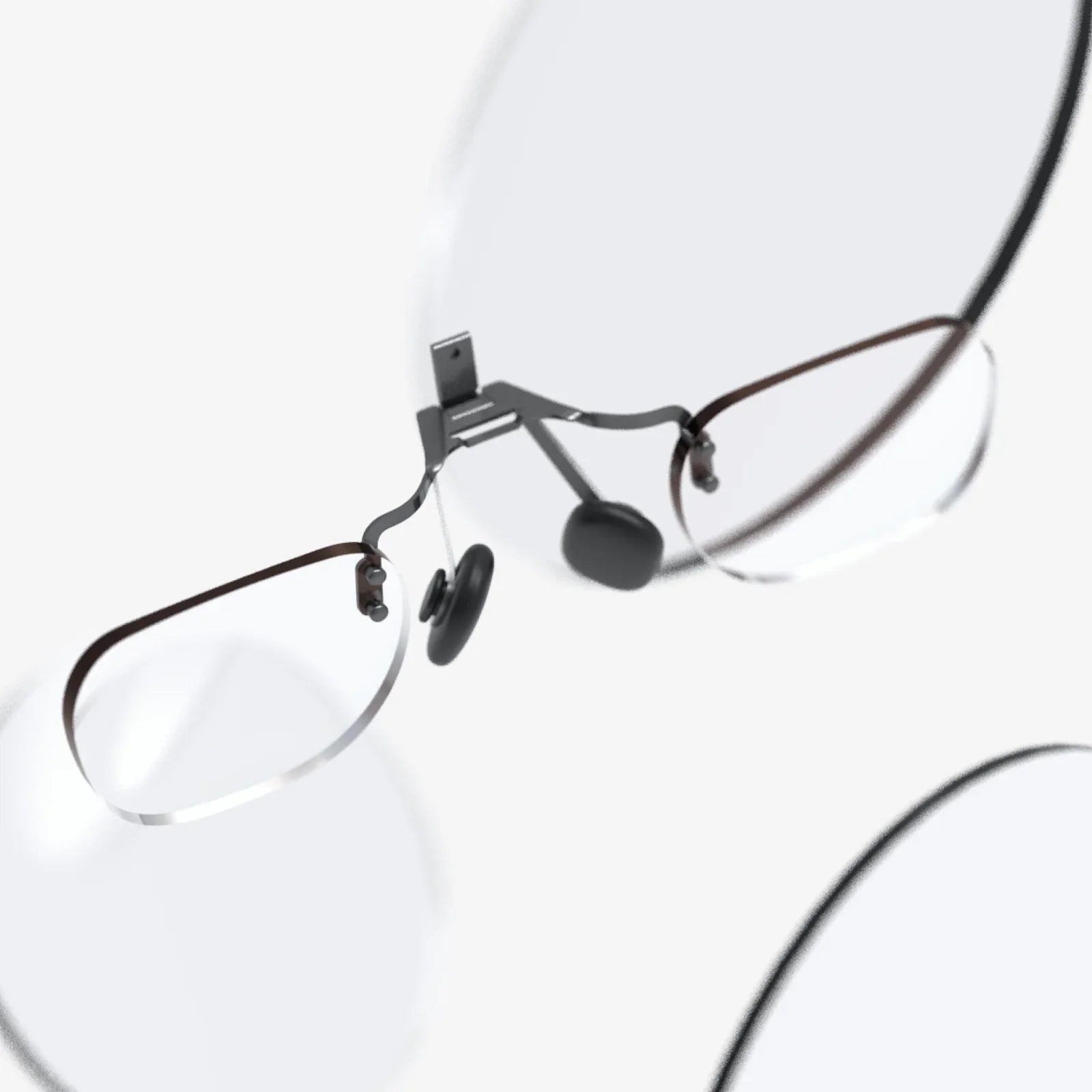
Imagine a world where digital information doesn't live trapped behind a screen but flows seamlessly into your field of vision, enhancing your reality, empowering your actions, and unlocking possibilities you've only seen in science fiction. This is the promise of Augmented Reality (AR) glasses, a technology poised to revolutionize our lives as profoundly as the smartphone. But what do AR glasses actually do? The answer is far more complex and exciting than simply projecting images in front of your eyes. They are a gateway to a new layer of existence, a symbiotic blend of the physical and the digital.
The Core Function: A Digital Layer on the Physical World
At their most fundamental level, AR glasses perform a single, powerful task: they overlay computer-generated information—known as digital content—onto your view of the real world. Unlike Virtual Reality (VR), which completely replaces your surroundings with a simulated environment, AR enhances and augments the reality you are already in. This is achieved through a sophisticated combination of hardware and software working in perfect harmony.
The magic begins with a series of tiny cameras and sensors embedded in the frames. These act as the glasses' "eyes," continuously scanning your environment. They map the geometry of the room, understand the surfaces of your desk or walls, track the position of your hands, and identify objects you are looking at. This real-time environmental understanding is the bedrock of all AR functionality.
Once the environment is mapped, the processing unit—often a small onboard computer or a connected device—determines what digital content to display and where to place it. This content is then projected towards your eyes via a complex system of waveguides, holographic optical elements, or miniature projectors. The result is that you see a holographic image, a piece of text, or a 3D model that appears to be anchored to a specific point in your physical space, whether it's a virtual pet sitting on your real couch or a step-by-step recipe floating next to your kitchen stove.
Deconstructing the Magic: The Technology Inside the Frames
To fully grasp what AR glasses do, it's essential to understand the key technological pillars that enable their capabilities.
Spatial Mapping and Computer Vision
This is the brains of the operation. Using technologies like Simultaneous Localization and Mapping (SLAM), the glasses create a 3D digital twin of your surroundings. Computer vision algorithms then parse this data to recognize objects: Is that a television? Is this a flat wall suitable for a virtual screen? This allows digital content to interact with the real world in a believable way, respecting physics and space.
Display and Optics
This is the heart of the visual experience. The challenge is to project bright, high-resolution images that can be seen clearly in various lighting conditions, all while keeping the hardware small and lightweight. Different approaches exist, from projecting light onto transparent lenses (optical see-through) to using cameras to capture the real world and blend it with digital elements on a screen (video see-through). The goal is always to make the digital elements feel solid and present.
Interaction Paradigms
How do you interact with a world that is half-real? AR glasses have moved beyond the need for a traditional mouse and keyboard. They enable intuitive, natural interaction through:
- Hand Tracking: Cameras track the precise movement of your fingers, allowing you to reach out and "touch," grab, resize, and manipulate virtual objects with gestures.
- Voice Commands: Speaking to your digital assistant becomes the primary way to search for information or launch applications, making the experience hands-free.
- Gaze and Dwell Control: Simply looking at a virtual button for a moment can act as a click, enabling subtle selection without moving a muscle.
- Spatial Anchors: Digital content can be pinned to a specific GPS location or a physical object, meaning it will be waiting for you or others exactly where you left it.
Beyond Novelty: Practical Applications Reshaping Industries
The true power of AR glasses is revealed not in tech demos, but in their practical, problem-solving applications across countless fields.
Revolutionizing the Workplace
In industrial and field service settings, AR glasses are a game-changer. A technician repairing a complex machine can see a schematic diagram overlaid directly onto the equipment, with animated arrows pointing to the exact bolt that needs tightening. A remote expert can see what the on-site worker sees and draw virtual annotations directly into their field of view to guide them, eliminating travel time and errors. For logistics and warehousing, workers can see optimal picking routes and item information displayed on the shelves, dramatically speeding up fulfillment and reducing training time.
Transforming Healthcare and Medicine
Surgeons can have vital signs, ultrasound data, or 3D anatomical models of a patient's organs projected into their view during an operation, keeping their focus on the patient instead of glancing at distant monitors. Medical students can practice procedures on hyper-realistic virtual patients, and nurses can use AR to instantly locate veins for injections, improving patient comfort and care.
Redefining Social Connection and Communication
AR glasses promise to evolve video calls into spatial, shared experiences. Instead of talking to a grid of faces on a screen, you could have life-sized, volumetric holograms of your colleagues or family members sitting in your living room, making conversations feel natural and present. This technology, often referred to as "telepresence," has the potential to make physical distance feel insignificant, fostering a deeper sense of connection.
Unleashing Creativity and Design
Architects and interior designers can walk clients through a full-scale, photorealistic holographic model of a building before a single brick is laid. Artists can sculpt virtual clay in 3D space with their hands, and automotive designers can examine a full-scale virtual prototype of a car, walking around it and making changes in real-time. This merges the digital freedom of creation with the intuitive understanding of the physical world.
Enhancing Everyday Life and Navigation
For the consumer, the applications are vast. Walking through a foreign city, directions can be painted onto the streets in front of you. Glancing at a restaurant could reveal its reviews and menu. A recipe can appear floating next to your frying pan, automatically progressing to the next step as you complete each one. You could identify constellations in the night sky or see a virtual dinosaur roaring in your local park, turning the entire world into an interactive learning and entertainment platform.
The Road Ahead: Challenges and the Future Vision
Despite the incredible potential, the path to ubiquitous AR glasses is not without its hurdles. The technology faces significant challenges in achieving a perfect form factor—glasses that are as stylish, lightweight, and comfortable as regular eyewear while packing immense computing power. Battery life remains a constraint for all-day use, and generating photorealistic graphics that blend perfectly with reality requires immense processing power, often necessitating a tether to a more powerful device.
Furthermore, societal and ethical questions loom large. How do we manage the constant collection of visual and spatial data? What are the etiquette rules for wearing AR glasses in social situations? How do we prevent digital spam or visual pollution from cluttering our reality? These are complex issues that developers, policymakers, and society as a whole must address.
Yet, the trajectory is clear. The ultimate goal is a contextually aware, always-available assistant that provides information exactly when and where you need it, without you ever having to ask. It’s a future where the boundary between our digital and physical lives dissolves, not to distract us, but to make us more capable, connected, and creative within our own world.
The journey into this augmented future is already underway, and it promises to redefine not just what we see, but how we see, learn, work, and connect with everything around us. The next time you put on a pair of glasses, they might just show you a whole new world layered on top of your own.
Share:
Virtual Office Description: The Definitive Guide to the Future of Work
Best VR Goggles for PC: Your Ultimate Guide to High-Fidelity Immersion